
HR’s Guide to Unlimited PTO: Pros, Cons and Best Practices
By

In the past, it was commonplace for employers to give workers a set amount of vacation days that typically increased with tenure. However, the past few years have seen a lot of changes in the workplace, from remote work to flexible scheduling, and paid time off (PTO) is not exempt from the changes.
Now, some employers are offering unlimited PTO, which gives employees an unlimited amount of PTO throughout the year rather than a set number, giving employees the freedom to take time off when they need it.
Here’s everything you need to know about unlimited time off to determine whether it’s right for your company.
How unlimited PTO works
Unlimited PTO doesn’t mean that employees can take off work with no notice. The process works largely like any other PTO policy, and employees must still submit a PTO request ahead of time to ensure it doesn’t interfere with important duties.
The main difference with unlimited time off is that there is no cap on the number of PTO days an employee can take. There are, however, some unspoken guidelines, such as the amount of time taken off is reasonable and does not affect their work. Many companies also require the leave to be signed off by a manager or for leave to be staggered between colleagues.
Companies may implement an unlimited PTO policy for a variety of reasons. Still, most reasons have to do with improving employee wellness or attracting and retaining top talent. Many companies have already implemented unlimited PTO:
- Zoom offers unlimited vacation days with a “My Time Off” policy
- Netflix has offered unlimited PTO since 2003, and
- Evernote gives employees an annual vacation stipend in addition to unlimited PTO.
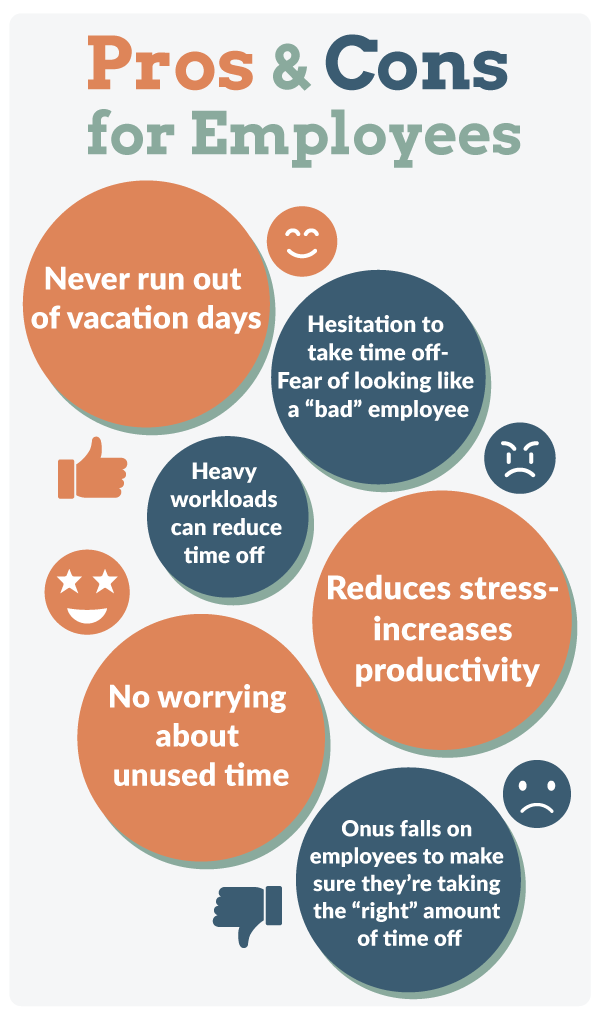
Pros and cons for employees
Although unlimited time off sounds like a dream, it doesn’t come without pitfalls. There are some pros and cons for employees.
Pros and cons for employers
Unlimited PTO can have serious benefits for employers, as well as risks.
Pro: Attracts and retains talent. Unlimited PTO is a sought-after benefit, and amid a tight labor market and economic uncertainty, top-notch benefits can attract talent and boost retention.
Con: Risk of policy abuse. “Employees may take off more time and, in some cases, may take off excessive time. Also in this vein, it [can] be hard to discipline employees for taking off too much time if their time off is ‘unlimited,’” says John Viola, employment law attorney at Thompson Coburn.
Pro: Boosts employee morale. “Unlimited PTO may help boost morale and promote a trusting workplace environment,” says Viola. Employees who have the freedom to take time off when they need it to reset and recharge often come back ready to hit the ground running, do better work and have increased productivity.
Advertisement
Con: Causes conflict among employees. Unlimited time off can cause tension between colleagues if one employee is taking a much larger amount of leave than colleagues, and lead to resentment and conflict.
Pro: Saves HR time and effort. Getting rid of a limited PTO policy can help to eliminate administrative tasks for the HR department such as tracking PTO days and accruals.
Con: Potential for legal concerns. Unlimited PTO can clash with other types of leave, according to Viola. “If an employee takes a six-month military leave of absence, [they] may claim [they are] entitled to receive pay during that entire period. Employers must handle such absences consistently and in a nondiscriminatory way,” advises Viola.
How to tell if unlimited PTO will work for your business
Unlimited PTO isn’t one-size-fits-all, and there’s a chance it may not work at all for your business. Before deciding if an unlimited time off policy is a feasible benefit for your company, consider:
- Business type: It’s important to take the type of business you’re in into consideration. Can it sustain an unlimited PTO policy without sacrificing business needs? What guidelines would you need to set in place to maximize efficiency?
- Employee needs: Even though it sounds good on paper, unlimited PTO isn’t always the best option for your employees. It’s important to consider the demographics and needs of your workers to see if they’d benefit from unlimited time off or some other PTO policy.
- Company culture: Unlimited PTO relies on trust between employees and employers. A culture of employees not trusting their managers, or vice versa, can mean that unlimited PTO can be misused, abused or not used at all. Before you implement a new policy, assess your current company culture to make sure it’s a suitable fit.
Transitioning to an unlimited PTO policy: 3 best practices
If you think your company could benefit from an unlimited PTO policy, you may be ready to start implementing a trial run to see how it works. Here are a few best practices to create a smooth transition to a new PTO policy:
- Specify what is and isn’t allowed within the policy and update the handbook with clear guidelines
- Provide education to employees that answers frequently asked questions and guides employees through the new policy, and
- Use a master calendar to help teams stay on track and coordinate leave to ensure work needs are fulfilled.
Further Reading
Connecticut Paid Sick Leave Expands to Nearly All Employers Jan. 1
Starting Jan. 1, 2027, employers with one or more employees in Connecticut must provide paid sick leave under Public Act 24-8. The current threshold for covered employers is 11 or more employees. Covered employers must allow covered employees to accrue one hour of paid leave for every 30 hours worked, up to 40 hours a […]
Paid Sick Leave Notice Failures: Seattle Hotel, Staffing Agencies Pay $133K
A Seattle hotel operator and two staffing agencies will pay $133,026 to 11 workers to resolve alleged violations of the city’s paid sick leave ordinance and two other local laws protecting hotel employees. Investigators found evidence the companies: Payroll teams should check that pay stubs or other paid sick leave notices show leave earned, used […]
Colorado Cuts FAMLI Premium Rate to 0.86% for 2027
Colorado’s Family and Medical Leave Insurance (FAMLI) premium rate will decrease from 0.88% to 0.86% of wages effective Jan. 1, 2027. The new rate applies to all employers using the state plan. Employers should update payroll settings before their first 2027 pay run, according to the state’s FAMLI Business Brief. Employees may pay no more […]
IRS Raises 2027 Retirement Contribution Limits for 401(k)
The IRS has announced that the 2027 contribution limit for 401(k), 403(b) and 457(b) retirement plans will increase to $25,500, up from $24,500 in 2026. Higher Catch-Up Limits Boost Retirement Savings Catch-up limits are going up, too: The higher catch-up replaces the standard one, so employees can’t stack the two. And employees can make catch-up […]
Paid Parental Leave: New Requirements for Allegheny County Employers
On Oct. 22, 2026, Allegheny County, Pa., enacted what’s believed to be the nation’s first countywide paid parental leave mandate. Employers must comply by October 2027. Employers doing business in the county with 15 or more employees anywhere must fund 12 weeks at base pay, capped at $4,200 weekly, for birth, adoption, child placement or […]
Washington Paid Leave Premium Increases Jan. 1
On Jan. 1, 2027, Washington’s Paid Family & Medical Leave premium increases to 1.2%, from 1.13%. Employers will pay 29.3% of the paid leave premium; the employee share is 70.7%. Employers may cover some or all of employees’ share. Generally, employers with fewer than 50 employees don’t need to pay the employer share unless they […]