• Skip to primary navigation
  • Skip to main content

HRMorning

  • FREE RESOURCES
  • PREMIUM CONTENT
  • HR DEEP DIVES
  • PODCASTS
    • VOICES OF HR
    • WOMEN’S LEADERSHIP TODAY
  • LOGIN
  • SIGN UP FREE
  • Employment Law
  • Benefits
  • Recruiting
  • HR Technology
  • Payroll
  • Management
  • Women’s Leadership
  • More
    • Talent Management
    • Performance Management
    • Leadership & Strategy
    • Compensation
    • Policy & Procedures
    • Wellness
    • Staff Departure
    • HR Career & Self-Care
    • Health Care
    • Retirement Plans
  • Talent Management

The rise of Lazy Layoffs – and how you can avoid them

Alison Roller
By: Alison Roller
  • Share on

About the Author

Alison Roller is passionate about engaging and informative storytelling through writing and social media. She has been writing since 2018 on a range of topics: politics, higher education, leadership, workplace culture, and diversity, equity, & inclusion. She holds a Master's of Communication with a focus on journalism from Syracuse University's Newhouse School. When she’s not working, you can find her hanging out with her cat, knitting, and scrolling TikTok.

Show Less
Last Updated: December 9, 2022
3 minute engagement
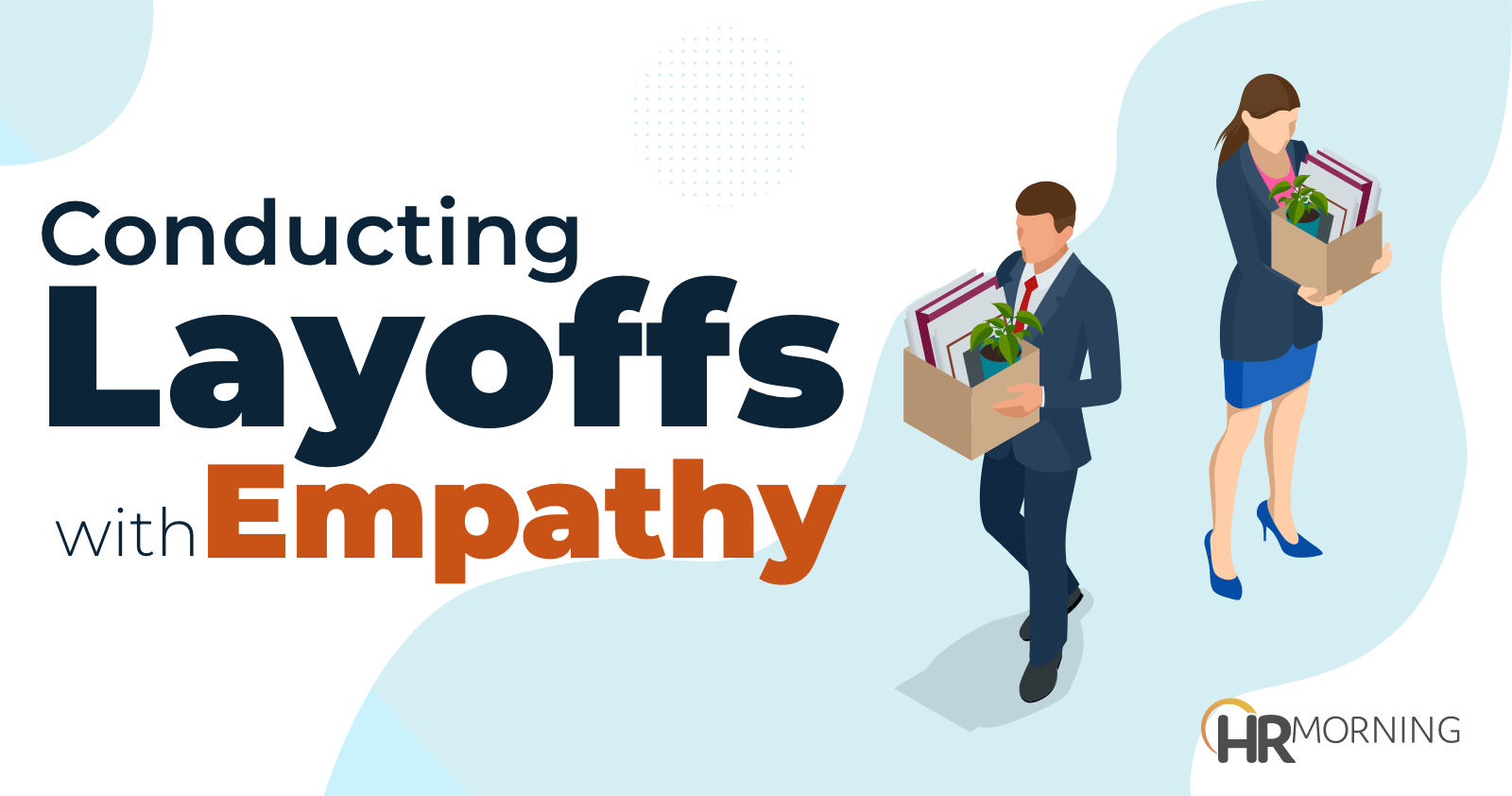
Conducting layoffs with Empathy

It seems like every day, another company is announcing mass layoffs. Just this past week, companies such as Adobe, Plaid and Buzzfeed conducted layoffs, with some cutting up to 12% of their workforce. 

The impact of layoffs, especially around the holiday season, can hit workers hard. Although there’s no way to mitigate the effects of a layoff, there are ways to conduct it in a compassionate and empathetic manner. A robotic and detached “Lazy Layoff” can cause unnecessary turmoil for the laid-off employee and create mistrust among the employees that stay.  

What is a Lazy Layoff?

Although the goal of a layoff conversation should always focus on delivering the news compassionately, offering support and answering any and all questions about logistics and next steps, sometimes managers – and even HR – can miss the mark in a Lazy Layoff. 

“A lazy layoff is putting more thought and ‘people power’ behind the spreadsheets and modeling of the layoff, than the communication and support for managers delivering the message and employees receiving it,” explains Ashley Herd, Founder and CEO of Manager Method.

Take, for example, a recent layoff conversation that went viral on TikTok. The manager in the now-deleted video, after informing the employee that their job was no longer critical and thanking the employee for her work at the company, immediately dropped off the call and handed it over to HR.

“It is uncomfortable delivering a hard message, so many leaders want others to have the conversation, or if they have to have it, get off the call as quickly as possible,” says Herd. “They are often thinking of their discomfort, rather than think of how sudden and harsh it can feel to employees affected.”

Lazy Layoffs can come across as cold-hearted and cruel, and they can also have detrimental effects on a laid-off employee’s mental health. During an already tumultuous time, full of uncertainty and shock, it can make them feel more like a number than a human. 

Best practices to avoid Lazy Layoffs

Layoffs are a delicate balance of delivering the information you need to in a succinct way while offering support and compassion to the employee. If one of those gets thrown out of balance, you may find yourself overstepping or falling into the dreaded Lazy Layoff. Here are some tips from Herd to help avoid the pitfalls of a Lazy Layoff.

  • Think about the employee first. Consider doing whatever you can to help make the employee’s life easier in a tumultuous time, such as giving a generous and appropriate severance package or sending a box to collect equipment instead of just a label. 
  • Script conversations. It’s important to prepare managers for the conversation beforehand. A layoff script should contain anything an employee needs to know and give the details that will ease uncertainty. Prepare for questions about everything from benefits to personal contacts.
  • Walk managers through the process. It may be hard for managers to deliver tough news, especially for an employee who works directly under them. You may want to suggest managers make eye contact and avoid reading directly off the script and making the conversation feel impersonal. “At the end of the day, remind managers, ‘This is uncomfortable to deliver but worse for those receiving it. Your job is to make sure you’re making it more bearable, not more terrible,’” suggests Herd.
  • Don’t be a silent witness. It’s important for HR to be proactive in case of missteps. While the manager should be in control of the conversation, if things start to go south, it’s important for HR to step in to redirect and take over the conversation instead.
Filed under
  • Talent Management
  • Share on

Get the HRMorning Newsletter

With HRMorning arriving in your inbox, you will never miss critical stories on labor laws, benefits, retention and onboarding strategies.

  • This field is for validation purposes and should be left unchanged.
  • This field is hidden when viewing the form
  • This field is hidden when viewing the form
  • This field is hidden when viewing the form
  • This field is hidden when viewing the form
  • This field is hidden when viewing the form
  • This field is hidden when viewing the form
  • This field is hidden when viewing the form
  • This field is hidden when viewing the form
  • This field is hidden when viewing the form
  • This field is hidden when viewing the form
  • This field is hidden when viewing the form
  • This field is hidden when viewing the form
  • This field is hidden when viewing the form
  • This field is hidden when viewing the form
  • This field is hidden when viewing the form
  • This field is hidden when viewing the form
  • This field is hidden when viewing the form
  • This field is hidden when viewing the form
  • This field is hidden when viewing the form
  • This field is hidden when viewing the form
  • This field is hidden when viewing the form
  • This field is hidden when viewing the form
  • This field is hidden when viewing the form
  • This field is hidden when viewing the form
  • This field is hidden when viewing the form
  • This field is hidden when viewing the form
  • This field is hidden when viewing the form
  • This field is hidden when viewing the form
  • This field is hidden when viewing the form
  • This field is hidden when viewing the form
  • This field is hidden when viewing the form
  • This field is hidden when viewing the form
  • This field is hidden when viewing the form
  • This field is hidden when viewing the form
  • This field is hidden when viewing the form
  • This field is hidden when viewing the form
  • This field is hidden when viewing the form
  • This field is hidden when viewing the form
  • This field is hidden when viewing the form
  • This field is hidden when viewing the form
  • This field is hidden when viewing the form
  • This field is hidden when viewing the form
  • This field is hidden when viewing the form
  • This field is hidden when viewing the form
  • This field is hidden when viewing the form
  • This field is hidden when viewing the form
  • This field is hidden when viewing the form
  • This field is hidden when viewing the form
  • This field is hidden when viewing the form
  • This field is hidden when viewing the form
  • This field is hidden when viewing the form
  • This field is hidden when viewing the form
  • This field is hidden when viewing the form
  • This field is hidden when viewing the form
  • This field is hidden when viewing the form
  • This field is hidden when viewing the form

Free Training & Resources

Webinars

The Manager Effect: The Most Overlooked Lever in Employee Experience

Provided by Inspirus

Webinars

Identifying and Closing Skills Gaps at Your Organization

White Papers

Seamless & Secure: Safeguarding the Member Experience

Provided by HealthEquity

Webinars

How To Address Excessive Workloads in Your Teams

SPONSORED CONTENT

HR Technology

sponsored content
The Best AI Software for HR Automation

Courtesy of G-P

Talent Management

sponsored content
Powerful Employee Retention Strategies for 2025: How to Keep Your Best People

Courtesy of PEOPLEGURU

Benefits

Health Care

Wellness

sponsored content
Proven Results: 5 Ways Teladoc Health Chronic Condition Management Transforms HR Outcomes

Courtesy of TELADOC HEALTH

Further Reading

  • Talent Management
‘Loud Loyalty’: 6 Ways to Make This Trend Work

Quiet stuff sucks. So let’s embrace what’s new and loud in HR — “Loud Loyalty.” Think about all the quiet ...

  • Talent Management
5 Ways to Keep Your Best People

Can you keep your best people from walking out the door? Shy of barricading the door, probably not. But you can create a workplace...

  • Talent Management
The importance of diversity and inclusion in the workplace

People often use the terms diversity and inclusion interchangeably. This can cause confusion in the workplace. But HR pros know these terms...

  • Talent Management
12 ideas for building an employee recognition program

Employee recognition is a key component of any healthy work environment. Recognizing your employees in various ways helps them feel like va...

  • Talent Management
Employee Engagement Surveys: 20 Important Questions to Ask

Low employee engagement costs the global economy about US $89 trillion, or 9% of global GDP, according to Gallup’s latest State of th...

  • Talent Management
‘Breadcrumbing’: How This Trend Hurts the Workplace and 6 Ways to Fix It

People inside your organization are likely breadcrumbing employees and job candidates. And it’s hurting everything from your reput...

Get the latest from HRMorning in your inbox PLUS immediately access 10 FREE HR guides.

I WANT MY FREE GUIDES
HR Morning Logo
  • Facebook
  • Linked In
  • ABOUT HRMORNING
  • ADVERTISE WITH US
  • WRITE FOR US
  • CONTACT
  • Employment Law
  • Benefits
  • Recruiting
  • Talent Management
  • Performance Management
  • HR Technology
  • Leadership & Strategy
  • Compensation
  • Policy & Procedures
  • Wellness
  • Staff Departure
  • HR Career & Self-Care
  • Health Care
  • Retirement Plans
  • DEI

HRMorning, part of the Rover Insights Network, provides the latest HR and employment law news for HR professionals in the trenches of small-to-medium-sized businesses. Rather than simply regurgitating the day's headlines, HRMorning delivers actionable insights, helping HR execs understand what HR trends mean to their business.

Powered By Rover Insights
Privacy Policy | Terms of Service
Copyright© 2026 Rover Insights
HRMorning Logo

WELCOME BACK!

Enter your username and password below to log in

Forget Your Username or Password?

Reset Password

Lost your password? Please enter your username or email address. You will receive a link to create a new password via email.

Log In

Why do we need your credit card for a free trial?

We ask for your credit card to allow your subscription to continue should you decide to keep your membership beyond the free trial period.  This prevents any interruption of content access.

Your card will not be charged at any point during your 21 day free trial
and you may cancel at any time during your free trial.

During your free trial, you can cancel at any time with a single click on your “Account” page.  It’s that easy.