• Skip to primary navigation
  • Skip to main content

HRMorning

  • FREE RESOURCES
  • PREMIUM CONTENT
  • HR DEEP DIVES
  • PODCASTS
    • VOICES OF HR
    • WOMEN’S LEADERSHIP TODAY
  • LOGIN
  • SIGN UP FREE
  • Employment Law
  • Benefits
  • Recruiting
  • HR Technology
  • Payroll
  • Management
  • Women’s Leadership
  • More
    • Talent Management
    • Performance Management
    • Leadership & Strategy
    • Compensation
    • Policy & Procedures
    • Wellness
    • Staff Departure
    • HR Career & Self-Care
    • Health Care
    • Retirement Plans
  • Leadership & Strategy
  • Talent Management

All-Hands Meetings Done Right: 5 Steps to Strengthen Company Culture

Kim Hiler, HR Expert Contributor
By: Kim Hiler, HR Expert Contributor
  • Share on

About the Author

In Kim Hiler’s role as Intradiem’s Chief People Officer, she leads the people strategy and execution for Intradiem. Kim brings more than 20 years of experience as a successful leader of key growth initiatives in HR and employee culture for World 50, Fiserv, and TRX. She has led initiatives in employee benefits, compensation, employee programs, employee relations, talent acquisition, and talent management.

Show Less
Last Updated: March 19, 2026
4 minute engagement
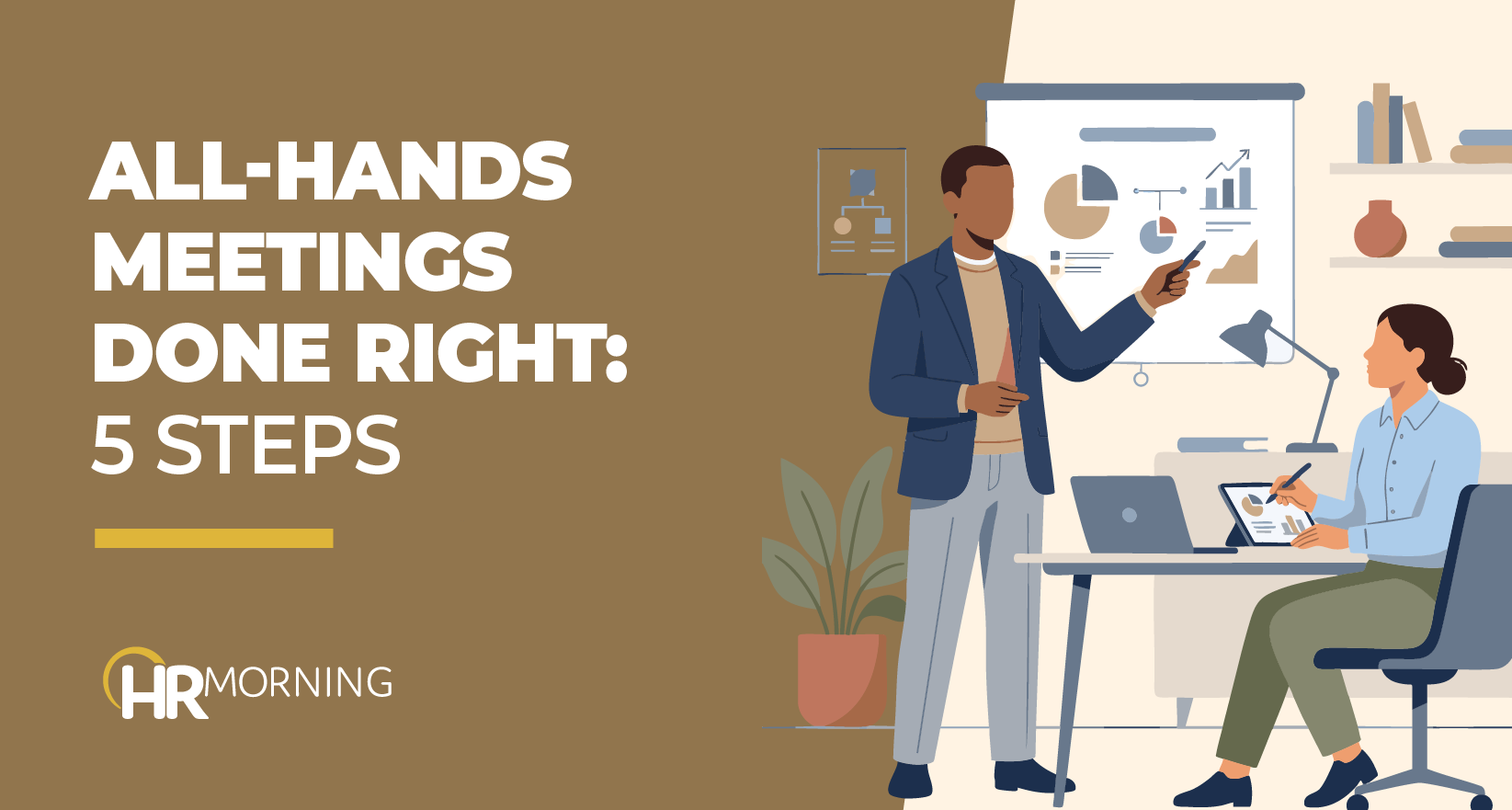
HR Morning blog graphic titled “All-Hands Meetings Done Right: 5 Steps,” featuring a manager presenting data charts to an employee in an office setting, representing effective team communication and leadership.

Company all-hands meetings present great opportunities to provide clarity and connection. For fully remote organizations, the stakes are especially high. These annual gatherings are strategic culture touchpoints — rare occasions for leaders to reinforce alignment, belonging and shared purpose across their entire organization.

A strong all-hands meeting is not defined by production value or polished presentations, but by the intentional work done before, during and after the event to strengthen trust and connection.

1. Lay the Cultural Foundation

An all-hands meeting doesn’t fix cultural problems; it reflects the cultural health of the company. When employees feel unheard or disengaged year-round, no meeting can compensate for that gap.

People teams play a critical role. Readiness begins long before the agenda is set, with ongoing feedback loops that help leaders understand how employees are experiencing the organization. Regular pulse checks, employee-people leader conversations, and open channels for feedback ensure that employees feel heard well before they gather in person.

Equally important are the rituals that sustain cohesion in remote environments. Shared norms around communication, collaboration and decision-making create clarity when informal cues we get from working together every day are not available. When expectations are clear and consistently reinforced, all-hands meetings feel more like a continuation of shared understanding than a reset.

Trust is the foundation. All-hands meetings are most effective when employees already believe leadership listens and follows through. Without that trust, even the best-designed event risks being met with skepticism.

2. Create Leadership Alignment

One of the fastest ways to undermine an all-hands meeting is to treat it as a production led by the people team. In reality, these meetings are enterprise strategy moments, and they should be approached that way. Engagement influences retention. Alignment affects execution. Clarity reduces friction. When leaders understand how culture directly supports business performance, buy-in becomes much easier.

Internal data can help anchor the conversation. Trends in employee retention, engagement surveys or post-meeting feedback provide tangible evidence of what’s working and where gaps exist. Data alone isn’t the story, but it gives leaders a shared starting point as they work to improve from one year to the next.

Co-creation of pre-event messaging is just as important. When executives collaborate on themes and priorities ahead of time, they present a unified narrative rather than a disjointed collection of individual updates.

Employees notice when leaders are aligned, and they notice just as quickly when they’re not. When all-hands meetings are treated as a shared responsibility, they bolster credibility and authority. Well-aligned leaders make the gathering feel less like a presentation to employees and more like a moment shaped intentionally for leaders and employees alike.

3. Build Connection

As much as possible, all-hands meetings should feel participatory rather than scripted. Employees want to engage, not just consume information. Accomplish this by designing employee-driven moments into the agenda. For example, open Q&A sessions, spotlight stories and cross-team showcases allow employees to see themselves reflected in the broader organization.

Varying content formats is also helpful. Mixing formal updates with storytelling, discussions and informal interaction helps maintain energy and prevent cognitive overload. Screen fatigue is a real issue for remote organizations, so variety and thoughtful pacing make a real difference.

Creating the right energy happens through tone, inclusion and intentional design. Leaders who show up as fellow human beings who are willing to answer tough questions and acknowledge uncertainty create an environment where employees feel safe to engage. A properly designed all-hands meeting can renew collective momentum and remind employees they’re part of something bigger than their individual roles.

4. Convert Momentum into Cultural Strength

One big risk is that energy peaks during the meeting and evaporates shortly afterward. To prevent that drop-off, momentum must be carried forward deliberately.

Equipping people leaders with follow-up guides helps teams digest key messages, interpret them in the local context and translate ideas into action. These actions don’t need to repeat the meeting; they should extend it. Revisiting major themes through internal channels helps keep priorities visible without overwhelming employees or rehashing content verbatim.

Listening after the event is just as important. Structured feedback loops provide insights into how employees received and interpreted messages. Did they walk away with the understanding leadership intended? Where did interpretation diverge? That feedback should inform future planning. All-hands meetings are inputs into culture evolution, not just outputs of planning.

5. Co-Architect Culture  

In remote organizations, all-hands gatherings are high-leverage tools that an organization has to strengthen company culture at scale. If they’re treated as isolated events, their impact fades quickly. But when they’re approached as culture-building cycles, they multiply connection, clarity and engagement over time.

The most successful all-hands meetings are the result of intentional partnership across all the team leaders in an organization, functioning as co-architects of culture. When that partnership is strong, all-hands gatherings reinforce belonging and sustain momentum long after everyone goes back to their home offices.

Filed under
  • Leadership & Strategy
  • Talent Management
  • Share on

Get the HRMorning Newsletter

With HRMorning arriving in your inbox, you will never miss critical stories on labor laws, benefits, retention and onboarding strategies.

  • This field is for validation purposes and should be left unchanged.
  • This field is hidden when viewing the form
  • This field is hidden when viewing the form
  • This field is hidden when viewing the form
  • This field is hidden when viewing the form
  • This field is hidden when viewing the form
  • This field is hidden when viewing the form
  • This field is hidden when viewing the form
  • This field is hidden when viewing the form
  • This field is hidden when viewing the form
  • This field is hidden when viewing the form
  • This field is hidden when viewing the form
  • This field is hidden when viewing the form
  • This field is hidden when viewing the form
  • This field is hidden when viewing the form
  • This field is hidden when viewing the form
  • This field is hidden when viewing the form
  • This field is hidden when viewing the form
  • This field is hidden when viewing the form
  • This field is hidden when viewing the form
  • This field is hidden when viewing the form
  • This field is hidden when viewing the form
  • This field is hidden when viewing the form
  • This field is hidden when viewing the form
  • This field is hidden when viewing the form
  • This field is hidden when viewing the form
  • This field is hidden when viewing the form
  • This field is hidden when viewing the form
  • This field is hidden when viewing the form
  • This field is hidden when viewing the form
  • This field is hidden when viewing the form
  • This field is hidden when viewing the form
  • This field is hidden when viewing the form
  • This field is hidden when viewing the form
  • This field is hidden when viewing the form
  • This field is hidden when viewing the form
  • This field is hidden when viewing the form
  • This field is hidden when viewing the form
  • This field is hidden when viewing the form
  • This field is hidden when viewing the form
  • This field is hidden when viewing the form
  • This field is hidden when viewing the form
  • This field is hidden when viewing the form
  • This field is hidden when viewing the form
  • This field is hidden when viewing the form
  • This field is hidden when viewing the form
  • This field is hidden when viewing the form
  • This field is hidden when viewing the form
  • This field is hidden when viewing the form
  • This field is hidden when viewing the form
  • This field is hidden when viewing the form
  • This field is hidden when viewing the form
  • This field is hidden when viewing the form
  • This field is hidden when viewing the form
  • This field is hidden when viewing the form
  • This field is hidden when viewing the form
  • This field is hidden when viewing the form

Free Training & Resources

White Papers

How a Delivery Service Provider Achieved HR Efficiency With Employee-Driven Payroll

Provided by Paycom

White Papers

The Business Case for Maven Clinic

Provided by Maven Clinic

Webinars

2022 Labor Law Poster Compliance

White Papers

Completion Rates Aren’t a Training Strategy

Provided by Navex

SPONSORED CONTENT

HR Technology

sponsored content
The Best AI Software for HR Automation

Courtesy of G-P

Talent Management

sponsored content
Powerful Employee Retention Strategies for 2025: How to Keep Your Best People

Courtesy of PEOPLEGURU

Benefits

Health Care

Wellness

sponsored content
Proven Results: 5 Ways Teladoc Health Chronic Condition Management Transforms HR Outcomes

Courtesy of TELADOC HEALTH

Further Reading

  • Leadership & Strategy
Open Door Policy Nightmares – And 4 Ways To End Them

You pride yourself on having an open door policy. After all, employees know you’re receptive to their needs and can talk to you about any...

  • Leadership & Strategy
Escaping the Trap of Toxic Productivity: Practical Advice

Productivity for the sake of productivity can be toxic in a workplace. It creates divides between team members, fosters a competitive workp...

  • Leadership & Strategy
Yahoo’s New HR Strategy: Useful Tips for HR Pros

Realigning HR strategy when a company moves in a bold, new direction can be done in a way that’s actually well received by stakeholde...

  • Talent Management
Workplace Romance: 3 Keys to Handling Love in the Office

Valentine’s Day brings workplace relationships into focus. Office romances introduce risk, especially when authority, pay, or performance...

  • Talent Management
Make good employees great: 4 ways to build on strengths

HR leaders and front-line managers can spend more than a day a week trying to fix employee performance issues. Correcting problems and ...

  • Talent Management
Long Live WFH! 4 Arguments for More Remote Work

Many employees at companies around the globe have done more than make arguments for more remote work: They’ve demanded it. And the...

Get the latest from HRMorning in your inbox PLUS immediately access 10 FREE HR guides.

I WANT MY FREE GUIDES
HR Morning Logo
  • Facebook
  • Linked In
  • ABOUT HRMORNING
  • ADVERTISE WITH US
  • WRITE FOR US
  • CONTACT
  • Employment Law
  • Benefits
  • Recruiting
  • Talent Management
  • Performance Management
  • HR Technology
  • Leadership & Strategy
  • Compensation
  • Policy & Procedures
  • Wellness
  • Staff Departure
  • HR Career & Self-Care
  • Health Care
  • Retirement Plans
  • DEI

HRMorning, part of the Rover Insights Network, provides the latest HR and employment law news for HR professionals in the trenches of small-to-medium-sized businesses. Rather than simply regurgitating the day's headlines, HRMorning delivers actionable insights, helping HR execs understand what HR trends mean to their business.

Powered By Rover Insights
Privacy Policy | Terms of Service
Copyright© 2026 Rover Insights
HRMorning Logo

WELCOME BACK!

Enter your username and password below to log in

Forget Your Username or Password?

Reset Password

Lost your password? Please enter your username or email address. You will receive a link to create a new password via email.

Log In

Why do we need your credit card for a free trial?

We ask for your credit card to allow your subscription to continue should you decide to keep your membership beyond the free trial period.  This prevents any interruption of content access.

Your card will not be charged at any point during your 21 day free trial
and you may cancel at any time during your free trial.

During your free trial, you can cancel at any time with a single click on your “Account” page.  It’s that easy.