
How to Build a Talent-Ready Workforce | 2-Minute Video
By
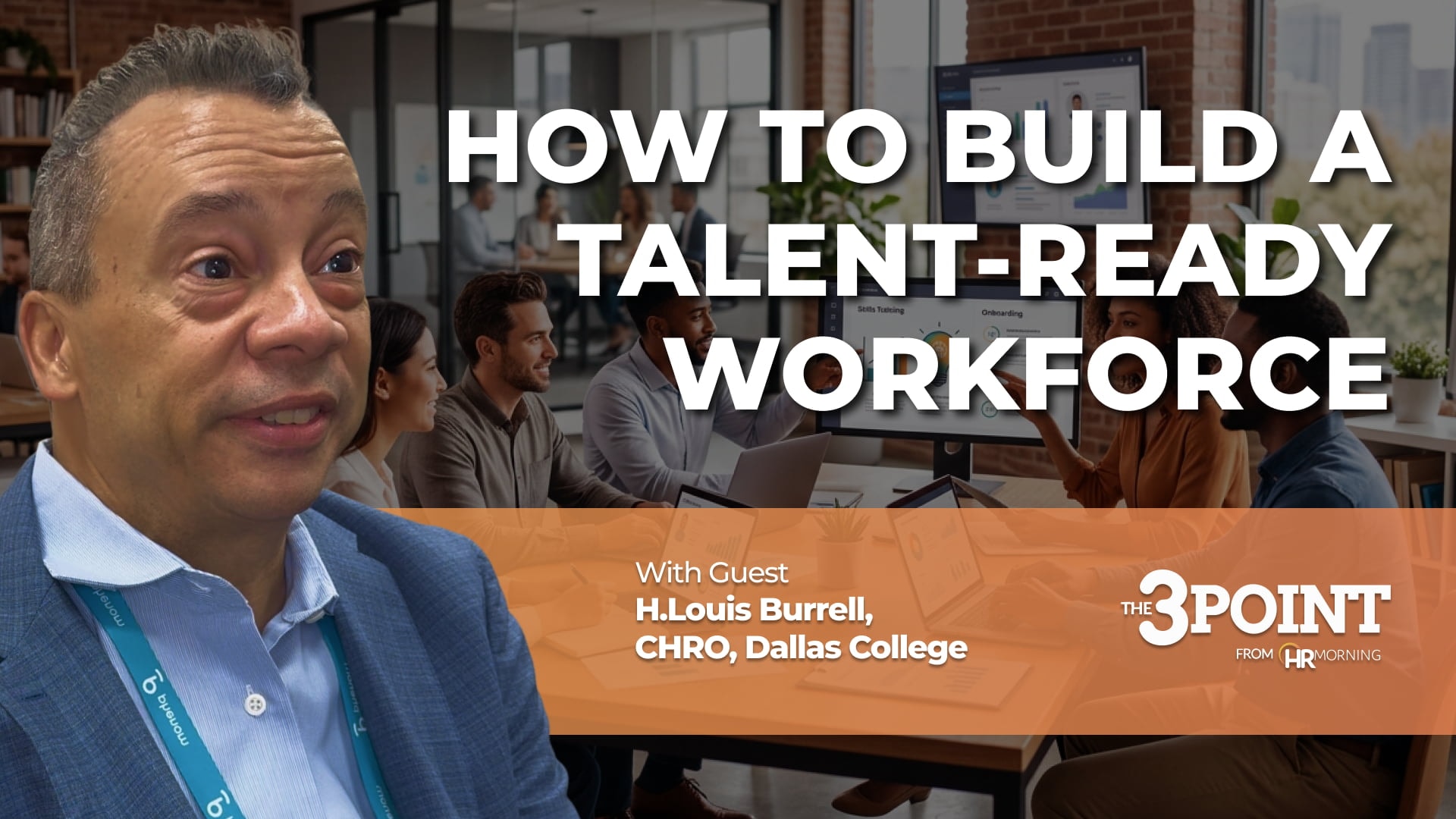
When you hire, the ideal candidate would be talent-ready.
Even if new hires didn’t have all the skills and experience you need to fill each role, having them more prepared to take on the job would help.
What’s Up in This Episode: Tips to Build a Talent-Ready
That’s why in this episode of HRMorning’s 3-Point, we introduce you to an organization that has built a talent-ready workforce — and helped many organizations in its community do the same. H. Louis Burrell, the CHRO at Dallas College, explains how they’ve partnered with other organizations to build pipelines of well-trained job candidates and employees.
Click, watch and listen for more details on creating a talent-ready workforce.
Transcript (edited for clarity):
Do you ever wish job candidates came to you already trained to do the job? Or at least, more prepared to step into the job? Your hiring managers probably do. And in this episode of the 3-Point, we’re going to help you get there with a cool case study that goes full circle.
Here’s where it starts from company to college …
H. Louis Burrell, CHRO, Dallas College: “We have one of their practitioners, who is in our classroom, actually telling us, or maybe telling or teaching, or they may be facilitating a session. But they have helped us design what the actual lab looks like. And, no, they’re not sending someone in to just say, ‘Hey, I need you to get some training.’ We’re training on the front end, so when they get to Baylor, Scott and White, they’re ready. And we use their staff. And sometimes their staff may be adjunct professors.”
So, Louis Burrell is with Dallas College, and Baylor, Scott and White is a medical provider. And he’s talking specifically here about a radiologic technologist program. But that’s just one of dozens of programs that the local college and businesses have partnered on to bolster readiness. The businesses provide teaching staff and ideas on the curriculum. The schools provide eager learners, plus …
Burrell: “I wanted to make sure how my students were getting connected to job opportunities – and not just, ‘Hey, we’re always hiring.’ But how do we make it so that it’s easy to facilitate, to always be notified around career opportunities?”
Part of that is informal. After all, practitioners are in the classroom. They can tell students about internships, training opportunities and job openings. The business and school also use job platforms that allow students to stay on top of jobs. And do they get those jobs? The number is astounding …
Burrell: “That may be in a variety of ways. They may be folks who come in who need continuous education and they get a certificate or credit. Or they’re a new student coming into the pipeline. So there are various ways that may happen, but yes, 52% of the staff have a touch to Dallas College.”
So, if you want to bolster your job candidate readiness and talent pipeline:
- Partner with education. It doesn’t have to be a local college. Think tech or high school, community college – whatever fits your business needs.
- Offer support. As much as you can, offer – and pay – your staff to teach the students. Help build the curriculum.
- Complete the circle. Hire the talent you supported – then support them to continue the cycle.
Advertisement
We’d love to hear more success stories like this from HRMorning readers and viewers. If you have something to share, go ahead and email me at mmgovern@HRMorning.com. Thanks for coming along for this episode.
Further Reading
How Military Veterans Can Improve Hiring and Retention
As our nation celebrates Veterans’ Day, consider increasing your efforts to find, recruit and retain veterans to your organization. Try it now as a catalyst to hire and retain more veterans for years to come. The voluntary quit rate is about 2%, according to data from the Labor Department. But if companies continue to hire […]
Posting Ghost Jobs Could Be Illegal: 7 Better Ways to Recruit
Lawmakers in several states have proposed bills targeting Ghost Jobs – roles posted that don’t exist or employers don’t intend to fill immediately. One state attorney general is investigating the legality of posting Ghost Jobs and profiting from it. The numbers speak some truth behind lawmakers’ concerns. About 25% of employers that have an open […]
Why Candidates Apply Everywhere: 5 Tips for a Better Experience
Employers are seeing more “spray and pray” applications from job seekers who submit dozens, or even hundreds, of applications with limited assessment of whether each role is a strong fit. But this behavior is not just about impatient candidates. It is often a survival response to a hiring process that feels unclear, automated, and silent. […]
Skills Flipping: 3 Things HR Needs to Know About Job Candidates’ New Trick
Skills-based hiring calls for a new trend that will help employers and employees get hiring even closer to perfect: Job candidates are “skills flipping” — turning what might be considered negative traits into strengths. It’s causing employers to reconsider how that trait could work in the increasingly skills-based hiring environment. That’s reflected in job postings: […]
The Return of ‘Blue Book’ Hiring in the Age of AI-Enabled Candidates: 6 Critical Factors
Candidates are increasingly using AI to strengthen their applications, draft resumes and prepare for interviews. In remote hiring environments, some are even using AI to answer recruiters’ questions in real time or to have AI avatars attend interviews on their behalf. Used appropriately, AI can be a helpful tool. It can make it easier for […]
New Collar Jobs: 7 Smart Moves to Fix Skills Gaps
New collar jobs may be the way forward for HR pros and their organizations. New collar workers tend to have technical fluency, manual capability and adaptability. And new collar jobs are becoming the backbone of the ever-changing economy, according to a report from LinkedIn. In fact, the US Bureau of Labor Statistics estimates that about […]