• Skip to primary navigation
  • Skip to main content

HRMorning

  • FREE RESOURCES
  • PREMIUM CONTENT
  • HR DEEP DIVES
  • PODCASTS
    • VOICES OF HR
    • WOMEN’S LEADERSHIP TODAY
  • LOGIN
  • SIGN UP FREE
  • Employment Law
  • Benefits
  • Recruiting
  • HR Technology
  • Payroll
  • Management
  • Women’s Leadership
  • More
    • Talent Management
    • Performance Management
    • Leadership & Strategy
    • Compensation
    • Policy & Procedures
    • Wellness
    • Staff Departure
    • HR Career & Self-Care
    • Health Care
    • Retirement Plans
  • Talent Management

The importance of diversity and inclusion in the workplace

Bruno Boksic, HR Expert Contributor
By: Bruno Boksic, HR Expert Contributor
  • Share on

About the Author

Bruno Boksic is an HR content marketing writer who specializes in employee engagement, talent management, recruitment and L&D. Before becoming a freelance writer, Boksic worked as the head of HR of a global nonprofit organization. You can contact him via Linkedin.

Show Less
Last Updated: February 14, 2023
5 minute engagement
Differences between diversity and inclusion

People often use the terms diversity and inclusion interchangeably. This can cause confusion in the workplace. But HR pros know these terms have specific meanings and vital jobs.

To help employers keep it all straight, here’s a quick review of their definitions and how to implement them.

Difference between diversity and inclusion

Even though most people use the terms diversity and inclusion interchangeably, they’re quite different. There can be companies and organizations that are the champions of diversity but aren’t inclusive at all. On the other hand, there are workplaces that are highly inclusive but are far from diverse. 

In order to understand both diversity and inclusion, we will define the terms. 

Diversity

Diversity is a set of traits, experiences and characteristics that make one person different from another. Usually, when talking about diversity in the workplace, the emphasis lies on the visible specter of diversity such as race, gender or age. 

However, that’s only one aspect of diversity. Broadly speaking, there are four categories of diversity: 
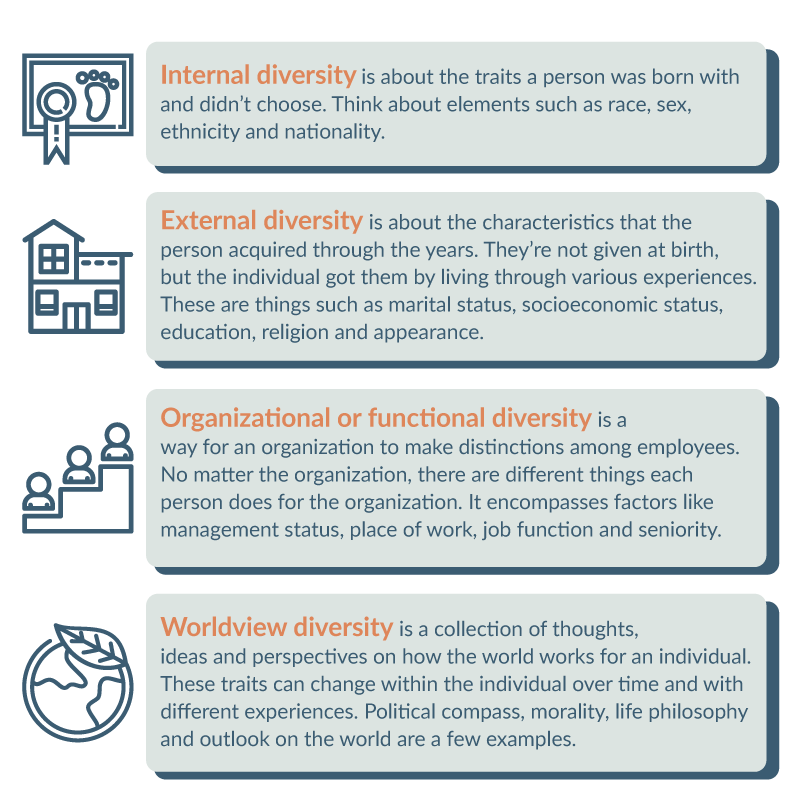
• Internal diversity is about the traits a person was born with and didn’t choose. Think about elements such as race, sex, ethnicity and nationality. • External diversity is about the characteristics that the person acquired through the years. They’re not given at birth, but the individual got them by living through various experiences. These are things such as marital status, socioeconomic status, education, religion and appearance. • Organizational or functional diversity is a way for an organization to make distinctions among employees. No matter the organization, there are different things each person does for the organization. It encompasses factors like management status, place of work, job function and seniority. • Worldview diversity is a collection of thoughts, ideas and perspectives on how the world works for an individual. These traits can change within the individual over time and with different experiences. Political compass, morality, life philosophy and outlook on the world are a few examples.

Now, let’s take a look at inclusion in the workplace.

Inclusion

Diversity was the “what”, while inclusion is the “how.” 

Inclusion is the process of welcoming, accepting and providing a comfortable workplace to all of your employees. That’s why a place can be diverse, but not inclusive. The company can have practices with which they employ diverse individuals, but not have practices that include those employees in the workplace. 

An inclusive workplace is respectful, affirming and welcoming to employees regardless of their diversity. 

A great workplace would have both a diverse workforce and inclusive practices that would welcome that diversity. These two concepts work perfectly with one another, complementing each other and dealing with each other’s blind spots. 

Companies that conflate diversity and inclusion can create plenty of problems.

The risks of conflating diversity and inclusion

Even though the terms diversity and inclusion are closely related, they shouldn’t be treated as the same thing. 

If a company treats diversity and inclusion as the same thing, but only focuses on diversity, it can create the following scenarios: 

  • Hiring diverse people to fill the quota, but not doing anything to include diverse people in the workplace, or
  • Having diverse hiring practices, but not having inclusive cultural practices.

If a company treats diversity and inclusion as the same thing, but only focuses on inclusion, it can create the following scenarios:

  • Having inclusive practices, but not investing in hiring people with diverse backgrounds, and
  • Having a single-minded workforce which can lead to a lack of innovation and creativity.

So companies need to work both on diversity and inclusion and treat them as two separate elements in the workplace. 

How diversity and inclusion work together
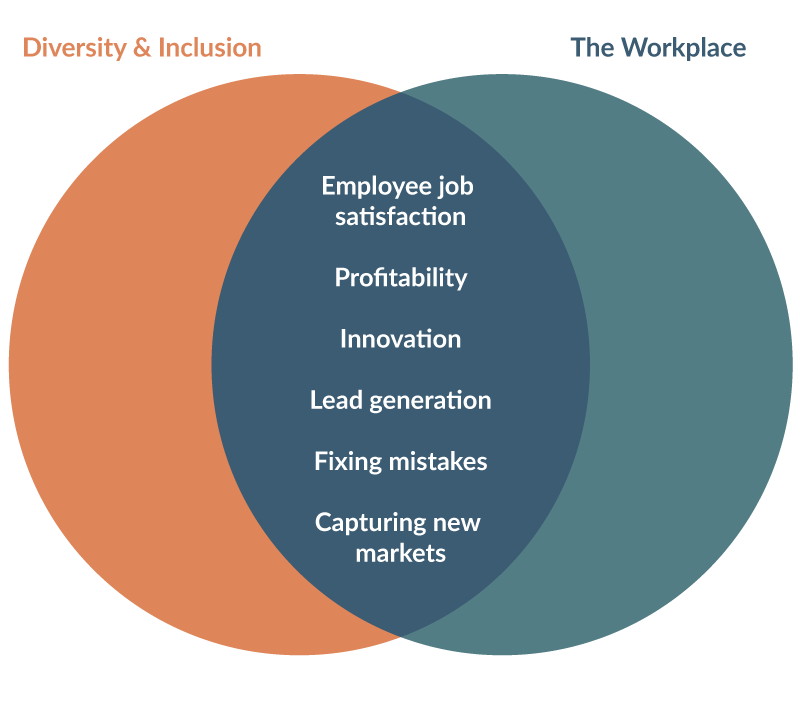
Diversity & Inclusion - The Workplace: Employee job satisfaction, Profitability, Innovation, Lead generation, Fixing mistakes, Capturing new markets.

Diversity and inclusion aren’t “nice to have” things in the workplace; they’re essential for a successful business. They positively impact so many different elements in the workplace such as: 

  • Employee job satisfaction. Employees who believe that their company will treat them and their colleagues the same no matter their ethnicity, gender or race, are more likely to enjoy their jobs. According to GreatPlaceToWork.com research, employees are 9.8 times more likely to look forward to going to work and 6.3 times more likely to take pride in their work.
  • Profitability. A McKinsey research found that the most diverse companies are 21% more likely to have above-average profitability. On top of that, if they have highly diverse executive teams as well, the likelihood of higher-than-average profitability increases to 25%. 
  • Innovation. According to Josh Bersin’s report, highly diverse companies are 1.8 times more likely to be willing to change and adapt to the market. On top of that, they’re 1.7 times more likely to be innovation leaders in their perspective markets. 
  • Lead generation. VantageCircle found out that there’s a high number of people that wouldn’t even apply for a job if the company isn’t diverse. Over 60% of their black poll takers and more than 30% of their white poll takers said they wouldn’t even apply for a job if the workplace isn’t diverse. 
  • Fixing mistakes. A Deloitte research found that diverse workplaces are 30% more likely to recognize and spot mistakes in the workplace. So if you have a diverse workplace, you will be able to recognize mistakes early on and fix them before they become too big to handle. 
  • Capturing new markets. Diverse companies, according to HBR research, are 70% more likely to capture new markets. So having a diverse workplace means that you’ll be able to expand your products easier into a new market.

As the above-mentioned statistics show, there are so many benefits to having diversity and inclusion in the workplace. All companies should work on their diversity and inclusion processes because they can produce massive returns on investment.

Creating a diverse and inclusive workplace

For all companies that want to improve diversity and inclusion in their workplace, they should look into the following processes: 
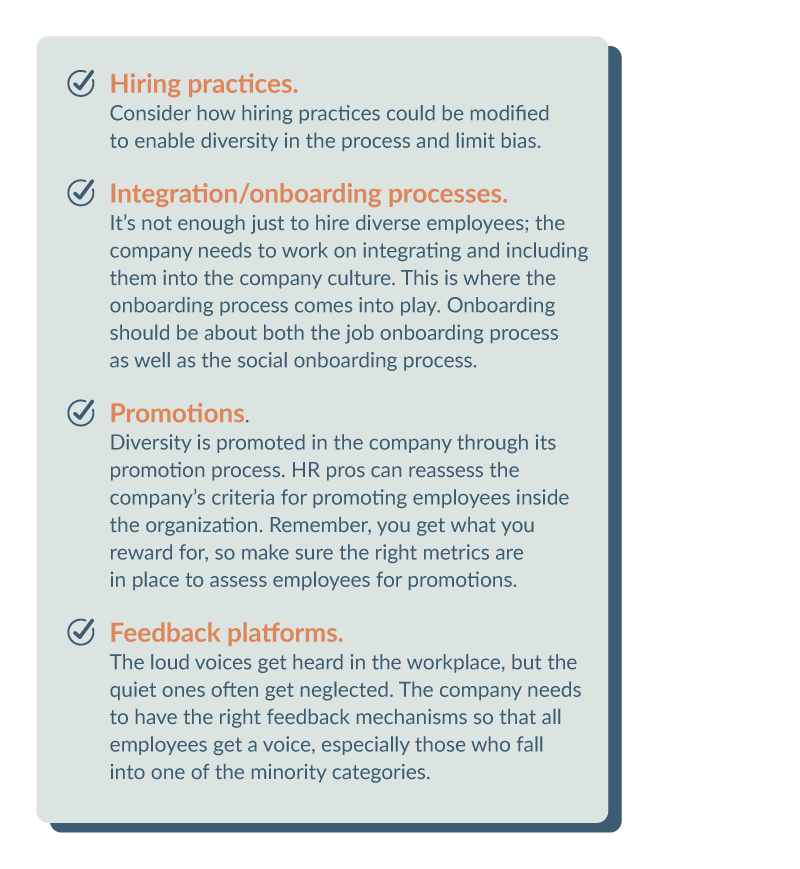
Hiring practices. Consider how hiring practices could be modified to enable diversity in the process and limit bias. • Integration/onboarding processes. It’s not enough just to hire diverse employees; the company needs to work on integrating and including them into the company culture. This is where the onboarding process comes into play. Onboarding should be about both the job onboarding process as well as the social onboarding process. • Promotions. Diversity is promoted in the company through its promotion process. HR pros can reassess the company’s criteria for promoting employees inside the organization. Remember, you get what you reward for, so make sure the right metrics are in place to assess employees for promotions. • Feedback platforms. The loud voices get heard in the workplace, but the quiet ones often get neglected. The company needs to have the right feedback mechanisms so that all employees get a voice, especially those who fall into one of the minority categories.

Adding equity into the diversity and inclusion mix

Equity is about fairness and justice. What equity explains to us is that every individual has separate needs and circumstances and they need to get the right amount of resources to reach the same outcomes.

Equity in the workplace means treating everyone fair, but not the same. Some employees might need resource X to accomplish goal Z while others might need resource Y to accomplish the same goal. 

For example, the goal would be to calculate a series of numbers. Some employees might need a computer, others might just need a calculator, while a third group might just need a pen and paper. Different needs, different resources, but the same outcome. 

With equity, the company should take note of the individual’s needs and give them enough resources so that they can do their tasks. 

Implement diversity, inclusion and equity in the workplace 

Diversity and inclusion are practices that provide great returns on investment for every company. No matter the industry, the company should try to implement diversity and inclusion processes in its workplace. 

Add equity to the mix and you will get the anti-discrimination trifecta. 

For more information about diversity, read Trends in diversity, equity & inclusion for HR. 

Filed under
  • Talent Management
  • Share on

Get the HRMorning Newsletter

With HRMorning arriving in your inbox, you will never miss critical stories on labor laws, benefits, retention and onboarding strategies.

  • This field is for validation purposes and should be left unchanged.
  • This field is hidden when viewing the form
  • This field is hidden when viewing the form
  • This field is hidden when viewing the form
  • This field is hidden when viewing the form
  • This field is hidden when viewing the form
  • This field is hidden when viewing the form
  • This field is hidden when viewing the form
  • This field is hidden when viewing the form
  • This field is hidden when viewing the form
  • This field is hidden when viewing the form
  • This field is hidden when viewing the form
  • This field is hidden when viewing the form
  • This field is hidden when viewing the form
  • This field is hidden when viewing the form
  • This field is hidden when viewing the form
  • This field is hidden when viewing the form
  • This field is hidden when viewing the form
  • This field is hidden when viewing the form
  • This field is hidden when viewing the form
  • This field is hidden when viewing the form
  • This field is hidden when viewing the form
  • This field is hidden when viewing the form
  • This field is hidden when viewing the form
  • This field is hidden when viewing the form
  • This field is hidden when viewing the form
  • This field is hidden when viewing the form
  • This field is hidden when viewing the form
  • This field is hidden when viewing the form
  • This field is hidden when viewing the form
  • This field is hidden when viewing the form
  • This field is hidden when viewing the form
  • This field is hidden when viewing the form
  • This field is hidden when viewing the form
  • This field is hidden when viewing the form
  • This field is hidden when viewing the form
  • This field is hidden when viewing the form
  • This field is hidden when viewing the form
  • This field is hidden when viewing the form
  • This field is hidden when viewing the form
  • This field is hidden when viewing the form
  • This field is hidden when viewing the form
  • This field is hidden when viewing the form
  • This field is hidden when viewing the form
  • This field is hidden when viewing the form
  • This field is hidden when viewing the form
  • This field is hidden when viewing the form
  • This field is hidden when viewing the form
  • This field is hidden when viewing the form
  • This field is hidden when viewing the form
  • This field is hidden when viewing the form
  • This field is hidden when viewing the form
  • This field is hidden when viewing the form
  • This field is hidden when viewing the form
  • This field is hidden when viewing the form
  • This field is hidden when viewing the form
  • This field is hidden when viewing the form

Free Training & Resources

Webinars

Trump’s Agenda & HR: Understanding Legislative Actions and Preparing for Impact

Provided by Mitratech

White Papers

Seamless & Secure: Safeguarding the Member Experience

Provided by HealthEquity

White Papers

AI HR Prompts

Webinars

Top HR Trends and Priorities for 2026

Provided by Paycom

SPONSORED CONTENT

HR Technology

sponsored content
The Best AI Software for HR Automation

Courtesy of G-P

Talent Management

sponsored content
Powerful Employee Retention Strategies for 2025: How to Keep Your Best People

Courtesy of PEOPLEGURU

Benefits

Health Care

Wellness

sponsored content
Proven Results: 5 Ways Teladoc Health Chronic Condition Management Transforms HR Outcomes

Courtesy of TELADOC HEALTH

Further Reading

  • Talent Management
13 Fabulous Team-Building Exercises for Large Groups

From one end of the building to the other, coast to coast or around the globe, you likely have some large teams within your organization. ...

  • Talent Management
The Great Stay: 16 Ways to Maximize Trends, Buck Challenges

The days of the Great Resignation, characterized by rapid turnover and employee flight, seem to be fading into the rearview mirror. A new t...

  • Talent Management
Generations at Work: 5 Ways to Bridge the Gap

If you’ve been in HR more than a minute, it’s likely you have several generations in your workplace — employees from 18 t...

  • Benefits
  • Recruiting
Need some help recruiting Gen Z talent? Here are some important things to know

The World Economic Forum estimates that by 2025 – two short years away – more than 25% of the workforce will be comprised of Ge...

  • Talent Management
20 Employee Incentive Program Ideas to Boost Engagement

As any HR pro knows, employees are the lifeblood of every business. If your team is unhappy, productivity slows, employee retention suffers...

  • Talent Management
Love an employee, but it’s not a good fit now? 5 questions to figure out what’s next

Most HR pros and front-line managers come to this fork in the road: You love an employee but are finding it’s not a good fit anymore....

Get the latest from HRMorning in your inbox PLUS immediately access 10 FREE HR guides.

I WANT MY FREE GUIDES
HR Morning Logo
  • Facebook
  • Linked In
  • ABOUT HRMORNING
  • ADVERTISE WITH US
  • WRITE FOR US
  • CONTACT
  • Employment Law
  • Benefits
  • Recruiting
  • Talent Management
  • Performance Management
  • HR Technology
  • Leadership & Strategy
  • Compensation
  • Policy & Procedures
  • Wellness
  • Staff Departure
  • HR Career & Self-Care
  • Health Care
  • Retirement Plans
  • DEI

HRMorning, part of the Rover Insights Network, provides the latest HR and employment law news for HR professionals in the trenches of small-to-medium-sized businesses. Rather than simply regurgitating the day's headlines, HRMorning delivers actionable insights, helping HR execs understand what HR trends mean to their business.

Powered By Rover Insights
Privacy Policy | Terms of Service
Copyright© 2026 Rover Insights
HRMorning Logo

WELCOME BACK!

Enter your username and password below to log in

Forget Your Username or Password?

Reset Password

Lost your password? Please enter your username or email address. You will receive a link to create a new password via email.

Log In

Why do we need your credit card for a free trial?

We ask for your credit card to allow your subscription to continue should you decide to keep your membership beyond the free trial period.  This prevents any interruption of content access.

Your card will not be charged at any point during your 21 day free trial
and you may cancel at any time during your free trial.

During your free trial, you can cancel at any time with a single click on your “Account” page.  It’s that easy.