Microbreaks: 1 Fast Tactic to Cut Stress, Boost Productivity | 2-Minute Video

Take a break.
It’s easier — and better — than you might think for you and your staff.
Hear us out: If you want to help people cut stress and become more productive, the best thing they can do is take more breaks every day at work. But they’re special kinds of breaks.
What’s Up in This Episode: How to Embrace Microbreaks
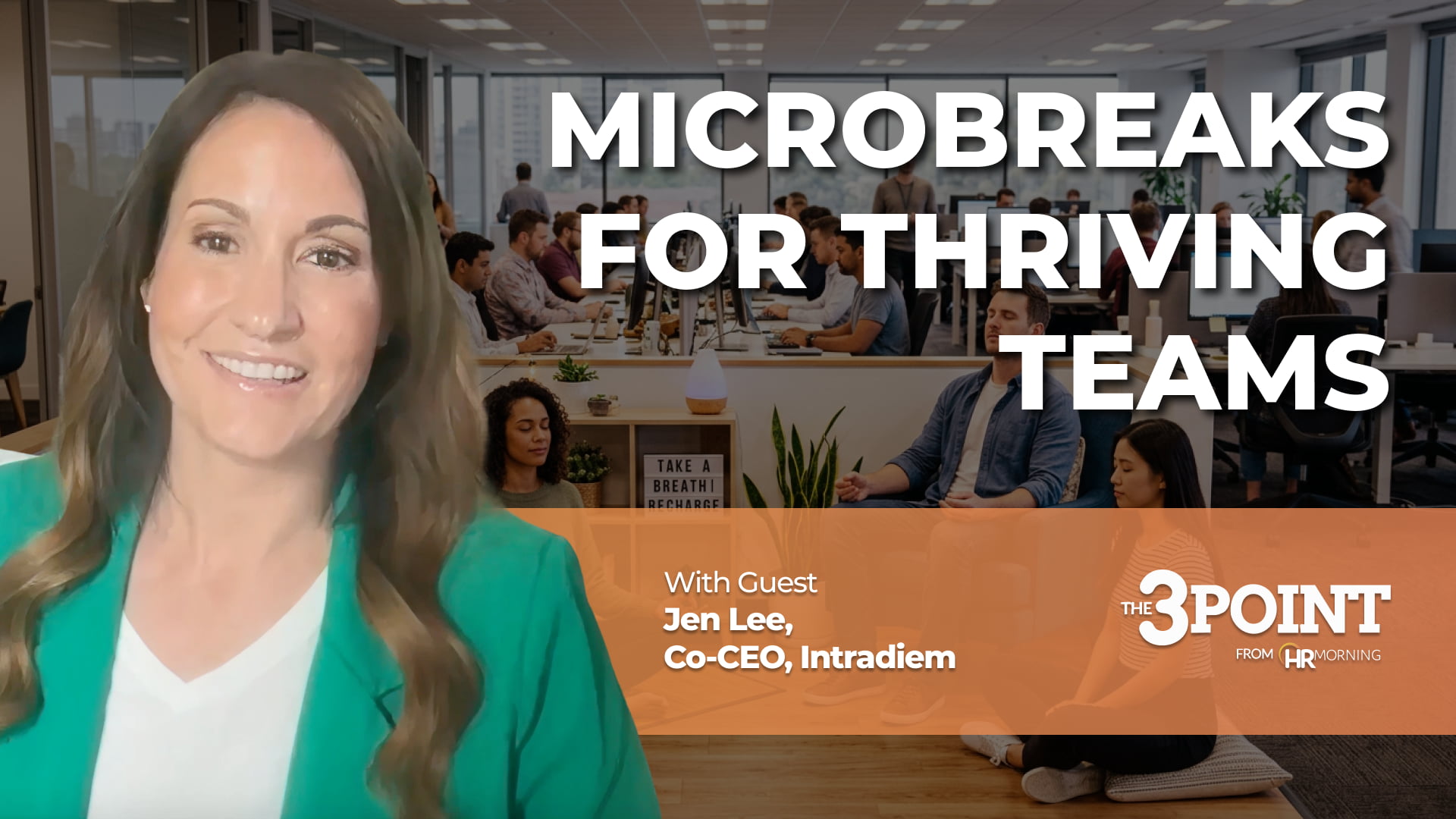
In this episode of HRMorning’s 3-Point, our expert, Jen Lee, Co-CEO, Intradiem, introduces us to microbreaks. She explains what they are, how she uses them — and encourages her staff to do the same. Plus, she shares tips on how to make them effective practices in your workplace.
Click, watch and listen for more details on microbreaks.
Transcript (edited for clarity):
We don’t have to know you to know that your employees are often stretched thin and sometimes pressing their limits. Nearly everyone is. That’s why we’re going to introduce you and your employees to a way to decompress quickly every day. Here’s why it’s important.
Jen Lee, Co-CEO, Intradiem: “As you go through your day, so you may have a moment of stress and think okay I’ve moved on beyond that you haven’t really your body hasn’t it stays with you and as you have the next stressful moment and the next one it’s like a snowball effect and the science shows that if you disrupt that with a microbreak, which is so simple to do, you can literally rewire your brain and your nervous system so that that stress doesn’t compound and doesn’t live in your body.“
That’s the fix. A microbreak. Lee uses them throughout the day, and she encourages her employees to do the same. She even starts meetings with microbreaks. Here’s what they are:
Lee: “Microbreaks are basically exactly what they sound. So they’re very short. I mean, they can even be less than a minute, anywhere from 30 seconds to usually two minutes at most. Moments or resets to pause and breathe, usually, and reset your nervous system.”
And here’s how they might be practiced.
Lee: “There are a lot of different ways to practice it. So the first is as simple as I do this often, in fact, because I context switch a lot in my role, as you can imagine, one meeting to the next and different topics in each meeting. So before you enter the next meeting, 30 seconds of closing your eyes and doing some deep breathing, belly breathing in particular, where you can feel it in your belly.
“So they can be as simple as that, just 30 seconds to close your eyes and breathe. There are also some great online microbreaks. You can find them on YouTube, where there are ocean waves or a little bit of a guided mini-meditation, as I would describe it. So a lot of different ways to do it, but it’s really just finding those moments to pause and again, it doesn’t have to be very long.“
So, to put microbreaks into practice in your workplace:
- Set the standard. Be like Lee. She’s at the top and she takes and encourages breaks before the stress snowballs.
- Give the tools. Share tips – like those we showed you here – on how to take microbreaks. Or give employees access to apps that help.
- Monitor it. Don’t assume employees are doing this. Check in that they are. Check on stress and productivity levels to ensure they’re moving in the right direction.
Bottom line: Employees don’t have to handle stress alone. Several apps can help with meditation and deep breathing. And you can find other episodes of the 3-Point with stress-breaking tips right here.
- Share on


Free Training & Resources
White Papers
Provided by Personify Health
White Papers
Provided by Maven Clinic
EBOOK, White Papers
Provided by Personify Health



