Talent acquisition vs. recruitment: Key differences and benefits

Hiring. Recruiting. Talent acquisition. Doesn’t it all mean the same thing?
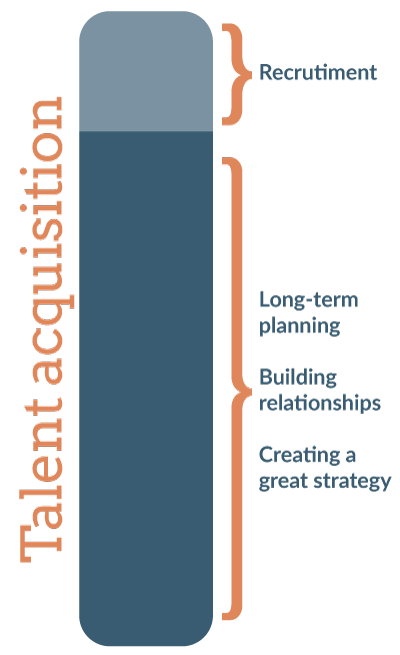
There’s actually a crucial difference between recruiting and talent acquisition, and understanding this will help you establish a more effective hiring strategy.
Recruiting happens when employers are addressing a current opening – they need a spot filled right away, so they look for candidates to do that job.
Talent acquisition is long-term planning that involves building relationships with talent – with the intention of hiring them at some point in the future. For example, some roles take much longer to fill than others, so proactive employers begin looking for potential talent before the job is even open.
So really, recruiting is just one small part of your overall talent acquisition strategy.
When recruitment is necessary
Of course, recruiting is a necessary tool to fill open positions. While it’s more of a short-term measure, sudden openings are inevitable and just a part of doing business.
And when a job needs filling quickly, it can be easy to pick a candidate who isn’t the best fit. But a mistake like that can prove to be both costly and time-consuming.
Here’s how some companies ensure they’re recruiting the best candidates.
Caitlyn Metteer, the recruiting manager of Lever, makes sure that applicants are very clear on what the job entails. She began tailoring job descriptions differently. Instead of having the job postings focus on past experience and future job duties, Metteer focused on the outcomes the company expected in the first year on the job.
This new focus allowed candidates to have a better idea of what would be asked of them, and whether they could see themselves being successful in the role and completing these goals. Metteer found that the candidates who applied to these jobs ended up being better fits compared with jobs that used traditional ads.
The right skill set is a big part of ensuring the candidate is a good fit – but so is making sure they fit in with your company’s culture.
Thibaud Clement, CEO of Loomly, found a way to address this issue. His company created a “Culture Code,” which included a description of the culture they strive to create, as well as a list of their core values: kindness, integrity, fairness, etc.
Once finalized, Clement sent the Culture Code out to all candidates early on in the hiring process. The people who weren’t a fan of the culture would self-eliminate, and those who liked what was described became even more enthusiastic about the position. It was a win-win.
While these companies’ recruiting tactics were successful, the better plan is to focus on long-term hiring goals – which is why it’s so important to have a talent acquisition strategy.
Importance of a talent acquisition strategy
Talent acquisition takes work and is an ongoing process, but it will make your hiring so much more efficient in the long run.
Here are the three main benefits of having an acquisition strategy, courtesy of talent acquisition tech company Skeeled:
- You’ll get the best people. Since you aren’t feeling the pressure to fill a job opening ASAP, you can take your time and truly find the most talented candidate.
- You’ll be competitive. When it comes down to it, employees determine the success of a company. Good people will give you a competitive edge – the best talent will want to work with equally talented team members.
- You’ll save money. Making a bad hire ends up being very costly when you need to replace them. Talent acquisition helps prevent that from happening. It also saves on expensive and time-consuming processes like advertising jobs, sorting through resumes and screening and interviewing candidates.
And a great talent acquisition strategy has three key components:
- Having a good employer brand
- Creating a talent pipeline, and
- Maintaining candidate relationships.
Employer branding
So first thing’s first – to evaluate your employer brand, you need to check your reputation. What are people saying about you? A good place to start is Glassdoor. Most candidates go there early on in the hiring process to find out what employees are saying – so you should check these as well to see what they see.
If you find negative reviews, don’t ignore them. The best thing to do is to respond in a professional manner, so candidates can see both sides of the story.
Here’s an idea for letting candidates know your company is a great place to work, courtesy of Procon’s employer brand consultant Annette Carroll. She had the company’s happiest employees make short videos explaining why they loved their jobs. Carroll then attached the videos to job postings, so everyone could get a feel for what the company was about.
Filling the pipeline
Once your brand is polished to perfection, you’ll want to start filling your talent pipeline. One way to achieve this is hosting networking events with the main mission of finding future talent. This is exactly what Tequilla Lopez, director of diversity at Best Buy, did.
By explaining to the event attendees she was looking for future talent, Lopez said it took a lot of the pressure off. She could speak with candidates about their skills and goals in a more casual setting – like a coffee date. Everyone was at ease, knowing they had nothing to lose but everything to gain. If the conversation went well, Lopez would exchange information and keep in contact with them, and begin preparing them for their potential future role.
Another option for filling your talent pipeline is to turn your attention to colleges. Talent acquisition manager for CVS Health, Christy Del Regno, partnered with colleges to reach top students for internship opportunities. Del Regno would send representatives to schools to promote the company and internship program. Del Regno stays in touch with interns even after they leave the program, and many end up taking on full-time positions after they graduate.
Candidate relationships
Once you have talent in your pipeline, it’s crucial you keep in touch and continue to maintain those relationships – or all that work of finding them would be for nothing.
Olivia Melman, recruiting operations manager for Digital Ocean, has an interesting way of doing this. She focuses on staying in touch with past applicants.
When Melman finds people who didn’t get the job they applied for but were impressive candidates, she puts them on a list. Every month, these candidates receive emails with updates on the company, as well as new job listings that may be a good fit.
Melman has had over 4,000 people reapply for jobs, and has hired a good number of them. Many of these hires ended up in positions that hadn’t even existed when they first applied to the company.
And even those who weren’t hired after all end up leaving with a great impression of the company, and would be more likely to recommend it to other job seekers.
Who’s responsible for TA?
Talent acquisition is a team effort. While HR pros take the lead, it’s important to be on the same page with higher-ups and hiring managers as well.
If everyone on your talent acquisition team isn’t in sync, it can cause major issues. A few common problems are that hiring managers can sometimes have unrealistic expectations for their ideal candidates, or want the process to move too quickly.
Founder of online hiring resource Recruiter Toolbox John Vlastelica says HR pros can help clear up some common misconceptions hiring managers have, which will ensure everyone is on the same page.
- More applicants is better. Some managers might want to see a ton of resumes, but trying to compare too many is impossible. HR should emphasize that reviewing three to five at a time is best.
- Cultural fit is the most important thing. Managers often want a new hire who’ll fit in, but this can actually discourage diversity. Not to mention, a candidate’s skill level and work ethic are the biggest factors that predict success – not cultural fit.
- A large panel of interviewers is necessary. If a manager has trouble making decisions, they may think more interviewers will help. But inviting too many opinions is a recipe for disagreement. The interview panel should have no more than three people – unless it’s for a senior-level position.
Next steps
Talent acquisition takes a lot of forethought and effort, but will save so much time and money in the long run when you aren’t scrambling to fill a position every time an employee leaves.
Ready to come up with your own talent acquisition plan? Assemble your HR team to discuss the best way to begin filling your talent pipeline, and be sure to check in with managers to see what kind of talent they’re looking for.
- Share on


Free Training & Resources
White Papers
Provided by AbsenceSoft
White Papers
Provided by Maven Clinic



