
3 Ways to Build a Bridge Over the Generation Gap | 2-Minute Video
By
From grandmas to grandkids, you probably have several generations in your workplace. And they don’t always see eye to eye. There’s likely a generation gap.
Even worse, 35% of employees say age or generational differences contributed to acts of incivility — witnessed or experienced — at work, according to SHRM’s Civility Index. People aren’t being nice to each other because just because they aren’t the same age. That’s unreal!
What’s Up in This Episode: Fill the Generation Gap
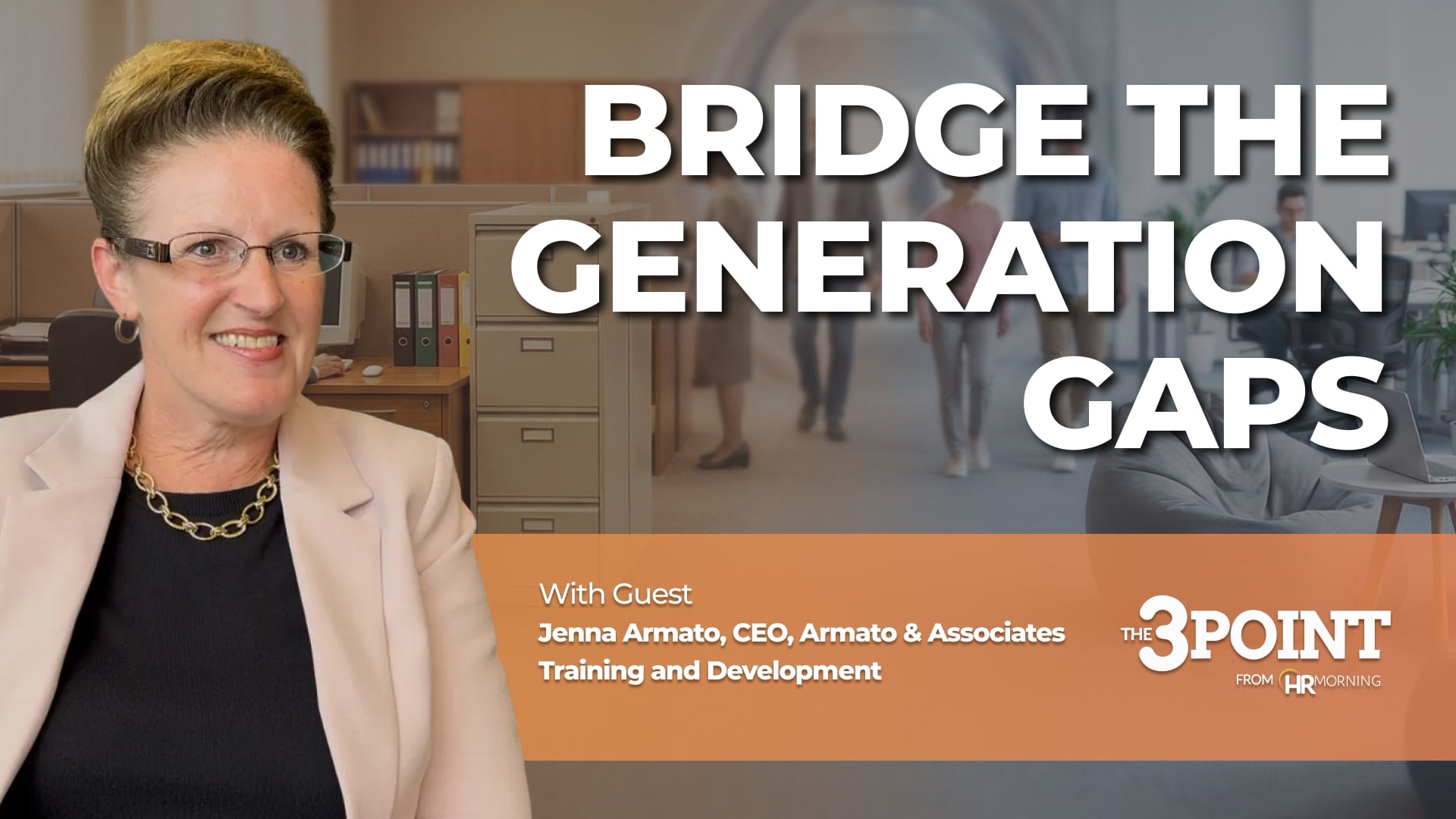
That’s why in this episode of HRMorning’s 3-Point, we talk with Jenna Armato, CEO, Armato & Associates Training and Development, about generational gaps. She helps us see why different generations sometimes don’t get along — or at least struggle to see eye to eye. And she identifies some ways HR pros and front-line leaders can help their employees bridge the generation gaps and even enjoy working together more.
Click, watch and listen for more on how you can help the five different generations can work together better.
Transcript (edited for clarity):
Can’t we all just get along? That’s the question we’ll explore in this episode of HRMorning’s 3-Point. We’ll look at why there’s often a generation gap in the workplace, and more importantly, how leaders can fix it. But let’s get some perspective on that first question right away.
Jenna Armato, CEO, Armato & Associates Training and Development: “That’s where the tension comes in, right – if you’re not understanding where I’m coming from. And I think at the end of the day, a lot of times, people are looking for being understood. They want you to hear them. You don’t have to agree with it. That’s OK. I just want you to understand where I’m coming from.”
Now, that makes sense, right. Employees from different generations literally don’t know where the other is coming from – say, 1980 or 2010. And while the years are just numbers, it’s all the things that happened in those years that influenced how they think, work and interact. So we can’t change who they are, but we can …
Armato: “If you really want to work together successfully, it’s important that you understand that someone has a completely different communication style than you do, right. It’s the same exact concept, but it’s about understanding what drives and shapes their thinking and coming from that place of empathy and understanding where they’ve been.“
But it’s not just about communication. There are many bridges to build.
Armato: “In understanding a little about what it might be like for someone else, what it might be like to be in someone else’s shoes. I think there’s great value in being in someone else’s shoes, but in also recognizing that we’re all different and we might need something a little different in order to succeed or thrive, and how to support other people in an organization.“
Advertisement
See the theme here? You aren’t trying to change any generation’s view. The goal is to help them understand one another’s perspectives so they can work together better. How? Armato gave these suggestions.
- Make connections. Set up fun events in or out of work for employees to mingle. Give the option to join in.
- Get their insight. Throw an organizational issue out to a cross-generation team and get them to work on a solution.
- Get out of their way. Remember, adults know how to be adults, too!
You can find many more articles on our website HRMorning.com on how to motivate, engage and work with the four generations in the workplace. Thanks again for watching this episode.
Further Reading
Microshifting Is Here to Stay: 4 Keys to Make It Work Now
For the past several years, the traditional 9-to-5 workday has been evolving, and for many organizations, flexibility has become less of a perk and more of a mainstay. Whether they’re working remotely or in hybrid environments, many employees structure their work to align with their personal responsibilities and match when they’re most productive. According to […]
31 Ways to Tell Employees You’re Thankful for Their Efforts
Words can be the most powerful tool you want to thank employees for their efforts. While any day of the year is a good day to praise or thank employees, this time of year reminds us it’s especially important to show employees how thankful we are. Even better, thanking employees isn’t just fluff. It pays […]
3 ‘Learning Culture’ Fails and How HR Can Fix Them Before Gen Z Quits
As a leader, it is easy to become “snowblind” in the current business climate. We are bombarded daily by a slew of buzzwords — job-hopping, job hugging, quiet quitting — and the looming, yet still undefined, shadow of AI’s impact on the workforce. But amid the noise, one statistic from a recent large-scale study demands […]
Kind v. Nice: It Makes a Big Difference for Employee Feedback | 2-Minute Video
When it comes to giving employee feedback, there’s a difference between being kind and being nice. It’s an important distinction HR pros and front-line managers want to make. What’s Up in This Episode: Kind v. Nice In this episode of HRMorning’s 3-Point, Amy Baker, Managing Partner at Happy Humans Consulting LLC, explains the difference between […]
10 Tips to Improve Employee Engagement as Engagement Rates Plummet
HR professionals might consider employee engagement the glue that holds company success together. No matter what you talk about – productivity, leadership, professional growth, retention, recognition, culture, well-being – everything ties back to employee engagement. Not to mention, it is the most important indicator to gauge work satisfaction. But it’s at high risk: Employee engagement […]
A Better Way to Give Employees Feedback Now | 2-Minute Video
Giving and receiving feedback can be difficult. Giving and receiving bad feedback is even worse. We’re not talking about negative evaluations. We’re talking about doing a bad job with any kind of performance or behavior conversation. What’s Up in This Episode: Feedback Redo In this episode of HRMorning’s 3-Point, Kathie Leslie, Owner of Kathryn Leslie, […]