• Skip to primary navigation
  • Skip to main content

HRMorning

  • FREE RESOURCES
  • PREMIUM CONTENT
  • HR DEEP DIVES
  • PODCASTS
    • VOICES OF HR
    • WOMEN’S LEADERSHIP TODAY
  • LOGIN
  • SIGN UP FREE
  • Employment Law
  • Benefits
  • Recruiting
  • HR Technology
  • Payroll
  • Management
  • Women’s Leadership
  • More
    • Talent Management
    • Performance Management
    • Leadership & Strategy
    • Compensation
    • Policy & Procedures
    • Wellness
    • Staff Departure
    • HR Career & Self-Care
    • Health Care
    • Retirement Plans
  • Leadership & Strategy

4 Big Summer Challenges and How HR Can Manage Them

Michele McGovern
By: Michele McGovern
  • Share on

About the Author

Michele McGovern writes. A lot. These days, she covers HR, digging deep into company culture, DEI, leadership, management and the everchanging world of work. In the years between getting a BA in journalism from a state school and writing about HR, she wrote about big-city crime for a wire service and small-town life for local newspapers. She’s a mediocre mom, decent wife, wannabe athlete and consummate pursuer of fun - on land, snow and water. Find her on LinkedIn @michele-mcgovern-writer.

Show Less
Last Updated: May 29, 2026
5 minute engagement
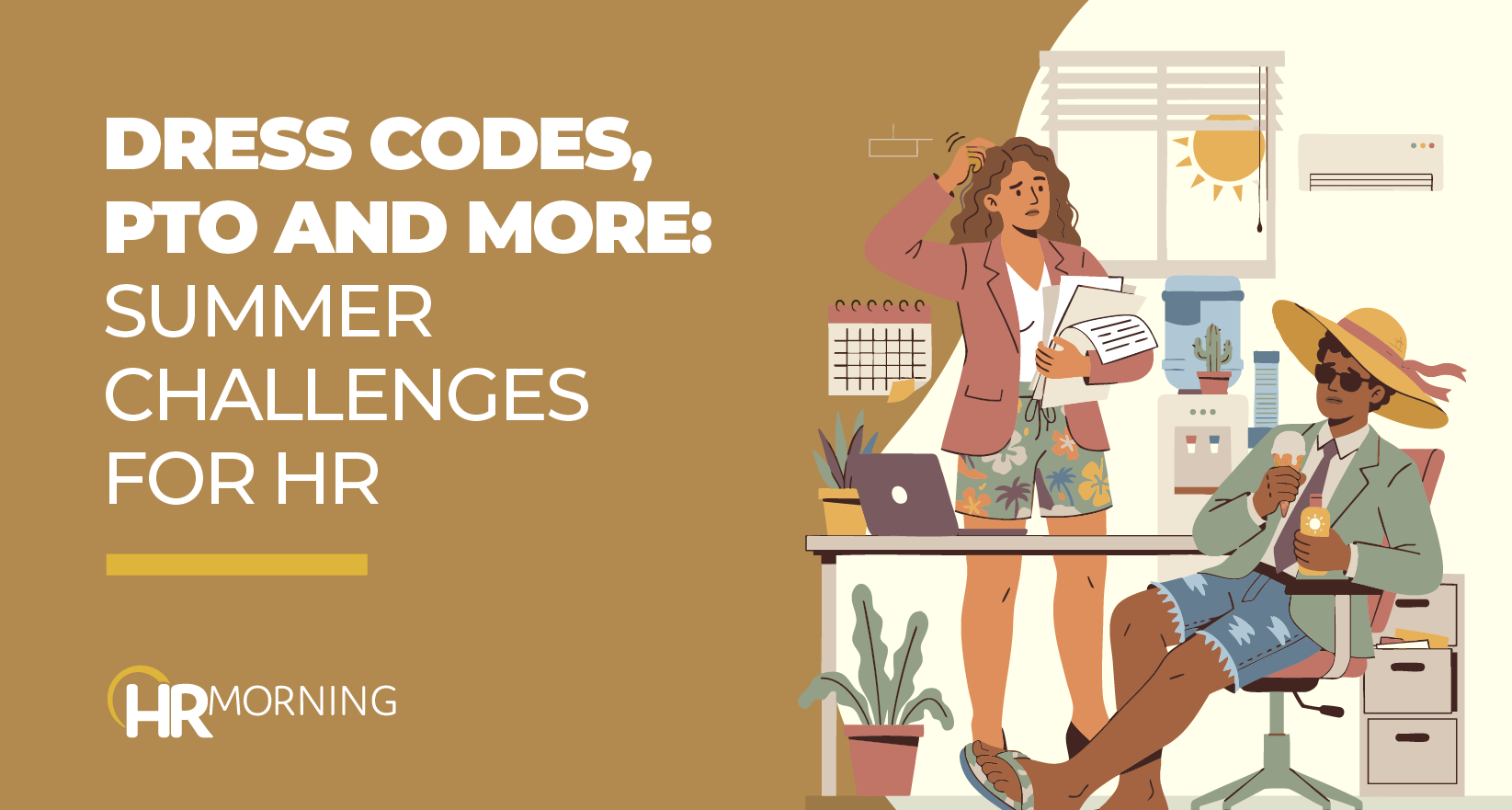
A Corporate Memphis style illustration for an HRMorning blog titled "Dress Codes, PTO and More: Summer Challenges for HR." The scene captures the tension between professional standards and summer relaxation. One professional looks stressed while holding documents and wearing a blazer with floral shorts, while another sits fully relaxed in a sun hat and flip-flops with an ice cream cone. This visually represents the common seasonal hurdles HR departments face regarding policy enforcement and productivity during vacation season.

For HR, summer isn’t all sunshine. In fact, it usually presents some challenges for HR pros.  

As the unofficial start of summer — Memorial Day — is here and gone, HR wants to balance flexibility and freedom to keep employees safe and operations smooth.  

To help, we address four issues HR pros face most years as the summer months approach and share practical ways to address each.   

1. Summer Dress Code 

The problem: Nearly 45% of offices have no official dress code, according to a Monster survey. Even those that do, many employees have no direction on what’s appropriate and what’s not during the summer months when temps get warm, and people naturally reach for tanks and flip-flops.  

Solution: “It’s a good idea for employers to create a summer dress code by Memorial Day weekend, if not sooner in warmer climates,” says Monster’s Career Expert Vicki Salemi. “In addition to defining what’s appropriate and what’s not, it’s important to communicate it to employees so it’s easily available to them, such as an email blast and indicating where it can be found for reference on the company’s HR portal.”

You can follow that up in meetings. And managers will want to set the standard.

Practical tip: Whatever type of summer dress code policy you implement, ensure that expectations are set for employees and penalties for not abiding by it are includled. Salemi says: “Appropriate attire can vary by industry, especially with safety top of mind, but overall, it should maintain a professional, respectful environment.”

For example, tech startups might be more casual than accounting firms. Then Salemi says be specific for employees:

  • “Here are some ideas: lightweight clothing (think linen and cotton), short-sleeve shirts or blouses (no logos, graphics, etc.), knee-length skirts and dresses, tailored shorts, and open-toed shoes (if it’s not a hazardous environment). 
  • Inappropriate clothing may include: flip flops, ripped clothing, extremely short clothing, athletic wear, safety-averse attire (like wearing open-toed shoes in a manufacturing plant).
  • Within the guidelines, there may be caveats such as more formal summer attire may be expected for client meetings, when leaders from other offices are in the office, etc.”

2. Work Schedules 

The problem: Most employees take advantage of the summer season to spend time outside or go on trips. Employees can get distracted and unproductive, planning or just thinking about that. Plus, employees who don’t have ample time to rest and recharge can be more prone to burnout, leading to disengagement and turnover. 

Solution: To keep employees engaged, many companies do “Summer Fridays” – where employees work half days or not at all on Fridays or every other Friday. This benefit can be especially desirable in the summer months to help employees plan time away to recharge and reset, overall promoting a healthier work-life balance. 

Practical tip: These types of perks aren’t one-size-fits-all, and not every type of flexible scheduling policy can work for every company. There are many ways to approach flexible scheduling. 

For example, some companies may have a policy that requires employees to work their full hours for the week, just with a more flexible schedule, while others may be able to offer employees a full Friday off with no strings attached.  

3. Managing PTO 

The problem: Many workers tend to save their vacation time for summer when kids are out of school and the weather is nicer in much of the country. These trips and vacations can often throw off workers’ schedules and create scheduling conflicts, particularly when many leave requests come in at one time.  

You want to balance well-deserved time off and smooth operations. Plus, you open the door to complaints of preferential treatment if you let one employee take time off and deny another employee’s request.  

The solution: The best way to handle these requests is to put clear language in your employee handbook that requires employees to give ample notice for any time off requests. That way, managers can plan to ensure that teams are still working efficiently. 

You might also want to hire some extra seasonal help or contract workers to allow employees to relax and recharge while keeping operations running smoothly. 

Practical tip: To avoid claims of preferential treatment – or even more severe claims such as retaliation – ensure that you have clear policies in place when it comes to handling time off requests fairly. This can include: 

  • Handling and documenting each PTO request on a first-come, first-served basis  
  • Tracking previous time off requests, or 
  • Allowing team members to trade shifts to allow for more flexibility. 

4. Health and Safety 

The problem: Sometimes the heat can not only be uncomfortable – it can be dangerous. Especially when it comes to warehouse workers or those who are doing manual labor outside, the summer heat can take a real toll on their bodies. 

With stricter dress codes where workers are required to wear specific uniforms or protective gear, the wrong clothing can put employees at risk for heat-related illnesses like heatstroke and heat stress. In fact, there were 36 work-related deaths due to environmental heat exposure in the most recent DOL data. 

The solution: It’s important to take all necessary precautions, even if workers don’t seem overheated or unwell. Heat can creep up quickly, and especially during the hot summer months, it’s always better to be overly cautious than risk injury.  

Although routine reminders to take breaks to cool down and drink water are helpful, HR can take some more actionable steps to keep workers healthy and safe during the summer, like: 

  • Creating designated cool-down spaces equipped with water and fans 
  • Keep coolers around the worksite stocked with water bottles or electrolyte drinks, and 
  • Ensure uniforms are made of lightweight, breathable material.  

Practical tip: If you have an especially at-risk workforce, or simply want to ensure employees are staying on top of their health, you may want to consider incentivizing employees to cool down and stay safe. 

You can encourage employees to stay hydrated by providing company-issued refillable water bottles or setting a company-wide goal for water bottle refills.  

Filed under
  • Leadership & Strategy
  • Share on

Get the HRMorning Newsletter

With HRMorning arriving in your inbox, you will never miss critical stories on labor laws, benefits, retention and onboarding strategies.

  • This field is for validation purposes and should be left unchanged.
  • This field is hidden when viewing the form
  • This field is hidden when viewing the form
  • This field is hidden when viewing the form
  • This field is hidden when viewing the form
  • This field is hidden when viewing the form
  • This field is hidden when viewing the form
  • This field is hidden when viewing the form
  • This field is hidden when viewing the form
  • This field is hidden when viewing the form
  • This field is hidden when viewing the form
  • This field is hidden when viewing the form
  • This field is hidden when viewing the form
  • This field is hidden when viewing the form
  • This field is hidden when viewing the form
  • This field is hidden when viewing the form
  • This field is hidden when viewing the form
  • This field is hidden when viewing the form
  • This field is hidden when viewing the form
  • This field is hidden when viewing the form
  • This field is hidden when viewing the form
  • This field is hidden when viewing the form
  • This field is hidden when viewing the form
  • This field is hidden when viewing the form
  • This field is hidden when viewing the form
  • This field is hidden when viewing the form
  • This field is hidden when viewing the form
  • This field is hidden when viewing the form
  • This field is hidden when viewing the form
  • This field is hidden when viewing the form
  • This field is hidden when viewing the form
  • This field is hidden when viewing the form
  • This field is hidden when viewing the form
  • This field is hidden when viewing the form
  • This field is hidden when viewing the form
  • This field is hidden when viewing the form
  • This field is hidden when viewing the form
  • This field is hidden when viewing the form
  • This field is hidden when viewing the form
  • This field is hidden when viewing the form
  • This field is hidden when viewing the form
  • This field is hidden when viewing the form
  • This field is hidden when viewing the form
  • This field is hidden when viewing the form
  • This field is hidden when viewing the form
  • This field is hidden when viewing the form
  • This field is hidden when viewing the form
  • This field is hidden when viewing the form
  • This field is hidden when viewing the form
  • This field is hidden when viewing the form
  • This field is hidden when viewing the form
  • This field is hidden when viewing the form
  • This field is hidden when viewing the form
  • This field is hidden when viewing the form
  • This field is hidden when viewing the form
  • This field is hidden when viewing the form
  • This field is hidden when viewing the form

Free Training & Resources

Webinars

What’s Changed in HR Compliance: Labor Laws, Pay Transparency & Best Practices

Provided by Asure Software

Webinars

Improve Your Hiring with Background Screenings – Intellicorp page

Webinars

Serena Williams and Paycom: A Conversation About Purpose, Success and Work Ethic

Provided by Paycom

Webinars

Trump’s Agenda & HR: Understanding Legislative Actions and Preparing for Impact

Provided by Mitratech

SPONSORED CONTENT

HR Technology

sponsored content
The Best AI Software for HR Automation

Courtesy of G-P

Talent Management

sponsored content
Powerful Employee Retention Strategies for 2025: How to Keep Your Best People

Courtesy of PEOPLEGURU

Benefits

Health Care

Wellness

sponsored content
Proven Results: 5 Ways Teladoc Health Chronic Condition Management Transforms HR Outcomes

Courtesy of TELADOC HEALTH

Further Reading

  • Leadership & Strategy
New Report: Top 5 States, Industries for Workplace Fatalities

The American Federation of Labor and Congress of Industrial Organizations (AFL-CIO) has released its 35th annual report on health and safet...

  • Leadership & Strategy
Emotional Intelligence at Work: How to Achieve It and Why It’s Important

In the midst of many uncertainties for workers – from recession fears to record-high burnout levels – utilizing emotional intelligence ...

  • Leadership & Strategy
How to disagree with your boss – and still have a good relationship

Your boss has a really good idea — at least she thinks so — and you hate it. Awkward, isn’t it? But how do you disagree wi...

  • Leadership & Strategy
Stop the Confusion: 4 Keys to Communicate with More Clarity

If you talk, and it seems like no one is listening, the problem could be you. While managers know they need to communicate with more cla...

  • Leadership & Strategy
6 Leadership Traits Managers Must Keep in Balance to Become the Best

Most leaders rise to the top because they excel at their work. But the most successful leaders stay at the top – and set the bar for othe...

  • Leadership & Strategy
Escaping the Trap of Toxic Productivity: Practical Advice

Productivity for the sake of productivity can be toxic in a workplace. It creates divides between team members, fosters a competitive workp...

Get the latest from HRMorning in your inbox PLUS immediately access 10 FREE HR guides.

I WANT MY FREE GUIDES
HR Morning Logo
  • Facebook
  • Linked In
  • ABOUT HRMORNING
  • ADVERTISE WITH US
  • WRITE FOR US
  • CONTACT
  • Employment Law
  • Benefits
  • Recruiting
  • Talent Management
  • Performance Management
  • HR Technology
  • Leadership & Strategy
  • Compensation
  • Policy & Procedures
  • Wellness
  • Staff Departure
  • HR Career & Self-Care
  • Health Care
  • Retirement Plans
  • DEI

HRMorning, part of the Rover Insights Network, provides the latest HR and employment law news for HR professionals in the trenches of small-to-medium-sized businesses. Rather than simply regurgitating the day's headlines, HRMorning delivers actionable insights, helping HR execs understand what HR trends mean to their business.

Powered By Rover Insights
Privacy Policy | Terms of Service
Copyright© 2026 Rover Insights
HRMorning Logo

WELCOME BACK!

Enter your username and password below to log in

Forget Your Username or Password?

Reset Password

Lost your password? Please enter your username or email address. You will receive a link to create a new password via email.

Log In

Why do we need your credit card for a free trial?

We ask for your credit card to allow your subscription to continue should you decide to keep your membership beyond the free trial period.  This prevents any interruption of content access.

Your card will not be charged at any point during your 21 day free trial
and you may cancel at any time during your free trial.

During your free trial, you can cancel at any time with a single click on your “Account” page.  It’s that easy.