• Skip to primary navigation
  • Skip to main content

HRMorning

  • FREE RESOURCES
  • PREMIUM CONTENT
  • HR DEEP DIVES
  • PODCASTS
    • VOICES OF HR
    • WOMEN’S LEADERSHIP TODAY
  • LOGIN
  • SIGN UP FREE
  • Employment Law
  • Benefits
  • Recruiting
  • HR Technology
  • Payroll
  • Management
  • Women’s Leadership
  • More
    • Talent Management
    • Performance Management
    • Leadership & Strategy
    • Compensation
    • Policy & Procedures
    • Wellness
    • Staff Departure
    • HR Career & Self-Care
    • Health Care
    • Retirement Plans
RM Logo
  • Leadership & Strategy

Stop These 6 Communication Habits That Drive Co-Workers Crazy

Michele McGovern
By: Michele McGovern
  • Share on

About the Author

Michele McGovern writes. A lot. These days, she covers HR, digging deep into company culture, DEI, leadership, management and the everchanging world of work. In the years between getting a BA in journalism from a state school and writing about HR, she wrote about big-city crime for a wire service and small-town life for local newspapers. She’s a mediocre mom, decent wife, wannabe athlete and consummate pursuer of fun - on land, snow and water. Find her on LinkedIn @michele-mcgovern-writer.

Show Less
Last Updated: April 28, 2026
4 minute engagement

Does your boss send rambling email messages? Do employees’ memes make you want to scream? Do you drive co-workers crazy with texts?

Yes, yes and – as much as you’d like to think you’re innocent of communication gaffes – the answer is, yes. We’re all guilty of communication habits that drive co-workers, employees and the boss crazy.

And as we see less of each other in actual workplaces, it’s only become worse. We text, Slack, ping, email and DM more than we actually talk to people.

What’s Acceptable and Doesn’t Drive Co-workers Crazy?

“The scope of what’s considered acceptable at work has changed,” says Tessa West, a professor of psychology at New York University and author of Job Therapy: Finding Work that Works for You.

While almost all employees agree that electronic communication is essential and preferred for the workplace, nearly 90% agree email specifically has led to miscommunication issues, according to a report from Preply.

Beyond miscommunication – or perhaps contributing to it – here are six communication habits that drive co-workers crazy, plus ways to eliminate them.

1. Annoying Email Wordage

We’ll start with those emails that often lead to miscommunication.

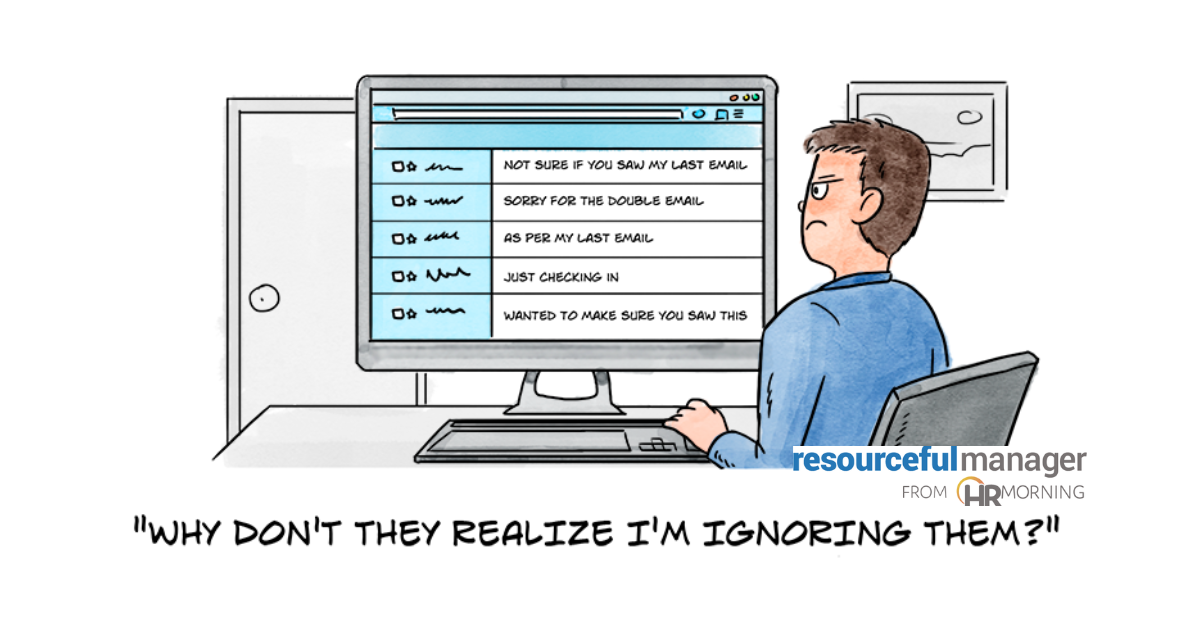
If you open any of your email messages with these phrases, you drive employees and colleagues batty:

  • Not sure if you saw my last email
  • Sorry for the double email, or
  • As per my last email.

You know why? Because what you’re really saying is, “I know you saw my other emails and I want you to respond now. I don’t care what else you have going on!”

Alternative: If you really need an immediate response, talk to the person. If it can wait, then you wait.

2. The Wrong Signal

When it comes to instant messaging, nearly 90% of employees use Slack, Microsoft Teams or Google Chat. But something in this channel annoys colleagues: dishonesty about where you are.

They dislike it when co-workers set themselves as online and available when they aren’t working. And, almost equally, they dislike when colleagues set themselves as offline and unavailable when they are able to communicate.

Both cases make it seem like you want to avoid communicating with colleagues.

Alternative: Send the right signal. If you’re online but don’t have time to interact, put that in your status. If you’re out, fess up.

3. An Unexpected Video Call

While we’re on the messaging subject, let’s jump to video calls. See how I warned you we’d go to a call? In the workplace, it’s a courtesy that’s expected.

So employees hate it when colleagues start a video call without giving some kind of notice.

It could be vanity – no one wants to be caught on camera looking their worst. But it could legitimately be professionalism. People prefer to be prepared for business (unlike a couple of the attendees in this Saturday Night Live skit).

Alternative: Message, text or email your intentions for a video call – and wait for a response – before you initiate one.

4. Weird Images

GIFs can be fun with friends. But most employees call them unprofessional and a waste of time (to read or bother sending) in work communication. Still, 80% of employees think emojis are helpful to decipher emotions in written communication, a LiveCareer survey found.

Alternative: It seems OK to send an appropriate emoji – one that truly reflects what you’re feeling. But, stop short of sending memes and GIFs that aren’t related to work just for the sake of getting a rise or laugh out of colleagues.

5. Email After Hours

There’s a lot to love about email. In fact, 49% of employees say it’s their preferred form of workplace communication.

But they don’t want to hear from you via email when they’re not working. About 30% of employees think it’s a bother to receive work email at odd hours. And nearly the same percentage don’t like non-work-related messages coming in from colleagues.

Alternative: Send emails to employees only during work hours. If you draft a message after hours, put a snooze on it so it’s released when the next workday starts.

6. Too Many Words

Whether it’s email, chat or text, too much is too much! Written communication is convenient and allows us to work asynchronously, but it’s not always the most efficient or reader-friendly way to handle business.

Employees in the survey said rambling messages and long paragraphs in electronic communication are annoying and ineffective. People tend to scan that kind of information, rather than soak in what they need to know, respond to or act on.

Alternative: If it’s a long message, follow the style we usually use here on HRMorning: short paragraphs, bullet points and several subheads to break up copy. If the message is complex, sensitive or information-heavy, try a conversation to get the communication started.

Filed under
RM Logo
  • Leadership & Strategy
  • Share on

Get the HRMorning Newsletter

With HRMorning arriving in your inbox, you will never miss critical stories on labor laws, benefits, retention and onboarding strategies.

  • This field is for validation purposes and should be left unchanged.
  • This field is hidden when viewing the form
  • This field is hidden when viewing the form
  • This field is hidden when viewing the form
  • This field is hidden when viewing the form
  • This field is hidden when viewing the form
  • This field is hidden when viewing the form
  • This field is hidden when viewing the form
  • This field is hidden when viewing the form
  • This field is hidden when viewing the form
  • This field is hidden when viewing the form
  • This field is hidden when viewing the form
  • This field is hidden when viewing the form
  • This field is hidden when viewing the form
  • This field is hidden when viewing the form
  • This field is hidden when viewing the form
  • This field is hidden when viewing the form
  • This field is hidden when viewing the form
  • This field is hidden when viewing the form
  • This field is hidden when viewing the form
  • This field is hidden when viewing the form
  • This field is hidden when viewing the form
  • This field is hidden when viewing the form
  • This field is hidden when viewing the form
  • This field is hidden when viewing the form
  • This field is hidden when viewing the form
  • This field is hidden when viewing the form
  • This field is hidden when viewing the form
  • This field is hidden when viewing the form
  • This field is hidden when viewing the form
  • This field is hidden when viewing the form
  • This field is hidden when viewing the form
  • This field is hidden when viewing the form
  • This field is hidden when viewing the form
  • This field is hidden when viewing the form
  • This field is hidden when viewing the form
  • This field is hidden when viewing the form
  • This field is hidden when viewing the form
  • This field is hidden when viewing the form
  • This field is hidden when viewing the form
  • This field is hidden when viewing the form
  • This field is hidden when viewing the form
  • This field is hidden when viewing the form
  • This field is hidden when viewing the form
  • This field is hidden when viewing the form
  • This field is hidden when viewing the form
  • This field is hidden when viewing the form
  • This field is hidden when viewing the form
  • This field is hidden when viewing the form
  • This field is hidden when viewing the form
  • This field is hidden when viewing the form
  • This field is hidden when viewing the form
  • This field is hidden when viewing the form
  • This field is hidden when viewing the form
  • This field is hidden when viewing the form
  • This field is hidden when viewing the form
  • This field is hidden when viewing the form

Free Training & Resources

White Papers

How Employee Spending is Changing the Benefits Landscape

White Papers

Participation Is Not Engagement

Provided by Terryberry

White Papers

Building an Incident Management Program? Start With These Four Fundamentals

Provided by Navex

White Papers

Making the Case: Proving ROI of Employee Recognition Programs

Provided by Inspirus

SPONSORED CONTENT

Benefits

Staff Administration

sponsored content
PEO ROI: 3 Numbers to Know Before You Leave Patchwork HR

Courtesy of TRINET

Talent Management

sponsored content
Employee Retention Strategies: 5 That Work When You Can’t Pay More

Courtesy of INSPIRUS

Employment Law

Policy & Procedures

sponsored content
Speak-Up Culture: 3 Signs Your Hotline Volume Is a Warning

Courtesy of NAVEX

Further Reading

  • Leadership & Strategy
How Influence Beats Authority in the Workplace — and 3 Ways to Make it Work Best

As HR leaders, you are responsible for shaping the policies and practices that become the culture of your company. You set the tone for how...

  • Leadership & Strategy
  • Staff Administration
Workplace mental health: What to do when HR’s discouraged from talking about it

More than half of employers (55%) are having some kind of conversation about workplace mental health, according to a survey of workers and ...

  • Leadership & Strategy
CEO: Start benchmarking your company’s eNPS (Employee Net Promoter Score) now

Because employee engagement is top of mind for your fellow HR pros these days, you’ve probably heard about eNPS. It measures how s...

  • Leadership & Strategy
3 Ways to Foster Connection, Reduce Loneliness in Hybrid or Remote Work Now

As mental health was brought to the forefront during the pandemic, loneliness emerged more – and organizations still want to take ste...

  • Leadership & Strategy
Workplace Culture: History, Modern Dynamics & 5 Critical Elements

Workplace culture has evolved from being a mere backdrop to a crucial driver of organizational success. In the past, company culture was fr...

  • Leadership & Strategy
  • Payroll
Pay Raise Outlook 2027: Modest 3.5% Average Increase Planned

As employers map out 2027 pay increases, modest budget numbers mask the tougher challenges ahead: deciding who gets what money, and then co...

Get the latest from HRMorning in your inbox PLUS immediately access 10 FREE HR guides.

I WANT MY FREE GUIDES
HR Morning Logo
  • Facebook
  • Linked In
  • ABOUT HRMORNING
  • ADVERTISE WITH US
  • WRITE FOR US
  • CONTACT
  • Employment Law
  • Benefits
  • Recruiting
  • Talent Management
  • Performance Management
  • HR Technology
  • Leadership & Strategy
  • Compensation
  • Policy & Procedures
  • Wellness
  • Staff Departure
  • HR Career & Self-Care
  • Health Care
  • Retirement Plans
  • DEI

HRMorning, part of the Rover Insights Network, provides the latest HR and employment law news for HR professionals in the trenches of small-to-medium-sized businesses. Rather than simply regurgitating the day's headlines, HRMorning delivers actionable insights, helping HR execs understand what HR trends mean to their business.

Powered By Rover Insights
Privacy Policy | Terms of Service
Copyright© 2026 Rover Insights
HRMorning Logo

WELCOME BACK!

Enter your username and password below to log in

Forget Your Username or Password?

Reset Password

Lost your password? Please enter your username or email address. You will receive a link to create a new password via email.

Log In

Why do we need your credit card for a free trial?

We ask for your credit card to allow your subscription to continue should you decide to keep your membership beyond the free trial period.  This prevents any interruption of content access.

Your card will not be charged at any point during your 21 day free trial
and you may cancel at any time during your free trial.

During your free trial, you can cancel at any time with a single click on your “Account” page.  It’s that easy.
