Do People Hate What You’re Writing? If You Have These 2 Bad Habits, They Do

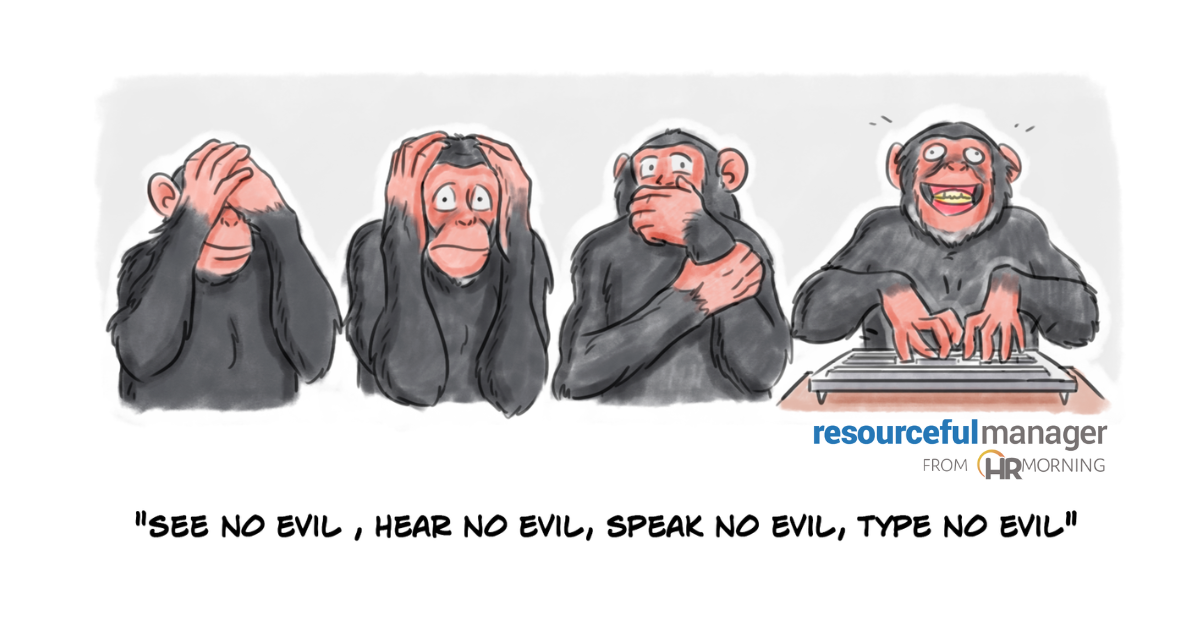
Even good leaders can have bad writing habits.
It’s mostly because they don’t think they’re committing them. Or they’re hiding behind the keyboard, trying to avoid committing those faux pas verbally.
“Some words set us up to be misunderstood,” says Jo Anne Preston, author of Lead the Way in Five Minutes a Day: Sparking High Performance in Yourself and Your Team. “Others shut people down, make them feel excluded, and even make them dislike us.”
Be Better Than Bad Writing
But good leaders can be better than any bad writing habits.
“The idea is to think intentionally about whether our words work for or against our employees’ needs, says Preston. “A small shift in your … habits can make a big difference.”
The first step in making that shift: Know what makes for bad writing — in email, chat, social platforms, etc.
Here are the two major issues, why they’re problems and what to do instead:
1. Passive-Aggressive Language
We usually think of passive-aggressive behavior — indirectly expressing negative feelings instead of openly addressing them — in verbal and physical ways.
For instance, a manager says, “I guess if that’s what you want to do, go ahead.” But the manager’s tone and eye-rolling suggest she really wants the employee to handle the situation differently.
“Assumptions, fear of failure, conflict-aversion and poor anger management are just some of the reasons people wage their personal vendettas via email,” says Susan Room, a professional voice and executive coach.
In writing, the words and their meaning come out differently.
In fact, a survey by Preply found these 10 of the most passive-aggressive written phrases used in the workplace:
- Per my last email
- Correct me if I’m wrong
- As previously mentioned
- Just a gentle reminder
- Going forward
- Thought I’d bring this to your attention
- I might be mistaken, but
- Thanks in advance
- Just to clarify
- Please advise
Why it’s an issue: Most come off as a nudge, slight or veiled insult. They’re directives given without emotion or, in some cases, context. So recipients feel the aggressive push behind the soft, stilted language.
Better: Have a real conversation.
“Talk with — not at or to — your colleague, using a warm, direct tone of voice,” says Room. “Offer specific examples of what they say and how it impacts you, remembering this is your opinion; others may disagree. Ask if they see your point of view.”
For instance, instead of an email that says, “Going forward, you’ll need to get my approval on …” schedule a meeting to talk. Say, “When you do X, it affects how we do Y and the result is Z, which is not ideal. Can we work together on a better way to handle this going forward?”
“When speaking, you can flex your voice to communicate in the clearest, most helpful way,” says Room. “However carefully crafted, your written words may not be received the way you intended.”
2. Frustrating Words and Phrases
Beyond the passive-aggressive messages are messages tainted with words and phrases that tend to frustrate the recipients.
Here are four words and phrases that put off people most in the workplace:
- Subordinate
- LDI, ROI, HRSA, HIT (or any acronym)
- I/me, and
- The girls. You guys (and similar groupings)
Why it’s an issue: The more people see words that frustrate, belittle or just annoy them, the more they’ll tune out the message and its sender.
Better: “When managing a variety of people, it can be difficult to consider your every word,” says Preston. “But being intentional about prioritizing openness and understanding can make you a well-respected leader.”
For the words we listed above, here are some alternatives:
- Subordinate. Avoid the chasm it creates between the boss and employees with words that create unity, such as “team” and “employees.”
- LDI, ROI, HRSA, HIT (or any acronym). Spell it out on the first mention, and follow that with its acronym in parentheses. Use the acronym in the message after that.
- I/me. Too many mentions of what you think, expect or do put off readers. Instead, use “we” and “us” more.
- The girls. You guys. They’re not inclusive. Instead, write (and say) “team,” “everyone,” “folks” or “y’all.”

- Share on


Free Training & Resources
White Papers
Provided by AbsenceSoft
White Papers
Provided by Inspirus
White Papers
Provided by Maven Clinic
White Papers
Provided by Maven Clinic



