How to Fix the Worst Problem with Turnover | 2-Minute Video

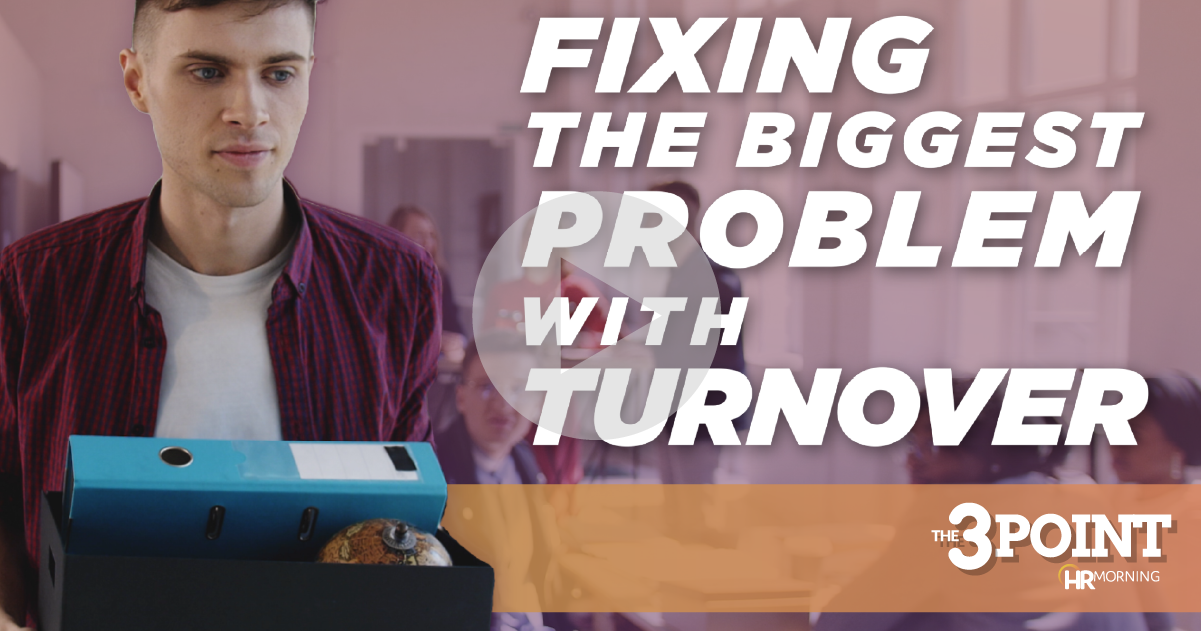
We aren’t going to paint any pretty pictures in this episode of the 3-Point: Turnover sucks.
And it’s not getting any better. Companies are laying off employees. And employees are holding on tight.
What’s Up in This Episode: Solving Turnover Issues
In this episode of HRMorning’s 3-Point, our expert, Dr. Mary Hayes, Director of Research, ADP’s Research for People and Performance, explains the biggest problem with turnover. Spoiler alert: It’s what walks out the door! And we share ideas on how to overcome that issue.
Click, watch and listen for more details on avoiding the biggest problem with turnover.
Transcript (edited for clarity):
Turnover sucks. We’ve covered that before. And you’re reminded every time an employee walks out the door.
But did you know how often turnover happens? The experts at ADP know, and they also found what’s possibly the worst thing about employees leaving.
Dr. Mary Hayes, Director of Research, ADP’s Research for People and Performance: “We looked across the payroll data and we discovered that 75% of workers leave their jobs within the first three years without receiving a promotion. And, of those who stay, only 1% receive a promotion by the end of the third year.”
So employees aren’t sticking around to stay in the position they’re in. And that might not seem like a problem … after all, not everyone can be the boss. But here’s the biggest problem with that kind of turnover.
Hayes: “It’s institutional knowledge. And when people walk out the door, that goes with them. And the person who comes in to replace them doesn’t know why we did something this way or not. And that’s the greatest downfall to leaving an organization after two or three years is the history, the knowledge is gone and can’t be replaced.”
Now, normally at HRMorning and on the 3-Point, we focus on the positive ways to prevent the bad things like institutional knowledge walking out your door.
But this time, our solutions are about what you can do to capture the knowledge. We’re doing that because turnover is inevitable. So to avoid the knowledge drain, you want to:
- Spread the knowledge. Ever hear the folklore about Coca-Cola? Supposedly, no single person knows the whole recipe. Two people know separate parts of the formula. Point here is, ensure knowledge is spread, never hoarded.
- Create a pipeline of new leaders. They don’t have to lead immediately, but they can learn what their leaders know.
- Document. Create Standard Operational Procedures (SOPs). At least annually, get employees to update specifics on what they do and how they get it done.
The reality is you’re going to lose someone who knows a lot. But you don’t have to lose the institutional knowledge.
- Share on


Free Training & Resources
Webinars
Provided by Paycom
White Papers
Provided by Marsh