• Skip to primary navigation
  • Skip to main content

HRMorning

  • FREE RESOURCES
  • PREMIUM CONTENT
  • HR DEEP DIVES
  • PODCASTS
    • VOICES OF HR
    • WOMEN’S LEADERSHIP TODAY
  • LOGIN
  • SIGN UP FREE
  • Employment Law
  • Benefits
  • Recruiting
  • HR Technology
  • Payroll
  • Management
  • Women’s Leadership
  • More
    • Talent Management
    • Performance Management
    • Leadership & Strategy
    • Compensation
    • Policy & Procedures
    • Wellness
    • Staff Departure
    • HR Career & Self-Care
    • Health Care
    • Retirement Plans
RM Logo
  • Leadership & Strategy

11 Management Lessons from The Office (No. 3 Might Bring You to Tears)

Michele McGovern
By: Michele McGovern
  • Share on

About the Author

Michele McGovern writes. A lot. These days, she covers HR, digging deep into company culture, DEI, leadership, management and the everchanging world of work. In the years between getting a BA in journalism from a state school and writing about HR, she wrote about big-city crime for a wire service and small-town life for local newspapers. She’s a mediocre mom, decent wife, wannabe athlete and consummate pursuer of fun - on land, snow and water. Find her on LinkedIn @michele-mcgovern-writer.

Show Less
Last Updated: November 7, 2025
6 minute engagement
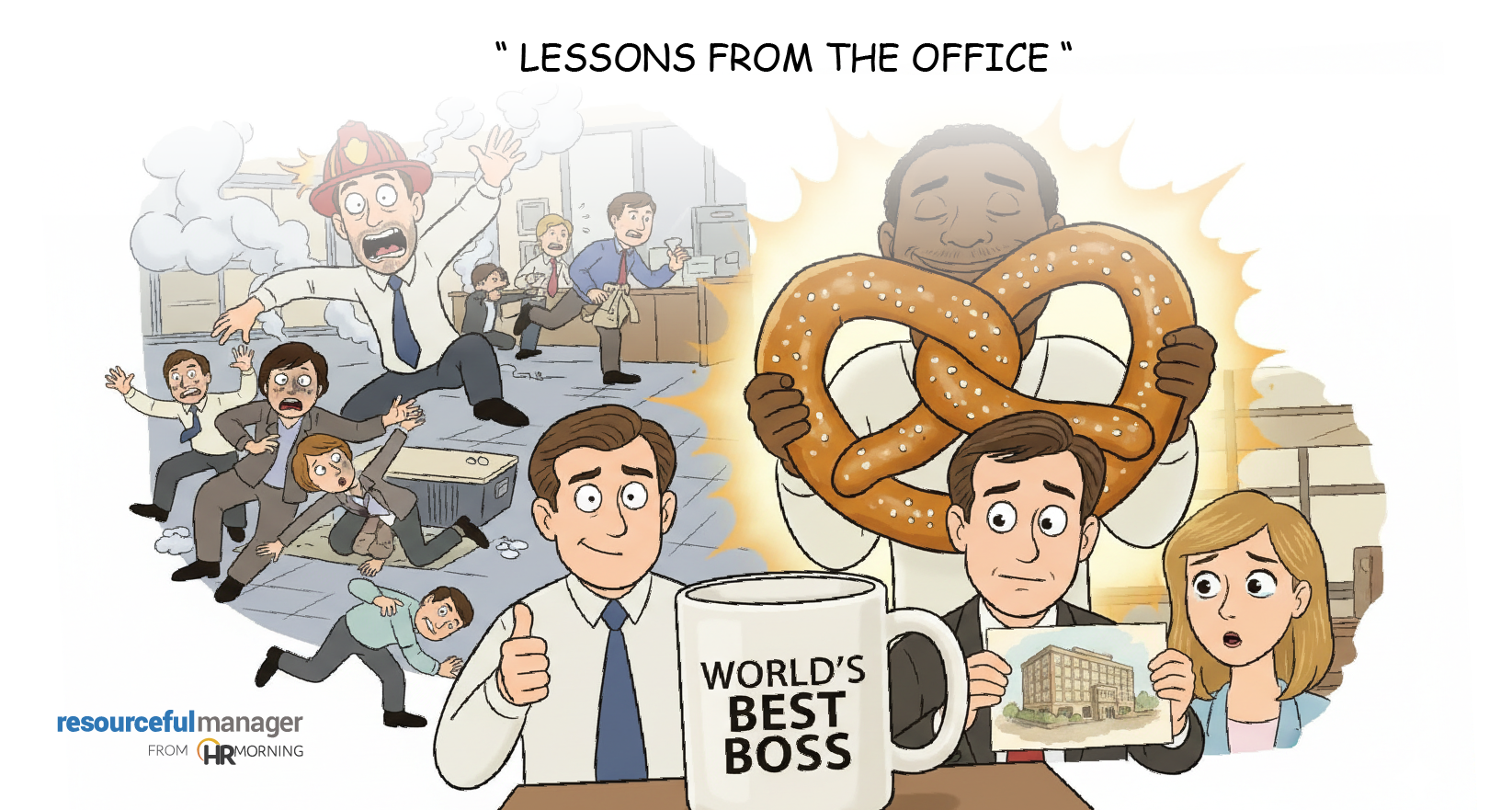
Lessons from the office

Sometimes the best management lessons come from the seemingly worst bosses.

While Michael Scott – the branch manager and self-proclaimed World’s Best Boss from The Office – seemed to be the furthest thing from the best, more often than not, he did the right thing in the end.

Spinoff Sparks Review of Management Lessons

And with the launch of The Office’s spinoff, The Paper, there’s no time like the present to look at Scott’s approach to handling employees. They ran the extremes – from tyrannical to compassionate, overbearing to disinterested, arrogant to humble. And it left many employees rolling their eyes.

But behind the shenanigans and dry humor are teaching moments that are still relevant today, 10 years after the iconic show ended. Perhaps they’re even more so now as a new generation in the workforce has fallen for the show in syndication.

Here are management lessons from The Office and its cast of characters.

No. 1: Be a Boss of the People

Why the moment matters: It’s important to recognize what keeps your employees engaged, motivated and cohesive. Even better, act on what you know about their engagement, motivation and team dynamics.

Significant line: “We’re here for the show, Michael.”

Office Tip: You don’t have to take a sucker punch for your team. But meet regularly one-on-one to find out what motivates, engages and concerns employees – and follow up with more of what they like.

No. 2: Involve Employees in Change

Why the moment matters: New managers take heart: Even when change seems practical, it can interfere with culture and morale. If it matters to employees, rethink some changes.

Significant line: “He doesn’t care. The power went to his head.”

Office Tip: Try to involve employees in change management – from being involved in the decisions to change to implementing the changes deemed necessary.

No. 3: Show Pride in the People, the Work

Why the moment matters: As a leader – and especially front-liners – you get so caught up in the minutiae of managing people, tasks, policies and procedures that it’s difficult to focus on the meaning behind it all.

Significant line: “And we sell paper.”

Be an Office leader: Take time – schedule it, if you must – to talk about what your organization does and why your employees are critical to it – and why they’re both important to you.

No. 4: Be Predictable

Why the moment matters: Employees feel stable when their boss doesn’t run the gamut on emotions and reactions. When they know what to expect – at least most of the time – they’ll be comfortable coming to you for advice and direction.

Significant line: “Michael’s birthday. It’s pretty fun to watch, actually. He gets very excited. He eats a lot of cake. Then he runs around the office. Then he gets a sugar crash in the afternoon. And then he falls asleep. And that’s when we get our work done.”

Office Tip: You might not want to be predictable in the Michael-Scott-birthday way. But make an effort to keep your tone, mood and approach to pressure predictable and assuring.

No. 5: Evaluate Your Calendar

Why the moment matters: Leaders pick up duties they weren’t intending to – perhaps to fill a hole when an employee or colleague left or a new task came up to be tested. Problem is, they keep doing unnecessary things because they didn’t assess why it was being done.

Significant line: “Why have I been separating the trash into whites and colors?”

Office Tip: At least twice a year, assess how your time is spent. Eliminate duties that are redundant, outdated or can be covered by someone else.

No. 6: Take a Pulse Check

Why the moment matters: Some managers think everything is OK because employees don’t outright complain. Or they might plan pizza parties and doughnut Mondays, thinking that will boost motivation. Meanwhile, their employees aren’t happy or motivated.

Significant line: “You guys got it soft and cushy. This place is freaking awesome. The people are awesome. Your boss is nice. Everybody seems to get along. People are tolerant.”

Office Tip: Take regular pulse checks to find out if employees A) are happy at work, B) get the most out of the employee experience, C) are challenged by their work, and D) get along with colleagues. You can use surveys or one-on-one conversations.

No. 7: Manage Conflict

Why the moment matters: Managers initiate, witness and are the target of conflict. You have to deal with it quite a bit. In this clip, Michael Scott does it all – initiates, witnesses, targets and eventually manages it.

Significant line: “You know what I want you to do? Shake hands. Get over it.”

Office Tip: Conflict will always bubble up in the workplace. There’s no cookie-cutter way to handle it all, but here are some of our best tips to manage it well.

No. 8: Never Be the Smartest Person in the Room

Why the moment matters: Managers can – and should – always learn. The more research, perspective and respected opinions you have, the more likely you’ll make good decisions.

Significant line: “He’s not smarter than me. He was just right about one thing.”

Office Tip: Michael Dell has been quoted as saying, “Try to never be the smartest person in the room. And, if you are, I suggest you invite smarter people or find a different room.” The point isn’t to actually find smarter people. The point is to ask for different perspectives when making decisions that affect others and operations.

No. 9: Maintain Bridges

Why the moment matters: Employees will come and go. You’ll leave teams and manage others. You and your employees’ careers will transition, but that doesn’t mean you need to sever ties.

Significant line: “I just really wish there was something I could do.”

Office Tip: Maintain the bridges you’ve built with employees, colleagues and organizations. Rebuilding a burned bridge will always be more difficult. You can use social media – especially LinkedIn – to stay in touch and abreast of happenings.

No. 10: Admit Mistakes

Why the moment matters: One of the worst mistakes a manager can make is not admitting to making mistakes. Employees need to see you’re human – and can learn from mistakes.

Significant line: “It takes a big man to admit his mistakes. And I am that big man.”

Office Tip: Beyond owning up to mistakes, ask employees what they think you can do to remedy the situation. Asking for suggestions – and using them – will further prove you value their insight.

No. 11: Leave a Legacy

Why the moment matters: You won’t always say or do the right thing. You’ll actually say and do stupid things (isn’t that what Michael Scott is better known for?) But if your heart is in it, you’ll likely lead like a legend.

Significant line: “Oh my God, something’s happening.”

Office Tip: Focus less on failures and more on triumphs – even the small ones. When you, as a leader, keep that in perspective, employees will, too.


Filed under
RM Logo
  • Leadership & Strategy
  • Share on

Get the HRMorning Newsletter

With HRMorning arriving in your inbox, you will never miss critical stories on labor laws, benefits, retention and onboarding strategies.

  • This field is for validation purposes and should be left unchanged.
  • This field is hidden when viewing the form
  • This field is hidden when viewing the form
  • This field is hidden when viewing the form
  • This field is hidden when viewing the form
  • This field is hidden when viewing the form
  • This field is hidden when viewing the form
  • This field is hidden when viewing the form
  • This field is hidden when viewing the form
  • This field is hidden when viewing the form
  • This field is hidden when viewing the form
  • This field is hidden when viewing the form
  • This field is hidden when viewing the form
  • This field is hidden when viewing the form
  • This field is hidden when viewing the form
  • This field is hidden when viewing the form
  • This field is hidden when viewing the form
  • This field is hidden when viewing the form
  • This field is hidden when viewing the form
  • This field is hidden when viewing the form
  • This field is hidden when viewing the form
  • This field is hidden when viewing the form
  • This field is hidden when viewing the form
  • This field is hidden when viewing the form
  • This field is hidden when viewing the form
  • This field is hidden when viewing the form
  • This field is hidden when viewing the form
  • This field is hidden when viewing the form
  • This field is hidden when viewing the form
  • This field is hidden when viewing the form
  • This field is hidden when viewing the form
  • This field is hidden when viewing the form
  • This field is hidden when viewing the form
  • This field is hidden when viewing the form
  • This field is hidden when viewing the form
  • This field is hidden when viewing the form
  • This field is hidden when viewing the form
  • This field is hidden when viewing the form
  • This field is hidden when viewing the form
  • This field is hidden when viewing the form
  • This field is hidden when viewing the form
  • This field is hidden when viewing the form
  • This field is hidden when viewing the form
  • This field is hidden when viewing the form
  • This field is hidden when viewing the form
  • This field is hidden when viewing the form
  • This field is hidden when viewing the form
  • This field is hidden when viewing the form
  • This field is hidden when viewing the form
  • This field is hidden when viewing the form
  • This field is hidden when viewing the form
  • This field is hidden when viewing the form
  • This field is hidden when viewing the form
  • This field is hidden when viewing the form
  • This field is hidden when viewing the form
  • This field is hidden when viewing the form
  • This field is hidden when viewing the form

Free Training & Resources

Webinars

Give Your Employees Meaningful Benefits – TalentCulture

Webinars

Improve Your Candidate Experience and Win Over Top Talent

Webinars

Unconscious Bias in Recruitment

White Papers

Reducing Employee Inpatient Readmissions with Coordinated Care Management:

Provided by Conifer Health

SPONSORED CONTENT

HR Technology

sponsored content
The Best AI Software for HR Automation

Courtesy of G-P

Talent Management

sponsored content
Powerful Employee Retention Strategies for 2025: How to Keep Your Best People

Courtesy of PEOPLEGURU

Benefits

Health Care

Wellness

sponsored content
Proven Results: 5 Ways Teladoc Health Chronic Condition Management Transforms HR Outcomes

Courtesy of TELADOC HEALTH

Further Reading

  • Leadership & Strategy
How leaders can learn to be empathetic: An ideal in today’s workplace

Whether some leaders like it or not, their employees want them to be more empathetic. A recent survey of employees by Ernst & Young fou...

  • Leadership & Strategy
Do People Hate What You’re Writing? If You Have These 2 Bad Habits, They Do

Even good leaders can have bad writing habits. It’s mostly because they don’t think they’re committing them. Or they&#...

  • Leadership & Strategy
Employee Relationships: They’re More Valuable Than You Ever Imagined

What really keeps good employees happy at work? Money? The right compensation might keep them on the payroll, but it won’t actuall...

  • Leadership & Strategy
3 reasons good managers make bad decisions – and how to avoid them

Even intelligent, well-informed managers sometimes make bad decisions. Armed with the best information and intentions, we still get trip...

  • Leadership & Strategy
5 Huge Mistakes When Delivering Bad News

Perhaps the one thing in the universe that travels faster than light … is bad news. And the only thing worse than hearing bad news...

  • Leadership & Strategy
Sick of Whining Employees? 6 Better Ways to Handle Their Gripes

When you’re a manager, it can be difficult to escape the whining these days. From the moment you walk in the door or turn on your...

Get the latest from HRMorning in your inbox PLUS immediately access 10 FREE HR guides.

I WANT MY FREE GUIDES
HR Morning Logo
  • Facebook
  • Linked In
  • ABOUT HRMORNING
  • ADVERTISE WITH US
  • WRITE FOR US
  • CONTACT
  • Employment Law
  • Benefits
  • Recruiting
  • Talent Management
  • Performance Management
  • HR Technology
  • Leadership & Strategy
  • Compensation
  • Policy & Procedures
  • Wellness
  • Staff Departure
  • HR Career & Self-Care
  • Health Care
  • Retirement Plans
  • DEI

HRMorning, part of the Rover Insights Network, provides the latest HR and employment law news for HR professionals in the trenches of small-to-medium-sized businesses. Rather than simply regurgitating the day's headlines, HRMorning delivers actionable insights, helping HR execs understand what HR trends mean to their business.

Powered By Rover Insights
Privacy Policy | Terms of Service
Copyright© 2026 Rover Insights
HRMorning Logo

WELCOME BACK!

Enter your username and password below to log in

Forget Your Username or Password?

Reset Password

Lost your password? Please enter your username or email address. You will receive a link to create a new password via email.

Log In

Why do we need your credit card for a free trial?

We ask for your credit card to allow your subscription to continue should you decide to keep your membership beyond the free trial period.  This prevents any interruption of content access.

Your card will not be charged at any point during your 21 day free trial
and you may cancel at any time during your free trial.

During your free trial, you can cancel at any time with a single click on your “Account” page.  It’s that easy.
