• Skip to primary navigation
  • Skip to main content

HRMorning

  • FREE RESOURCES
  • PREMIUM CONTENT
  • HR DEEP DIVES
  • PODCASTS
    • VOICES OF HR
    • WOMEN’S LEADERSHIP TODAY
  • LOGIN
  • SIGN UP FREE
  • Employment Law
  • Benefits
  • Recruiting
  • HR Technology
  • Payroll
  • Management
  • Women’s Leadership
  • More
    • Talent Management
    • Performance Management
    • Leadership & Strategy
    • Compensation
    • Policy & Procedures
    • Wellness
    • Staff Departure
    • HR Career & Self-Care
    • Health Care
    • Retirement Plans
RM Logo
  • Leadership & Strategy

Stop the Confusion: 4 Keys to Communicate with More Clarity

Michele McGovern
By: Michele McGovern
  • Share on

About the Author

Michele McGovern writes. A lot. These days, she covers HR, digging deep into company culture, DEI, leadership, management and the everchanging world of work. In the years between getting a BA in journalism from a state school and writing about HR, she wrote about big-city crime for a wire service and small-town life for local newspapers. She’s a mediocre mom, decent wife, wannabe athlete and consummate pursuer of fun - on land, snow and water. Find her on LinkedIn @michele-mcgovern-writer.

Show Less
Last Updated: April 7, 2026
3 minute engagement

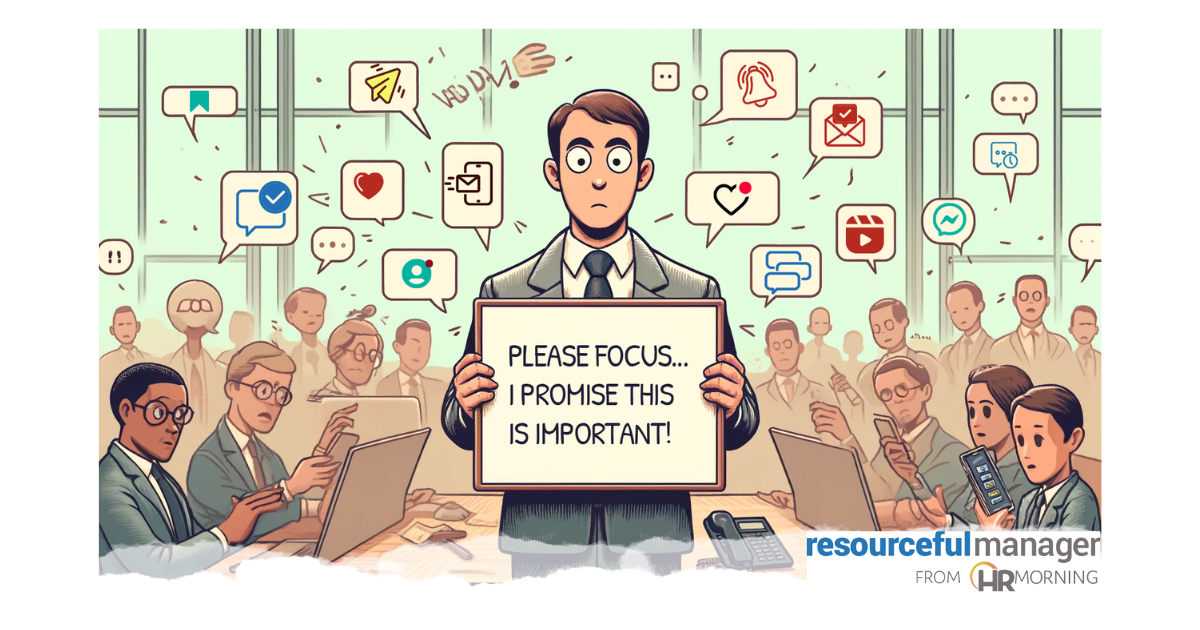
If you talk, and it seems like no one is listening, the problem could be you.

While managers know they need to communicate with more clarity, they often overwhelm others with information — and underwhelm them with the actual message.

Time to Communicate with More Clarity

How often does poor communication get in the way at work? Often enough.

Nearly a third of employees say their managers provide unclear instructions and guidance, which hinders their performance, according to a FlexOS study.

And really, poor communication leaves a lot at stake, especially since we don’t work together as much these days.

“Lack of in-person communication and limited interactions between employees can result in ineffective collaboration and significantly impact productivity,” says Yiannis Gavrielides, networking expert and CEO of COVVE. “A disconnected workforce is more prone to feelings of loneliness and injustice, which can deteriorate staff motivation, impact job satisfaction and increase turnover. Finally, company culture, vision and strategy become harder to pass down to the workforce, leading to a less coherent team.”

To help, we have four keys for leaders to communicate with more clarity, whether you’re writing, sharing in socials, training, presenting or passing along important information to employees.

1. Build Substance

Most managers are passionate about their messages and excited to share them. But that enthusiasm often makes you think everyone else cares as much as you do. Fact is, they probably don’t.

A clear message is a filtered message.

To hone in on what’s important, Mark Vickers, a certified sales coach and speaker, recommends you ask yourself:

  • What is the single most important thing I want them to hear?
  • What are the three most important details they need to know?
  • What do I want them to remember most?
  • What action do I want them to take?
  • What can I say or ask that will help them take action?
  • What story could I use to illustrate the key point?

As you develop the message, keep asking yourself, “Who cares?” If it’s you, and the information doesn’t impact others, leave it out.

2. Keep it Simple

Once you know the core message, deliver it in the simplest way. It’s essential because people are more distracted than ever. They don’t pay attention for long and struggle to stay focused.

The more straightforward you are, the more likely everyone will remember your message.

Use:

  • Simple terminology, not jargon
  • Short, concise sentences, and
  • A short story to illustrate a point.

Bottom line: Fewer words make room for a bigger message.

3. Create Structure

You don’t want the message to feel stilted. But it should be structured.

Try this guideline:

  • Build rapport. Refer to something shared, such as traffic, food, a daily event or another experience you’ve all had.
  • Open. Introduce the core message in one concise sentence.
  • Share information. Give the simplified key details.
  • Gather information. Ask questions to confirm the group understands, and/or invite them to ask questions.
  • Place the story. Pick a point in your structure where a short, poignant story will have the strongest impact.

4. Pace Yourself

When you speak to convey the message, you can use speed to create a bigger impact.

Try to:

  • Record yourself speaking normally to find your baseline speed, tone and volume
  • Highlight your most exciting points and say them at a faster rate and slightly higher tone
  • Slow down and lower your tone for the important stuff, and
  • Pause to let people connect your points and think about the impact.

For a written message, follow a similar guide. Use short, pointed sentences to highlight exciting points. Break down important points using bullets.

Encourage people to ponder the impact with questions at the end.

Filed under
RM Logo
  • Leadership & Strategy
  • Share on

Get the HRMorning Newsletter

With HRMorning arriving in your inbox, you will never miss critical stories on labor laws, benefits, retention and onboarding strategies.

  • This field is for validation purposes and should be left unchanged.
  • This field is hidden when viewing the form
  • This field is hidden when viewing the form
  • This field is hidden when viewing the form
  • This field is hidden when viewing the form
  • This field is hidden when viewing the form
  • This field is hidden when viewing the form
  • This field is hidden when viewing the form
  • This field is hidden when viewing the form
  • This field is hidden when viewing the form
  • This field is hidden when viewing the form
  • This field is hidden when viewing the form
  • This field is hidden when viewing the form
  • This field is hidden when viewing the form
  • This field is hidden when viewing the form
  • This field is hidden when viewing the form
  • This field is hidden when viewing the form
  • This field is hidden when viewing the form
  • This field is hidden when viewing the form
  • This field is hidden when viewing the form
  • This field is hidden when viewing the form
  • This field is hidden when viewing the form
  • This field is hidden when viewing the form
  • This field is hidden when viewing the form
  • This field is hidden when viewing the form
  • This field is hidden when viewing the form
  • This field is hidden when viewing the form
  • This field is hidden when viewing the form
  • This field is hidden when viewing the form
  • This field is hidden when viewing the form
  • This field is hidden when viewing the form
  • This field is hidden when viewing the form
  • This field is hidden when viewing the form
  • This field is hidden when viewing the form
  • This field is hidden when viewing the form
  • This field is hidden when viewing the form
  • This field is hidden when viewing the form
  • This field is hidden when viewing the form
  • This field is hidden when viewing the form
  • This field is hidden when viewing the form
  • This field is hidden when viewing the form
  • This field is hidden when viewing the form
  • This field is hidden when viewing the form
  • This field is hidden when viewing the form
  • This field is hidden when viewing the form
  • This field is hidden when viewing the form
  • This field is hidden when viewing the form
  • This field is hidden when viewing the form
  • This field is hidden when viewing the form
  • This field is hidden when viewing the form
  • This field is hidden when viewing the form
  • This field is hidden when viewing the form
  • This field is hidden when viewing the form
  • This field is hidden when viewing the form
  • This field is hidden when viewing the form
  • This field is hidden when viewing the form
  • This field is hidden when viewing the form

Free Training & Resources

Webinars

Maximizing Employee Value: Hire Smarter and Retain Top Talent

Webinars

Digital Onboarding: Happier Hires and Higher Productivity from the Start

Webinars

Empower Your Employees to Pick the Right Health Plan

White Papers

7 Common Employer HR Mistakes

Provided by Asure

SPONSORED CONTENT

HR Technology

sponsored content
The Best AI Software for HR Automation

Courtesy of G-P

Talent Management

sponsored content
Powerful Employee Retention Strategies for 2025: How to Keep Your Best People

Courtesy of PEOPLEGURU

Benefits

Health Care

Wellness

sponsored content
Proven Results: 5 Ways Teladoc Health Chronic Condition Management Transforms HR Outcomes

Courtesy of TELADOC HEALTH

Further Reading

  • HR Technology
  • Leadership & Strategy
HRIS Guide for HR: How HRIS Software Enhances Strategy

Picture this: Payroll cutoff is a few hours away, and a manager submits a last-minute change. The pay and title information in payroll does...

  • Leadership & Strategy
1 Ingredient To Build Cohesive, High-Performing Teams Today

The most important ingredient for achieving cohesive, high-performing teams can be summed up in just one word: trust. Trust is the magi...

  • Leadership & Strategy
Need your idea heard? Never spend more than 7 minutes to say it

Want your idea heard — and acted on? Can you get just a few minutes with decision-makers? Need to make an impact fast? Whatever yo...

  • Leadership & Strategy
7 Team Leadership Rules from the GOAT

As the first weekend of the newest NFL season winds down — and the season winds up — let’s talk about leadership football...

  • Leadership & Strategy
5 Keys to Communicate Better in Uncertain Times

It’s important for leaders to communicate clearly, but it’s absolutely critical that it happens in uncertain times. So managers and ...

  • Leadership & Strategy
7 Things It Takes to Get Promoted

So, you say you want to get promoted? Maybe even become the top dog one day? If so, here’s some encouraging news: The line may not be ...

Get the latest from HRMorning in your inbox PLUS immediately access 10 FREE HR guides.

I WANT MY FREE GUIDES
HR Morning Logo
  • Facebook
  • Linked In
  • ABOUT HRMORNING
  • ADVERTISE WITH US
  • WRITE FOR US
  • CONTACT
  • Employment Law
  • Benefits
  • Recruiting
  • Talent Management
  • Performance Management
  • HR Technology
  • Leadership & Strategy
  • Compensation
  • Policy & Procedures
  • Wellness
  • Staff Departure
  • HR Career & Self-Care
  • Health Care
  • Retirement Plans
  • DEI

HRMorning, part of the Rover Insights Network, provides the latest HR and employment law news for HR professionals in the trenches of small-to-medium-sized businesses. Rather than simply regurgitating the day's headlines, HRMorning delivers actionable insights, helping HR execs understand what HR trends mean to their business.

Powered By Rover Insights
Privacy Policy | Terms of Service
Copyright© 2026 Rover Insights
HRMorning Logo

WELCOME BACK!

Enter your username and password below to log in

Forget Your Username or Password?

Reset Password

Lost your password? Please enter your username or email address. You will receive a link to create a new password via email.

Log In

Why do we need your credit card for a free trial?

We ask for your credit card to allow your subscription to continue should you decide to keep your membership beyond the free trial period.  This prevents any interruption of content access.

Your card will not be charged at any point during your 21 day free trial
and you may cancel at any time during your free trial.

During your free trial, you can cancel at any time with a single click on your “Account” page.  It’s that easy.
