• Skip to primary navigation
  • Skip to main content

HRMorning

  • FREE RESOURCES
  • PREMIUM CONTENT
  • HR DEEP DIVES
  • PODCASTS
    • VOICES OF HR
    • WOMEN’S LEADERSHIP TODAY
  • LOGIN
  • SIGN UP FREE
  • Employment Law
  • Benefits
  • Recruiting
  • HR Technology
  • Payroll
  • Management
  • Women’s Leadership
  • More
    • Talent Management
    • Performance Management
    • Leadership & Strategy
    • Compensation
    • Policy & Procedures
    • Wellness
    • Staff Departure
    • HR Career & Self-Care
    • Health Care
    • Retirement Plans
RM Logo
  • Performance Management

I Quit Social Media – And This Is How It Affected My Work

Michele McGovern
By: Michele McGovern
  • Share on

About the Author

Michele McGovern writes. A lot. These days, she covers HR, digging deep into company culture, DEI, leadership, management and the everchanging world of work. In the years between getting a BA in journalism from a state school and writing about HR, she wrote about big-city crime for a wire service and small-town life for local newspapers. She’s a mediocre mom, decent wife, wannabe athlete and consummate pursuer of fun - on land, snow and water. Find her on LinkedIn @michele-mcgovern-writer.

Show Less
Last Updated: October 10, 2025
5 minute engagement

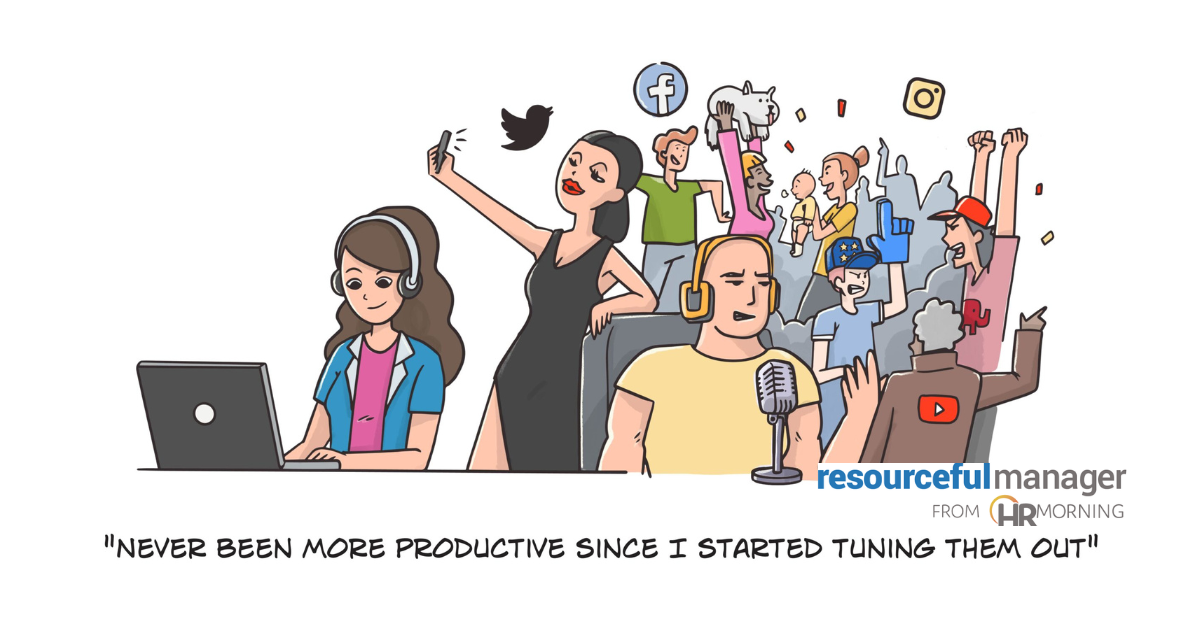
Nearly everyone talks about it. Nearly no one actually does it. Quit social media.

But I did it — for you and everyone who works and wonders: Is social media harmless or toxic, helpful or wasteful, or completely inconsequential?

While I don’t have all of your answers, my work experiment and life experience, plus expert research, should give you useful insight. Even better, the experiment is condensed here into practical tips you can use to get more done.

How I Quit Social Media

The test: Stay off social media for a month (for me, that was Instagram, Facebook and LinkedIn). Shut down alerts. Avoid in-person discussions sparked by social media. Don’t peek over people’s shoulders. Don’t “just look up something.”

Now, understand — I need social media to do my job beyond sharing stories (which I still had to do through the hiatus. But I clicked out of the apps immediately after I posted, never looking at notifications or scrolling.)

I need to see the business buzz, but I didn’t look. What I don’t need to see: Celia’s new puppy, Ryan’s rant about local politics, Liz’s newest listing or ski sweaters waiting to be bought.

Can You Quit Social Media?

That leads us to questions and answers.

First: Can you really quit social media? If you’re on it now, I would say no. Like I mentioned above, I still needed to share stories during the hiatus. If you’re reading this story, you’re likely an employee who has some social media element to your job at this point.

The other pressing questions and answers:

  • Is social media harmless or toxic? More toxic than not.
  • Helpful or wasteful at work? Both!
  • Completely inconsequential? It has consequences.

Let’s dig deeper (but not so deep as to bore you — and lead you to scroll elsewhere).

The Problems with Social Media

You probably don’t need me to tell you there are problems with social media. But my angle is work, and we’ll stick to that.

Social media at work is:

  • Toxic: A study published in Science Direct found more psychological harm in short breaks from work to use social media than benefits from the escape. What happens: Employees compare themselves to who and what they see, and then fall into “ego-depletion,” which negatively affects job performance immediately. If they go down the rabbit hole of scrolling or swiping deeper into a topic or people, the ego takes a bigger hit, and so does performance.
  • Wasteful/helpful. I don’t need to find research to prove this. I fall into social media rabbit holes, too. But I also find answers to my legitimate work questions, research to back up stories and experts to chime in on the stories on social media.
  • Consequential. A Harvard Business School study found employees who use/browse social media at work are engaged, about as productive as their counterparts, but aren’t easily retained. “Social media doesn’t reduce productivity nearly as much as it kills employee retention,” said Lorenzo Bizzi, the researcher.

So, here’s how I hope this experiment helps you – four ways to better handle social media within the parameters of work.

1. Be Realistic

If you haven’t gotten the gist of it by now, I found I can’t completely quit social media to do my job. If you’re a professional, you likely can’t either. Most especially, you’ll need LinkedIn. It’s not just about networking (although that is extremely helpful). It’s chock full of data, industry information and career help.

Tip 1: Assess your social media usage to find out what’s useful for work. Then commit to only opening those apps and accessing relevant information during work hours.

2. Be Practical

Once I accepted I had to use social media — and wanted to see it — I also had to accept that it can be a time-suck. And when I’m working, I can’t allow that. Even when I’m looking for information relevant to the job (or story) at hand, I can just as easily get distracted by irrelevant, but intriguing, information. For instance, finding a funny line from The Office turned into an hour of watching clips from old episodes.

Tip 2: Know you’ll find distractions when you want them. Try to choose and limit healthy distractions. For instance, if you need a break from an Excel project, and you love cooking, bookmark your favorite recipe sites to scroll.

3. Be Prepared

Here’s one thing that surprised me: I figured I’d be so much more focused and productive when I quit social media. And I was … at first. But, as it turned out, after the first week, I just found other online distractions when I needed them (let’s just say it usually involved shopping or celebrity trivia).

Tip 3: Once you give yourself permission to get distracted, use that time wisely. Whether it’s a useless dose of social media — such as scrolling TikTok for funny pet tricks — or a practical search — such as dinner recipes — set a timer. Cut the search when the alarm goes off.

4. Be Humble

This didn’t hurt my feelings, but it might hurt yours: No one seemed to notice I quit social media! So get over yourself. What you post on social media and how you respond to what others post probably aren’t as important as you think. Another reason I believe that: When I opened up my apps after the 30-day hiatus, there were only about eight things I needed to act on.

Tip 4: Take a break from social media. Try it one day a week. One week a month. A full month. Whatever it is, you’ll feel better — and here’s proof beyond my experiment: When researchers at Stanford and New York University paid people about $100 to quit Facebook for a month, participants spent less time with all online activities, spent more time being active and were more social, happier, and less anxious and depressed. And after the experiment, most curbed their social media use.

Finally, Forgive Me for the Quit

Finally, if I didn’t accept your LinkedIn, Facebook or Instagram connection request, don’t hold it against me. I saw the notifications, and I diligently ignored them. I even brushed off my saintly mother, who’s just finding her way on Facebook! Know that I’ll respond soon.

Filed under
RM Logo
  • Performance Management
  • Share on

Get the HRMorning Newsletter

With HRMorning arriving in your inbox, you will never miss critical stories on labor laws, benefits, retention and onboarding strategies.

  • This field is for validation purposes and should be left unchanged.
  • This field is hidden when viewing the form
  • This field is hidden when viewing the form
  • This field is hidden when viewing the form
  • This field is hidden when viewing the form
  • This field is hidden when viewing the form
  • This field is hidden when viewing the form
  • This field is hidden when viewing the form
  • This field is hidden when viewing the form
  • This field is hidden when viewing the form
  • This field is hidden when viewing the form
  • This field is hidden when viewing the form
  • This field is hidden when viewing the form
  • This field is hidden when viewing the form
  • This field is hidden when viewing the form
  • This field is hidden when viewing the form
  • This field is hidden when viewing the form
  • This field is hidden when viewing the form
  • This field is hidden when viewing the form
  • This field is hidden when viewing the form
  • This field is hidden when viewing the form
  • This field is hidden when viewing the form
  • This field is hidden when viewing the form
  • This field is hidden when viewing the form
  • This field is hidden when viewing the form
  • This field is hidden when viewing the form
  • This field is hidden when viewing the form
  • This field is hidden when viewing the form
  • This field is hidden when viewing the form
  • This field is hidden when viewing the form
  • This field is hidden when viewing the form
  • This field is hidden when viewing the form
  • This field is hidden when viewing the form
  • This field is hidden when viewing the form
  • This field is hidden when viewing the form
  • This field is hidden when viewing the form
  • This field is hidden when viewing the form
  • This field is hidden when viewing the form
  • This field is hidden when viewing the form
  • This field is hidden when viewing the form
  • This field is hidden when viewing the form
  • This field is hidden when viewing the form
  • This field is hidden when viewing the form
  • This field is hidden when viewing the form
  • This field is hidden when viewing the form
  • This field is hidden when viewing the form
  • This field is hidden when viewing the form
  • This field is hidden when viewing the form
  • This field is hidden when viewing the form
  • This field is hidden when viewing the form
  • This field is hidden when viewing the form
  • This field is hidden when viewing the form
  • This field is hidden when viewing the form
  • This field is hidden when viewing the form
  • This field is hidden when viewing the form
  • This field is hidden when viewing the form
  • This field is hidden when viewing the form

Free Training & Resources

White Papers

How a Delivery Service Provider Achieved HR Efficiency With Employee-Driven Payroll

Provided by Paycom

White Papers

Investing in HR Software

Webinars

The Fundamentals of Benefits & Compensation

Webinars

A Skill-Based Approach to Productivity and Wellbeing: Building Stronger, More Engaged Employees

SPONSORED CONTENT

HR Technology

sponsored content
The Best AI Software for HR Automation

Courtesy of G-P

Talent Management

sponsored content
Powerful Employee Retention Strategies for 2025: How to Keep Your Best People

Courtesy of PEOPLEGURU

Benefits

Health Care

Wellness

sponsored content
Proven Results: 5 Ways Teladoc Health Chronic Condition Management Transforms HR Outcomes

Courtesy of TELADOC HEALTH

Further Reading

  • Performance Management
Employees want to be ‘Quietly Managed’ – Here’s how to do it

Done with years of micromanaging and productivity concerns, employees want to be “Quietly Managed” in 2024. Last year saw a whole ho...

  • Performance Management
Bridge the Workforce Readiness Gap: 3 Key Steps for HR Leaders

Disrupted by automation and globalization, traditional role-based work requirements are on the decline. Hungry for workers with data analys...

  • Performance Management
8 employee cross-training benefits employers can’t afford to miss out on

Employee cross-training is the process of training employees for skills and job roles they weren’t initially hired for. Cross-training al...

  • Performance Management
What to Do With Mastermind Time | 2-Minute Video

As an HR leader, you always face decisions, challenges and opportunities. There’s never a dull moment. And rarely a time someone ...

  • Performance Management
Understanding employee burnout: Causes, symptoms and prevention strategies

Employee burnout has a long-term impact on employees’ well-being, workplace culture and the business’s bottom line. A recent WHO a...

  • Performance Management
Performance Reviews: 5 Things We’re Not Telling Employees

Despite the evidence that employees need — and want — more feedback than annual performance reviews, the yearly talk is still t...

Get the latest from HRMorning in your inbox PLUS immediately access 10 FREE HR guides.

I WANT MY FREE GUIDES
HR Morning Logo
  • Facebook
  • Linked In
  • ABOUT HRMORNING
  • ADVERTISE WITH US
  • WRITE FOR US
  • CONTACT
  • Employment Law
  • Benefits
  • Recruiting
  • Talent Management
  • Performance Management
  • HR Technology
  • Leadership & Strategy
  • Compensation
  • Policy & Procedures
  • Wellness
  • Staff Departure
  • HR Career & Self-Care
  • Health Care
  • Retirement Plans
  • DEI

HRMorning, part of the Rover Insights Network, provides the latest HR and employment law news for HR professionals in the trenches of small-to-medium-sized businesses. Rather than simply regurgitating the day's headlines, HRMorning delivers actionable insights, helping HR execs understand what HR trends mean to their business.

Powered By Rover Insights
Privacy Policy | Terms of Service
Copyright© 2026 Rover Insights
HRMorning Logo

WELCOME BACK!

Enter your username and password below to log in

Forget Your Username or Password?

Reset Password

Lost your password? Please enter your username or email address. You will receive a link to create a new password via email.

Log In

Why do we need your credit card for a free trial?

We ask for your credit card to allow your subscription to continue should you decide to keep your membership beyond the free trial period.  This prevents any interruption of content access.

Your card will not be charged at any point during your 21 day free trial
and you may cancel at any time during your free trial.

During your free trial, you can cancel at any time with a single click on your “Account” page.  It’s that easy.