3 Big Reasons HR Must Prevent Harassment at Work Today | 2-Minute Video

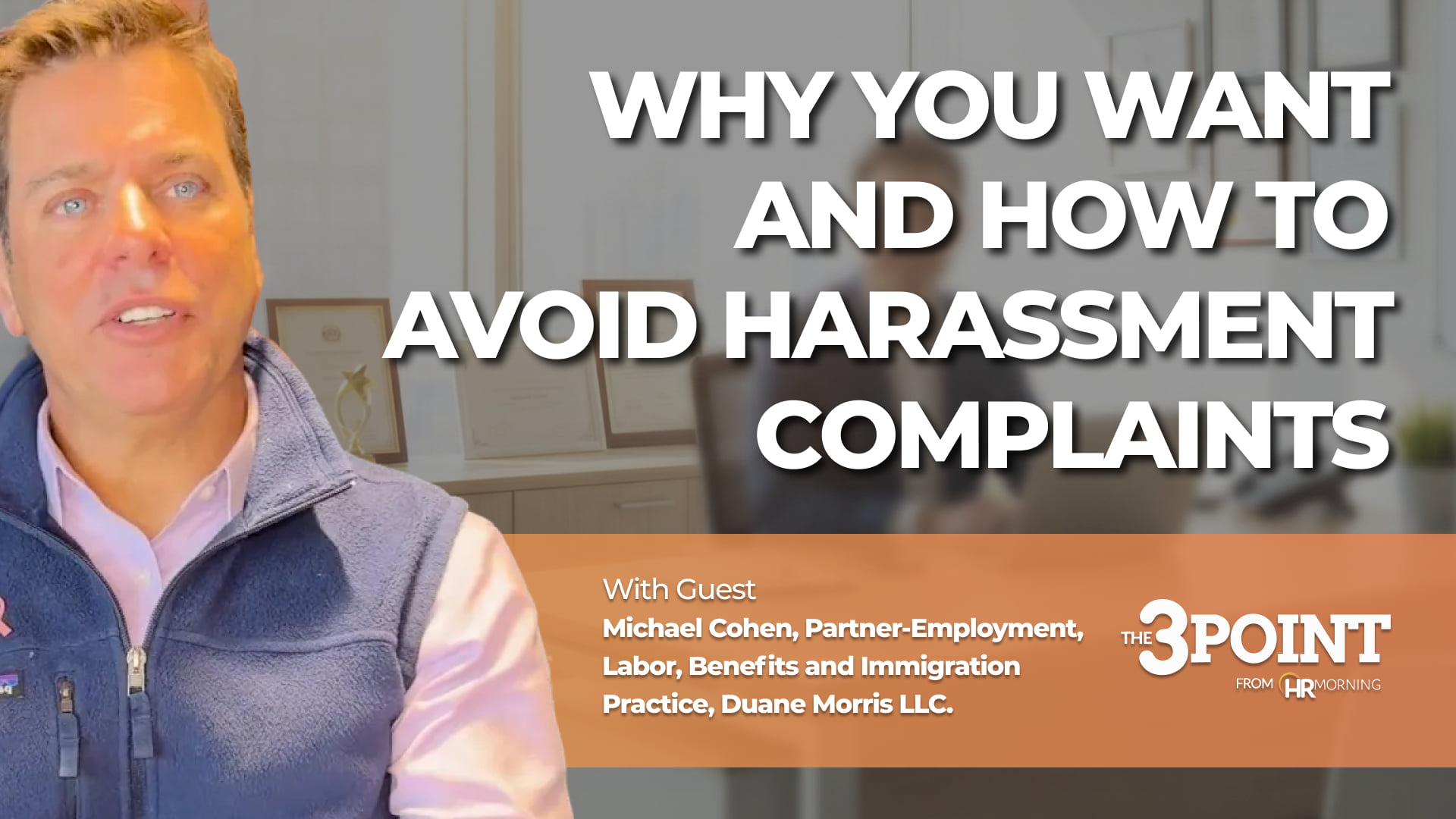
You know you must prevent harassment in the workplace. For a lot of reasons.
It’s costly to your bottom line and reputation. But what’s worse? It’s unfair.
What’s Up in This Episode: Preventing Harassment
That’s why in this episode of HRMorning’s 3-Point, we talk with Michael Cohen, a Partner in the Employment, Labor, Benefits and Immigration Practice at Duane Morris LLC. He identifies the practical reasons for ensuring a harassment-free workplace. But he also tells us the biggest reason — the headline reason — for doing everything you can to prevent any form of harassment in your workplace.
Click, watch and listen for more on preventing workplace harassment.
Transcript (edited for clarity):
We’ll cut to the chase in the episode of HRMorning’s 3-Point. No company wants to be involved in a harassment complaint because …
Michael Cohen, Partner-Employment, Labor, Benefits and Immigration Practice, Duane Morris LLC: “You’ve got time costs. You’ve got legal costs. The biggest reason … I guess, talk about burying the lead, right? … is fairness to employees. Employees shouldn’t be subjected to this kind of garbage.”
You see, there’s the practical side: costs. But seriously, what’s important here for HR leaders: people.
Cohen: “So we want to make sure that we facilitate an environment where people feel comfortable. We’re not going to create a utopia because it’s not something that exists. The other part of fairness is that people who are treated fairly, generally, are happier and more productive. And the converse of that, equally true, is if they’re not treated fairly, they’re not going to be as productive.”
Now, let’s be realistic. There will always be jerks at work. And this might be painful to hear, but some behaviors are not actually harassment. But other behaviors are. That means almost every employer will have harassment in their workplace.
So the baseline solution: Training. We’ll give you more resources on that at the end of this episode. From there, Cohen explains what leadership needs to do.
Cohen: “It’s the leaders’ understanding that if they engage in inappropriate conduct, other people will engage in inappropriate conduct as well. People are going to look to them for what they can and can not do. And probably said more accurately, employees are going to look to leaders for what they can get away with. So they need to make sure they’re conducting themselves the right way. Do leaders understand their absolute affirmative obligation to report to HR all harassment, discrimination or retaliation even if an employee says to the leader, ‘I don’t want you to do anything about it. I’m just telling you as a friend. I want you to keep it off the record.'”
Ok, here’s what Cohen says is important to know about harassment:
- It’s costly. If you let it happen, it costs you time, money and reputation.
- It’s unfair. Even when bad behavior doesn’t equal harassment, employers who allow jerks to act badly destroy morale and productivity.
- It’s the leaders’ job to stop. Period.
You can find several on-demand courses covering a variety of harassment topics on the HRMorning website. The link to courses is in the description below. Thanks for watching this episode.
- Share on


Free Training & Resources
EBOOK, White Papers
Provided by Personify Health
Webinars
Provided by Mitratech
White Papers
Provided by Maven Clinic



