• Skip to primary navigation
  • Skip to main content

HRMorning

  • FREE RESOURCES
  • PREMIUM CONTENT
  • HR DEEP DIVES
  • PODCASTS
    • VOICES OF HR
    • WOMEN’S LEADERSHIP TODAY
  • LOGIN
  • SIGN UP FREE
  • Employment Law
  • Benefits
  • Recruiting
  • HR Technology
  • Payroll
  • Management
  • Women’s Leadership
  • More
    • Talent Management
    • Performance Management
    • Leadership & Strategy
    • Compensation
    • Policy & Procedures
    • Wellness
    • Staff Departure
    • HR Career & Self-Care
    • Health Care
    • Retirement Plans
RM Logo
  • Talent Management

Are You a Jerk at Work? Or Know 1? Here’s Help

Michele McGovern
By: Michele McGovern
  • Share on

About the Author

Michele McGovern writes. A lot. These days, she covers HR, digging deep into company culture, DEI, leadership, management and the everchanging world of work. In the years between getting a BA in journalism from a state school and writing about HR, she wrote about big-city crime for a wire service and small-town life for local newspapers. She’s a mediocre mom, decent wife, wannabe athlete and consummate pursuer of fun - on land, snow and water. Find her on LinkedIn @michele-mcgovern-writer.

Show Less
Last Updated: September 10, 2025
5 minute engagement

Jerks come in all shapes and sizes.

Even the best leaders may not realize they’re sometimes a jerk at work.

Of course, we aren’t saying you’re a jerk. What we’re saying is that every person at work — colleagues, bosses, employees and clients — has different definitions of jerks. And some of our own behaviors might fall in line with others’ views of a jerk at work.

Then there’s a possibility that you might manage a jerk at work. And it’s almost certain that you have a colleague, client or — wait for it — boss who’s a jerk at work.

Dealing with a Jerk at Work

Bottom line, just about everyone has to deal with a jerk at work. And some of us might have to curb some of our own habits to reel in the what others see as jerk behaviors.

“Even well-intentioned bosses often don’t know how to handle office jerks,” says Tessa West, in her book Jerks at Work: Toxic Coworkers and What to Do About Them. “But most of us can handle problems at work if we can predict them and then strategize what to do.”

Here’s the good news: West has dug deep into the science of jerks at work, and identified the worst offenders and the best ways to deal with them — or even temper any of our own tendencies to be that person.

“No matter how educated you are or what your job title is, you can fall victim to a jerk at work,” says West. “Spending time in the workplace does not necessarily translate to having better conflict management skills.”

And if you’re wondering if you fit any of these descriptions — or want to avoid ever being like any of them — take West’s test to see if you have jerk tendencies.

Here are the six worst jerks.

1. The Bulldozer

They’re well-connected and aren’t afraid to flex muscles. They use those muscles to take over how things are done and decided within their groups. They also use fear and intimidation to get what they want from colleagues, bosses and direct reports.

Handle them: Practice “holding the floor” when dealing with Bulldozers. Get input and opinions from everyone involved in the project on the team to signal that you work with a variety of views. Encourage everyone to voice their thoughts throughout a project or process. And if you have any bulldozing tendencies, practice holding your thoughts in group meetings until everyone has spoken — then briefly cover anything you feel wasn’t. There’s a good chance that if you let others speak, they’ll come to the same conclusions you have — or they’ll open your eyes to other options.

2. The Kisser/Kicker

The Kiss Up/Kick Downer wants to climb to the top, treating others as the competition. They aim to gain the approval from higher-ups at any cost. That includes tossing co-workers and allies to the side as they climb.

Handle them: Find other victims to confirm the problem is widespread, especially if this kind of behavior is reported to management. Then either use the evidence – incidents, dates, places and how the behavior affects others – to address the situation with the employee. If you want to avoid being a Kiss Up or Kick Down, check in with trusted colleagues. Ask if they see or hear about you and those behaviors.

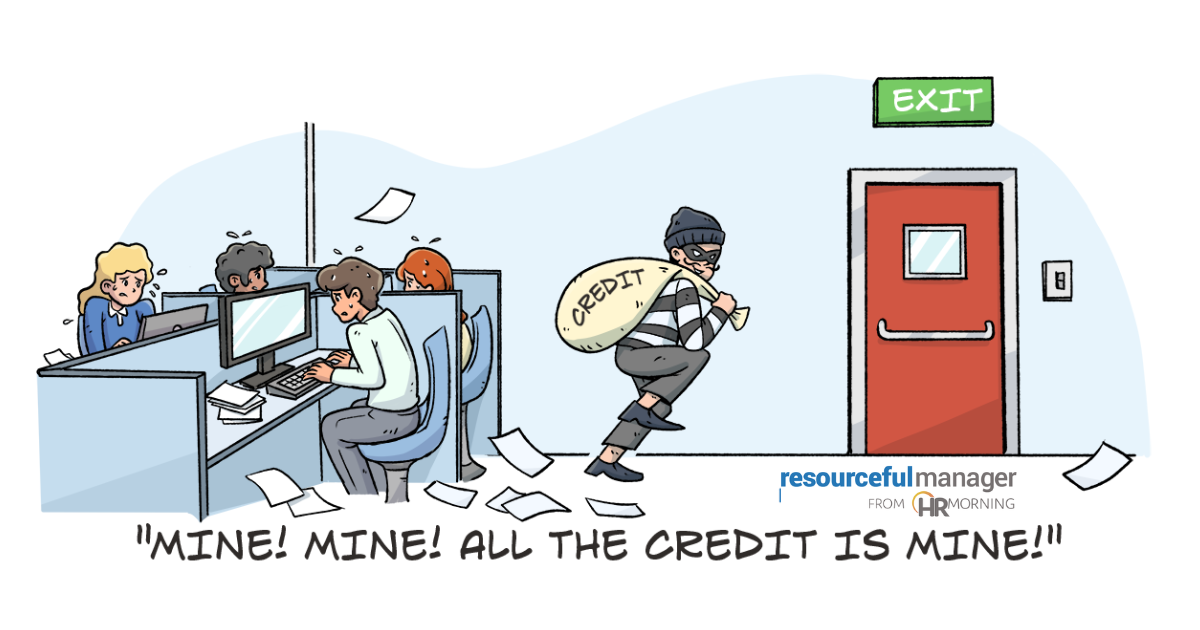
3. The Credit Stealer

These jerks act like a friend, but betray and steal credit for everything good – such as ideas, work and contributions – to better themselves. Even worse, they cover their tracks well. So they’ll hide their bad behaviors and the actual good work colleagues do.

Handle them: When it’s a colleague, use your voice and track record to highlight your individual contributions. You don’t have to brag. Say what you’ve done or will do before your thunder is stolen. To avoid being the credit stealer, follow the golden rule of leadership: Share credit for all successes and take responsibility for losses.

4. The Free Rider

They’re experts at doing the minimum – or nothing – and getting rewarded for it. They step up for important work that requires more oversight and less effort. Their secret to the ruse: They’re well-liked and friendly, making it difficult for others to call them out.

Handle them: Do a regular fairness check for workflows – for your teams and yourself. When you make workflows public, Free Riders will be outed. This tip helps weed out any tendencies a leader might have toward free riding.

5. The Micromanager

This could be your boss or a manipulative colleague or employee. They’re impatient and disrespect your time and space. They monitor time and behavior that’s none of their business.

Handle them: If it’s your boss, you’ll need to confront it. Talk about aligning big picture goals with your duties. For colleagues or employees, put up physical barriers – such as Do Not Disturb signs – and electronic barriers – do not disturb on communication apps. Offer limited – or no – status updates. And finally, if it could be you, ask your employees to call it out. Then step aside!

6. The Gaslighter

They’re grand-scale liars. They might isolate their victims and slowly build the altered reality they want believed. They might use the victim’s vulnerabilities to help them steal or cheat. You want to keep an eye out for these jerks who do this to vulnerable employees because those are the people who would not likely bring it to anyone’s attention.

Handle them: Find and rely on new allies. Help employees who are victims to align with better co-workers, too. The Gaslighter tries to socially isolate victims so they believe the altered reality. Check in with others you trust to decide what’s good and true. And check in on apparent victims to be sure they stay away from Gaslighters. This is difficult for people to self-regulate. It’s another instance where you’ll want to work with a trusted colleague to be certain you don’t have any of these tendencies.

Filed under
RM Logo
  • Talent Management
  • Share on

Get the HRMorning Newsletter

With HRMorning arriving in your inbox, you will never miss critical stories on labor laws, benefits, retention and onboarding strategies.

  • This field is for validation purposes and should be left unchanged.
  • This field is hidden when viewing the form
  • This field is hidden when viewing the form
  • This field is hidden when viewing the form
  • This field is hidden when viewing the form
  • This field is hidden when viewing the form
  • This field is hidden when viewing the form
  • This field is hidden when viewing the form
  • This field is hidden when viewing the form
  • This field is hidden when viewing the form
  • This field is hidden when viewing the form
  • This field is hidden when viewing the form
  • This field is hidden when viewing the form
  • This field is hidden when viewing the form
  • This field is hidden when viewing the form
  • This field is hidden when viewing the form
  • This field is hidden when viewing the form
  • This field is hidden when viewing the form
  • This field is hidden when viewing the form
  • This field is hidden when viewing the form
  • This field is hidden when viewing the form
  • This field is hidden when viewing the form
  • This field is hidden when viewing the form
  • This field is hidden when viewing the form
  • This field is hidden when viewing the form
  • This field is hidden when viewing the form
  • This field is hidden when viewing the form
  • This field is hidden when viewing the form
  • This field is hidden when viewing the form
  • This field is hidden when viewing the form
  • This field is hidden when viewing the form
  • This field is hidden when viewing the form
  • This field is hidden when viewing the form
  • This field is hidden when viewing the form
  • This field is hidden when viewing the form
  • This field is hidden when viewing the form
  • This field is hidden when viewing the form
  • This field is hidden when viewing the form
  • This field is hidden when viewing the form
  • This field is hidden when viewing the form
  • This field is hidden when viewing the form
  • This field is hidden when viewing the form
  • This field is hidden when viewing the form
  • This field is hidden when viewing the form
  • This field is hidden when viewing the form
  • This field is hidden when viewing the form
  • This field is hidden when viewing the form
  • This field is hidden when viewing the form
  • This field is hidden when viewing the form
  • This field is hidden when viewing the form
  • This field is hidden when viewing the form
  • This field is hidden when viewing the form
  • This field is hidden when viewing the form
  • This field is hidden when viewing the form
  • This field is hidden when viewing the form
  • This field is hidden when viewing the form
  • This field is hidden when viewing the form

Free Training & Resources

Webinars

Grow Your Future Workforce from Within

Webinars

The Biggest Workplace Trends of 2021

Webinars

Your Policy Changed. Did Employee Behavior?

Provided by Navex

Webinars

The Secret to Achieving Peak Performance From Every Employee

SPONSORED CONTENT

HR Technology

sponsored content
The Best AI Software for HR Automation

Courtesy of G-P

Talent Management

sponsored content
Powerful Employee Retention Strategies for 2025: How to Keep Your Best People

Courtesy of PEOPLEGURU

Benefits

Health Care

Wellness

sponsored content
Proven Results: 5 Ways Teladoc Health Chronic Condition Management Transforms HR Outcomes

Courtesy of TELADOC HEALTH

Further Reading

  • Talent Management
6 Stupid Things Managers Do To Sabotage Teams

Does your team ever fall short of goals? Or let things fall through the cracks? Or sometimes give half the effort? The problem might be...

  • Talent Management
Slowmaxxing: What It Is and Why HR Needs to Be Concerned

Slowmaxxing has hit the workplace. It’s the latest in the world of “maxxing” — when people take an activity to ...

  • Talent Management
Make good employees great: 4 ways to build on strengths

HR leaders and front-line managers can spend more than a day a week trying to fix employee performance issues. Correcting problems and ...

  • Talent Management
The Infinite Workday: 5 Things HR Needs to Know and Do About It

Your employees are working sunup to sundown. Some might work sundown to sunup. Either way, they’re working more hours than ever. A...

  • Recruiting
  • Talent Management
Talent pipeline: Definition, benefits and management

Creating a talent pipeline is a proactive recruiting technique where, instead of filling roles when there’s a vacancy, you consider what ...

  • Talent Management
Help Employees Find New Careers (With You!) | 2-Minute Video

Your employees shouldn’t find new careers at other companies. They should find their next step with you. Problem is, they often do...

Get the latest from HRMorning in your inbox PLUS immediately access 10 FREE HR guides.

I WANT MY FREE GUIDES
HR Morning Logo
  • Facebook
  • Linked In
  • ABOUT HRMORNING
  • ADVERTISE WITH US
  • WRITE FOR US
  • CONTACT
  • Employment Law
  • Benefits
  • Recruiting
  • Talent Management
  • Performance Management
  • HR Technology
  • Leadership & Strategy
  • Compensation
  • Policy & Procedures
  • Wellness
  • Staff Departure
  • HR Career & Self-Care
  • Health Care
  • Retirement Plans
  • DEI

HRMorning, part of the Rover Insights Network, provides the latest HR and employment law news for HR professionals in the trenches of small-to-medium-sized businesses. Rather than simply regurgitating the day's headlines, HRMorning delivers actionable insights, helping HR execs understand what HR trends mean to their business.

Powered By Rover Insights
Privacy Policy | Terms of Service
Copyright© 2026 Rover Insights
HRMorning Logo

WELCOME BACK!

Enter your username and password below to log in

Forget Your Username or Password?

Reset Password

Lost your password? Please enter your username or email address. You will receive a link to create a new password via email.

Log In

Why do we need your credit card for a free trial?

We ask for your credit card to allow your subscription to continue should you decide to keep your membership beyond the free trial period.  This prevents any interruption of content access.

Your card will not be charged at any point during your 21 day free trial
and you may cancel at any time during your free trial.

During your free trial, you can cancel at any time with a single click on your “Account” page.  It’s that easy.
