• Skip to primary navigation
  • Skip to main content

HRMorning

  • FREE RESOURCES
  • PREMIUM CONTENT
  • HR DEEP DIVES
  • PODCASTS
    • VOICES OF HR
    • WOMEN’S LEADERSHIP TODAY
  • LOGIN
  • SIGN UP FREE
  • Employment Law
  • Benefits
  • Recruiting
  • HR Technology
  • Payroll
  • Management
  • Women’s Leadership
  • More
    • Talent Management
    • Performance Management
    • Leadership & Strategy
    • Compensation
    • Policy & Procedures
    • Wellness
    • Staff Departure
    • HR Career & Self-Care
    • Health Care
    • Retirement Plans
RM Logo
  • Talent Management

6 Stupid Things Managers Do To Sabotage Teams

Michele McGovern
By: Michele McGovern
  • Share on

About the Author

Michele McGovern writes. A lot. These days, she covers HR, digging deep into company culture, DEI, leadership, management and the everchanging world of work. In the years between getting a BA in journalism from a state school and writing about HR, she wrote about big-city crime for a wire service and small-town life for local newspapers. She’s a mediocre mom, decent wife, wannabe athlete and consummate pursuer of fun - on land, snow and water. Find her on LinkedIn @michele-mcgovern-writer.

Show Less
Last Updated: November 22, 2025
5 minute engagement

Does your team ever fall short of goals? Or let things fall through the cracks? Or sometimes give half the effort?

The problem might be you. Even good managers do stupid things that sabotage teams.

Unfortunately, managers often fail to recognize their mistakes. So they can’t stop themselves from sabotaging things.

Shocker: Government Taught Us to Sabotage Teams!

Here’s something you might find amazing about sabotage in the workplace. In 1944, the government declassified a training manual on simple sabotage. CIA agents printed and handed out portions of the booklet to anyone who wanted to “inflict sabotage through ordinary means.”

The booklet had sections for specific audiences, including “Managers and Supervisors” and “Employees”! (You can download it through the link above, or listen to it here.)

At that time, the government wanted civilians to sabotage teams and co-workers to help end WWII. But guess what: The tactics they suggested — for instance, create unpleasant work conditions by making it more difficult for employees to get the tools they need and foster poor decision-making by bickering or playing stupid — were used and forgotten.

Team Sabotage Today

Today, many of these tactics have made their way back into the workplace.

Of course, managers don’t want to intentionally sabotage their teams. But they unwittingly do it with actions and words that confuse, undermine or upset their teams.

“Unconscious psychological processes can sabotage individual lives, the functioning of groups, teams and organizations, and even global politics,” says Michael Drayton in his book, The Saboteur at Work. “If you manage a team or lead an organization, you need to understand the role played by the saboteur in your workplace and in your own career and life.”

To help your people succeed, you want to avoid these top six ways managers sabotage teams:

1. Living, Working in the Past

Great leaders are at the top of their game because they’ve learned and honed great management strategies. But even the best of those strategies deserves a little scrutiny from time to time.

What causes problems is that we stick with what we know longer than it’s useful. Some leadership tactics and trends actually go out of style before you give them up. So we bring prior experiences, assumptions and interpretations of success into everyday decisions — even though so much has changed.

Fix it: Form or get involved in groups with other leaders from different backgrounds, tenures and lines of business to share and discuss best management practices.

2. Overcomplicating Things

In an effort to gain or maintain credibility, some managers overcomplicate things. They explain too much to highlight their authority. Or use too many complex words to sound smart. Or drop too many names to appear important.

Some experts call the overdoing it imposter syndrome. But even leaders who aren’t afraid of “being found out” overcomplicate things because they don’t believe enough in their employees.

“Bad managers often feel the need to control every aspect of their team’s work,” says Bonnie Low Kramen, author of Staff Matters: People-Focused Solutions for the Ultimate New Workplace. “They don’t trust their employees to do their jobs, which leads to frustration and low morale.”

Fix it: When you feel you need to give more detail, qualify a request or justify a decision, stop. Give employees the minimum, inviting them to ask questions if they need more. Then, and as long as they do the right things with what you’ve shared, give them more autonomy going forward.

3. Projecting

Sometimes managers project their emotions and reactions to situations beyond themselves — straight down to their employees, who tend to absorb the negative kind more easily.

The most disastrous emotion: stress. Managers who instinctively react to situations with outward signs of stress usually cause their team to feel overwhelmed and unprepared to handle it. They’re set up for failure.

Fix it: It’s not a simple fix to just change the way you respond to stressful situations. First, it calls for the reminder that you likely can’t change the situation, but you can change how you respond to it. Secondly, turn to a group of trusted managers to share your situation and get suggestions on how to handle it and cope with the emotions.

4. Inflexibility

Alright, we get it: You’re the boss and you get to make the rules. But when a boss lives and dies by “the rules,” the team will likely fail under them.

If the pandemic years have taught us anything, it’s the need for flexibility in the workplace — and the resilience of our workforce. Given difficult circumstances, employees in most places proved they could produce under almost any conditions. Yet, some leaders remain rigid in their approach to managing teams, and the structure suffocates them.

Fix it: Check your rules. Just because they work for you doesn’t mean they work for everyone all the time. “Managing is not about power and control. It’s about creating a safe and supportive environment where people can do their best work,” says Low Kramen.

5. Over Analysis

I had a colleague who used to hand work to her boss, keeping a tight grip on the bottom of the paper (yes, I’m from an era that we handed over actual paper!) Then she’d pull back, saying she needed to make another change. She told me once, “I just can’t let go of my copy.”

She overanalyzed everything. You know where it got her? Nowhere. It was and is analysis paralysis. Her work was late. Others stopped relying on her, and her career stalled.

Too many managers — especially new ones — overanalyze, fearing they’ll get something wrong. So their teams can’t move forward.

Fix it: Stop holding on to that sheet of paper and accept that you’ll learn from mistakes — if you even make one.

6. Seeking Consensus

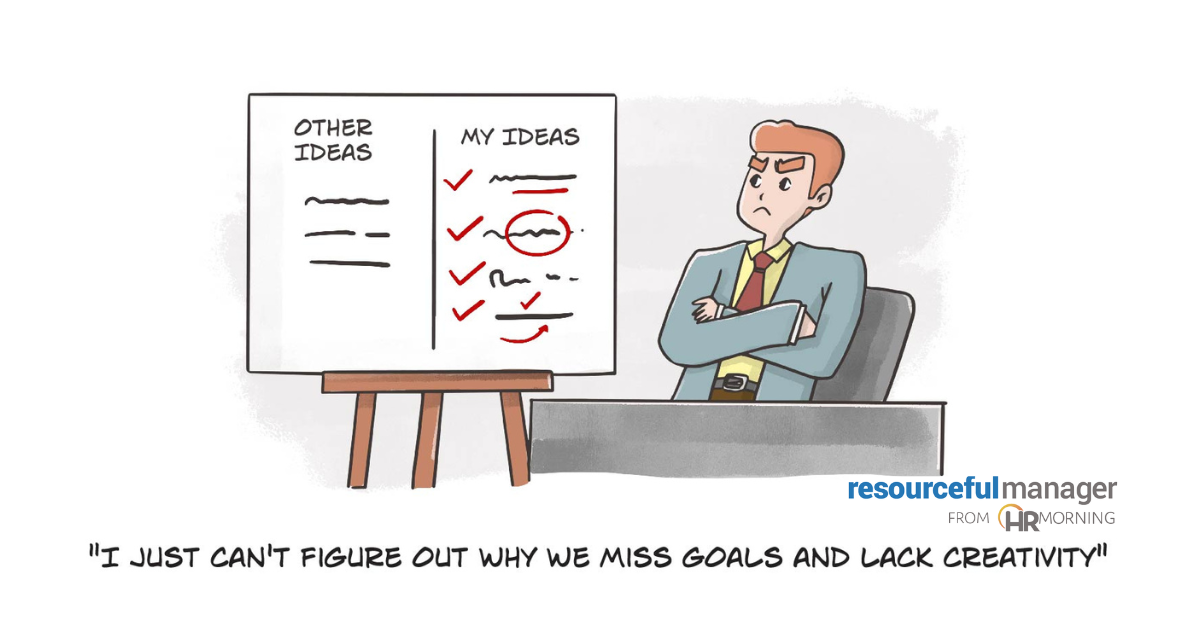
And then there are the bosses who won’t make a decision until everyone agrees or they force employees to see it their way. They seek and cause groupthink, which hurts team creativity and effectiveness.

Some conflict and pushback is OK, often leading to more critical thinking, better problem-solving and breakthrough ideas.

Fix it: Become an inner cynic. Poke holes in your ideas first, if you must, to get the team to offer more constructive criticism. Leave behind the need for harmony and consensus.

“It’s about being a mentor, a coach, and a cheerleader, as well as a boss,” says Low Kramen. “It’s about recognizing that you don’t have all the answers, and that your success is ultimately tied to the success of your team.”

Filed under
RM Logo
  • Talent Management
  • Share on

Get the HRMorning Newsletter

With HRMorning arriving in your inbox, you will never miss critical stories on labor laws, benefits, retention and onboarding strategies.

  • This field is for validation purposes and should be left unchanged.
  • This field is hidden when viewing the form
  • This field is hidden when viewing the form
  • This field is hidden when viewing the form
  • This field is hidden when viewing the form
  • This field is hidden when viewing the form
  • This field is hidden when viewing the form
  • This field is hidden when viewing the form
  • This field is hidden when viewing the form
  • This field is hidden when viewing the form
  • This field is hidden when viewing the form
  • This field is hidden when viewing the form
  • This field is hidden when viewing the form
  • This field is hidden when viewing the form
  • This field is hidden when viewing the form
  • This field is hidden when viewing the form
  • This field is hidden when viewing the form
  • This field is hidden when viewing the form
  • This field is hidden when viewing the form
  • This field is hidden when viewing the form
  • This field is hidden when viewing the form
  • This field is hidden when viewing the form
  • This field is hidden when viewing the form
  • This field is hidden when viewing the form
  • This field is hidden when viewing the form
  • This field is hidden when viewing the form
  • This field is hidden when viewing the form
  • This field is hidden when viewing the form
  • This field is hidden when viewing the form
  • This field is hidden when viewing the form
  • This field is hidden when viewing the form
  • This field is hidden when viewing the form
  • This field is hidden when viewing the form
  • This field is hidden when viewing the form
  • This field is hidden when viewing the form
  • This field is hidden when viewing the form
  • This field is hidden when viewing the form
  • This field is hidden when viewing the form
  • This field is hidden when viewing the form
  • This field is hidden when viewing the form
  • This field is hidden when viewing the form
  • This field is hidden when viewing the form
  • This field is hidden when viewing the form
  • This field is hidden when viewing the form
  • This field is hidden when viewing the form
  • This field is hidden when viewing the form
  • This field is hidden when viewing the form
  • This field is hidden when viewing the form
  • This field is hidden when viewing the form
  • This field is hidden when viewing the form
  • This field is hidden when viewing the form
  • This field is hidden when viewing the form
  • This field is hidden when viewing the form
  • This field is hidden when viewing the form
  • This field is hidden when viewing the form
  • This field is hidden when viewing the form
  • This field is hidden when viewing the form

Free Training & Resources

White Papers

CSR Industry Review

Provided by Blackbaud

White Papers

Employee Discount Program Buyer’s Guide

Provided by Perkspot

Webinars

The Compounding Cost of Payroll Inaccuracy

Provided by TestAssure

White Papers

State of Women’s and Family Health Benefits 2026

Provided by Maven Clinic

SPONSORED CONTENT

HR Technology

sponsored content
The Best AI Software for HR Automation

Courtesy of G-P

Talent Management

sponsored content
Powerful Employee Retention Strategies for 2025: How to Keep Your Best People

Courtesy of PEOPLEGURU

Benefits

Health Care

Wellness

sponsored content
Proven Results: 5 Ways Teladoc Health Chronic Condition Management Transforms HR Outcomes

Courtesy of TELADOC HEALTH

Further Reading

  • Talent Management
Long Live WFH! 4 Arguments for More Remote Work

Many employees at companies around the globe have done more than make arguments for more remote work: They’ve demanded it. And the...

  • Performance Management
  • Talent Management
How to conduct an employee performance review: A 5-step guide

As you take your first steps into your new managerial position, one of the key functions you’ll be required to do is employee performance...

  • Recruiting
  • Talent Management
What is culture fit?

Whenever you’re looking for a new employee to join your ranks, it’s standard to assess their ability to do a job, reviewing things such...

  • Talent Management
10 Effective Employee Retention Strategies Every Company Needs

Most turnover doesn’t come from a dramatic exit. It comes from small frustrations that stack up – stalled growth paths, uneven workload...

  • Talent Management
5 Stay Interview Questions to Boost Employee Retention Now

Managers often learn what went wrong only after someone hands in their notice. Stay interviews reverse that dynamic by openly discussing wh...

  • Talent Management
How to Calculate Your Employee Retention Rate

If you’re searching for a simple and quick explanation of how to calculate your employee retention rate, you’ve come to the right s...

Get the latest from HRMorning in your inbox PLUS immediately access 10 FREE HR guides.

I WANT MY FREE GUIDES
HR Morning Logo
  • Facebook
  • Linked In
  • ABOUT HRMORNING
  • ADVERTISE WITH US
  • WRITE FOR US
  • CONTACT
  • Employment Law
  • Benefits
  • Recruiting
  • Talent Management
  • Performance Management
  • HR Technology
  • Leadership & Strategy
  • Compensation
  • Policy & Procedures
  • Wellness
  • Staff Departure
  • HR Career & Self-Care
  • Health Care
  • Retirement Plans
  • DEI

HRMorning, part of the Rover Insights Network, provides the latest HR and employment law news for HR professionals in the trenches of small-to-medium-sized businesses. Rather than simply regurgitating the day's headlines, HRMorning delivers actionable insights, helping HR execs understand what HR trends mean to their business.

Powered By Rover Insights
Privacy Policy | Terms of Service
Copyright© 2026 Rover Insights
HRMorning Logo

WELCOME BACK!

Enter your username and password below to log in

Forget Your Username or Password?

Reset Password

Lost your password? Please enter your username or email address. You will receive a link to create a new password via email.

Log In

Why do we need your credit card for a free trial?

We ask for your credit card to allow your subscription to continue should you decide to keep your membership beyond the free trial period.  This prevents any interruption of content access.

Your card will not be charged at any point during your 21 day free trial
and you may cancel at any time during your free trial.

During your free trial, you can cancel at any time with a single click on your “Account” page.  It’s that easy.