• Skip to primary navigation
  • Skip to main content

HRMorning

  • FREE RESOURCES
  • PREMIUM CONTENT
  • HR DEEP DIVES
  • PODCASTS
    • VOICES OF HR
    • WOMEN’S LEADERSHIP TODAY
  • LOGIN
  • SIGN UP FREE
  • Employment Law
  • Benefits
  • Recruiting
  • HR Technology
  • Payroll
  • Management
  • Women’s Leadership
  • More
    • Talent Management
    • Performance Management
    • Leadership & Strategy
    • Compensation
    • Policy & Procedures
    • Wellness
    • Staff Departure
    • HR Career & Self-Care
    • Health Care
    • Retirement Plans
WLT Logo
  • Business Skills

6 Big Ways Good Communication Will Support Organizational Resilience

Michele McGovern
By: Michele McGovern
  • Share on

About the Author

Michele McGovern writes. A lot. These days, she covers HR, digging deep into company culture, DEI, leadership, management and the everchanging world of work. In the years between getting a BA in journalism from a state school and writing about HR, she wrote about big-city crime for a wire service and small-town life for local newspapers. She’s a mediocre mom, decent wife, wannabe athlete and consummate pursuer of fun - on land, snow and water. Find her on LinkedIn @michele-mcgovern-writer.

Show Less
Last Updated: April 8, 2026
3 minute engagement
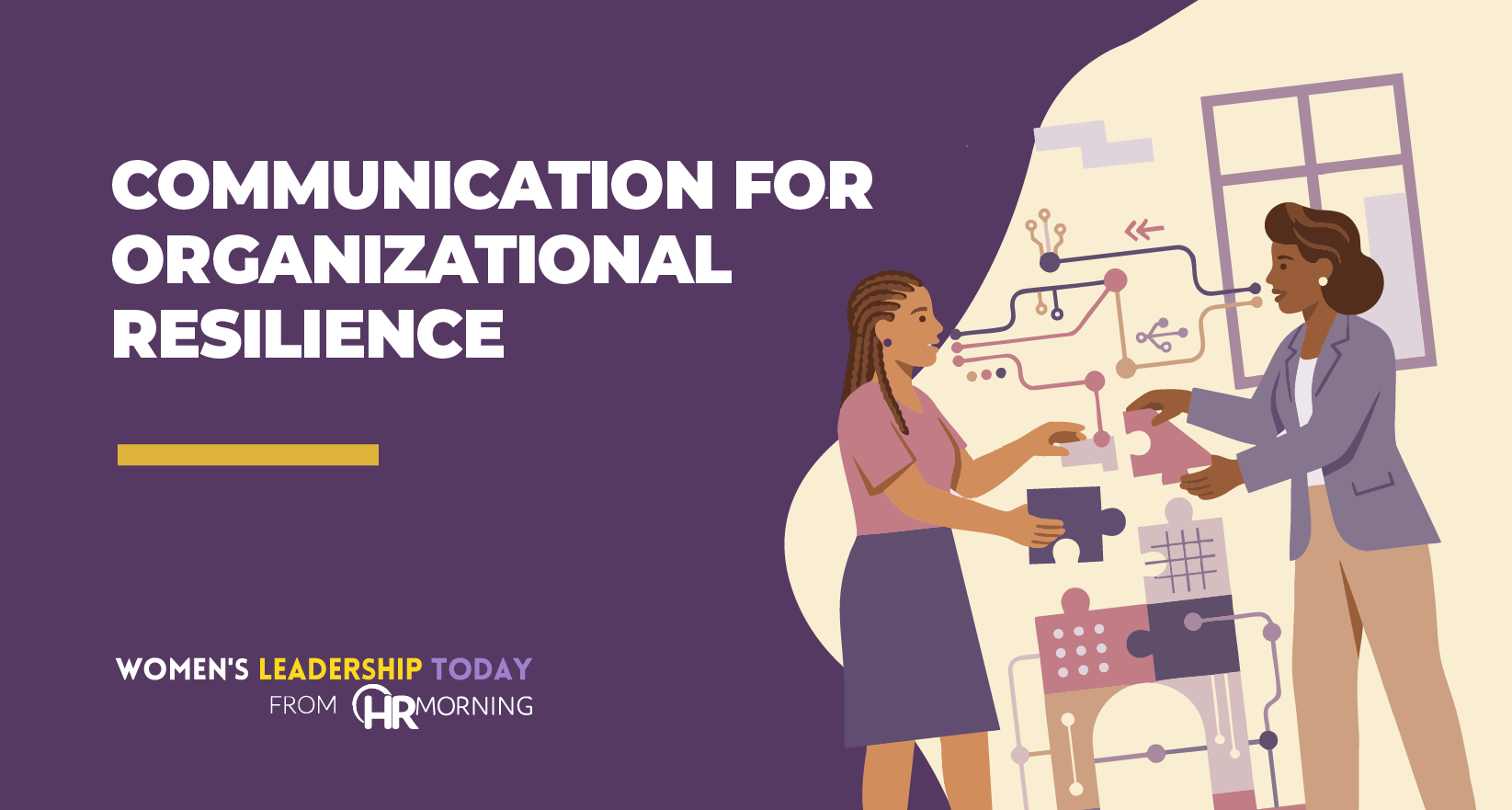
A flat Corporate Memphis style blog graphic from Women's Leadership Today and HRMorning titled "Communication For Organizational Resilience." Two diverse female leaders are shown collaboratively assembling puzzle pieces against a backdrop of circuit-like communication lines. This metaphorically represents how effective leadership and clear, interconnected communication serve as the fundamental building blocks of a resilient organization.

Management teams and individuals in leadership roles are constantly searching for new and effective ways to reinforce the strength and functionality of their organizations.

The resilience of your employees directly influences the company’s competence and adaptability. It’s not just individuals who need to develop resilience; companies also need to do it to navigate challenging times.

What is Organizational Resilience?

Organizational resilience is the practice of adapting to challenging situations in a variety of settings. Achieving this requires individuals to notice changes as they occur and find productive ways to react to or cope with them. By developing company-wide resilience, businesses can more effectively anticipate changes before they occur and respond to threats or opportunities accordingly.

When working on organizational resilience, businesses need to address the situation at hand and incorporate the proposed changes into the company’s goal plan. Doing so enables staff members and leaders alike to gain new insights and evolve as working professionals.

The Importance of Open Communication

Communication is a critical component of success for any organization as it allows leaders and staff to share information as soon as it becomes available. Sharing information enables respondents to identify and find ways to mitigate issues. Adequate communication allows professionals to create coordinated response efforts that enable the company to recover from events.

Communication is also essential when it comes to pinpointing issues before they become serious problems and keeping staff members informed and prepared as situations unfold. It builds trust, encourages staff to cooperate with each other to achieve a common goal, and improves the way businesses operate across the board.

Communication That Supports Resilience

To enhance a company’s organizational resilience, improving communication efforts is a must. For leaders who want to foster an environment that embraces communication and collaboration, leading by example is the best way to start.

Try the following tips if you want to develop better communication tactics throughout your workplace:

1. Encourage Questions and Discussions

When making announcements or introducing new ideas, leave room for questions and discussion periods. This way, you can address concerns right away rather than letting them build.

2. Promote Critical Thinking

Allow and encourage your employees to think critically, point out issues, demonstrate potential shortcomings, and present hypothetical situations that challenge current protocols.

3. Share Your Own Information

Share what you know. If something of concern has been brought to your attention, share it with your team.

While you do not want to incite panic at work, it is important to keep staff members informed about the latest goings-on within your organization.

4. Ask for Different Viewpoints

When asking for input, make an effort to seek comments, solutions and suggestions from individuals whose thoughts, experiences, and viewpoints may differ from the general tone you are observing.

Different outlooks are crucial for leaders who want to create critical response plans.

5. Lead Productive Meetings

Meetings are not always engaging and entertaining, but if you involve members of your team, you will find that your meetings are at least more productive than before.

Ask for input, discuss new ideas, and allow your team to brainstorm solutions for a challenge you all face.

6. Reduce Email Communication

There are plenty of instances where email communication works well, but preparing for big changes may not be one of them. Collaboration and buy-in are key. In these situations, call for an in-person or a virtual meeting in real time. This way, thoughts can be shared, ideas can be built upon and everyone can communicate as a group.

Communication is critical in all aspects of life, especially within the professional landscape. By working towards more effective communication, you can increase your team’s ability to generate positive results together, create multifaceted plans, and overcome challenges as a group. Enhanced communication efforts go hand in hand with the development of a flexible, resilient workforce.

Filed under
WLT Logo
  • Business Skills
  • Share on

Get the HRMorning Newsletter

With HRMorning arriving in your inbox, you will never miss critical stories on labor laws, benefits, retention and onboarding strategies.

  • This field is for validation purposes and should be left unchanged.
  • This field is hidden when viewing the form
  • This field is hidden when viewing the form
  • This field is hidden when viewing the form
  • This field is hidden when viewing the form
  • This field is hidden when viewing the form
  • This field is hidden when viewing the form
  • This field is hidden when viewing the form
  • This field is hidden when viewing the form
  • This field is hidden when viewing the form
  • This field is hidden when viewing the form
  • This field is hidden when viewing the form
  • This field is hidden when viewing the form
  • This field is hidden when viewing the form
  • This field is hidden when viewing the form
  • This field is hidden when viewing the form
  • This field is hidden when viewing the form
  • This field is hidden when viewing the form
  • This field is hidden when viewing the form
  • This field is hidden when viewing the form
  • This field is hidden when viewing the form
  • This field is hidden when viewing the form
  • This field is hidden when viewing the form
  • This field is hidden when viewing the form
  • This field is hidden when viewing the form
  • This field is hidden when viewing the form
  • This field is hidden when viewing the form
  • This field is hidden when viewing the form
  • This field is hidden when viewing the form
  • This field is hidden when viewing the form
  • This field is hidden when viewing the form
  • This field is hidden when viewing the form
  • This field is hidden when viewing the form
  • This field is hidden when viewing the form
  • This field is hidden when viewing the form
  • This field is hidden when viewing the form
  • This field is hidden when viewing the form
  • This field is hidden when viewing the form
  • This field is hidden when viewing the form
  • This field is hidden when viewing the form
  • This field is hidden when viewing the form
  • This field is hidden when viewing the form
  • This field is hidden when viewing the form
  • This field is hidden when viewing the form
  • This field is hidden when viewing the form
  • This field is hidden when viewing the form
  • This field is hidden when viewing the form
  • This field is hidden when viewing the form
  • This field is hidden when viewing the form
  • This field is hidden when viewing the form
  • This field is hidden when viewing the form
  • This field is hidden when viewing the form
  • This field is hidden when viewing the form
  • This field is hidden when viewing the form
  • This field is hidden when viewing the form
  • This field is hidden when viewing the form
  • This field is hidden when viewing the form

Free Training & Resources

Webinars

5 Ways Your Pre-Boarding Process Falls Flat

White Papers

Crowe LLP’s CSR Success Story

Provided by Blackbaud

Webinars

The Benefits Gap: How SMBs Can Compete for Talent Against Fortune 500 Companies

Provided by Trinet

White Papers

Reap the Benefits of a Single Human Capital Management Solution

Provided by Peopleguru

SPONSORED CONTENT

HR Technology

sponsored content
The Best AI Software for HR Automation

Courtesy of G-P

Talent Management

sponsored content
Powerful Employee Retention Strategies for 2025: How to Keep Your Best People

Courtesy of PEOPLEGURU

Benefits

Health Care

Wellness

sponsored content
Proven Results: 5 Ways Teladoc Health Chronic Condition Management Transforms HR Outcomes

Courtesy of TELADOC HEALTH

Further Reading

  • Business Skills
Finding a Mentor and Building a Meaningful Relationship: 3 Important Factors

When you’re new to the professional world, it can be difficult to find your footing and the skills you need to progress. A mentor can hel...

  • Business Skills
The Resilient Mindset: A Lesson from Jimmy Buffet

We all have places or things that we use as a sanctuary, whether we are celebrating or retreating inward for reflection time. So, I must let...

  • Business Skills
7 Strategies to Communicate with Ease and Power

Have you ever said something to your boss, co-worker, friend, or spouse and wished you could take it back? Have you ever jumbled the words ...

  • Business Skills
Presenting with Purpose: Strategies for Translating Knowledge into Action

What sets executive presentations apart from standard presentations? The answer is executive presence. Executive presence is a delivery sty...

  • Business Skills
Setting Healthy Boundaries: 8 Steps to Communicate What You Want

A boundary is a figurative line an individual draws that makes the limits of what they will and won’t tolerate. Healthy boundaries dir...

  • Business Skills
Impacts of Nutrition and Exercise: 2 Ways to Improve Employee Mental Health

Over the past few years, many companies have been amping up their mental health support for employees. This is with good reason: Employ...

Get the latest from HRMorning in your inbox PLUS immediately access 10 FREE HR guides.

I WANT MY FREE GUIDES
HR Morning Logo
  • Facebook
  • Linked In
  • ABOUT HRMORNING
  • ADVERTISE WITH US
  • WRITE FOR US
  • CONTACT
  • Employment Law
  • Benefits
  • Recruiting
  • Talent Management
  • Performance Management
  • HR Technology
  • Leadership & Strategy
  • Compensation
  • Policy & Procedures
  • Wellness
  • Staff Departure
  • HR Career & Self-Care
  • Health Care
  • Retirement Plans
  • DEI

HRMorning, part of the Rover Insights Network, provides the latest HR and employment law news for HR professionals in the trenches of small-to-medium-sized businesses. Rather than simply regurgitating the day's headlines, HRMorning delivers actionable insights, helping HR execs understand what HR trends mean to their business.

Powered By Rover Insights
Privacy Policy | Terms of Service
Copyright© 2026 Rover Insights
HRMorning Logo

WELCOME BACK!

Enter your username and password below to log in

Forget Your Username or Password?

Reset Password

Lost your password? Please enter your username or email address. You will receive a link to create a new password via email.

Log In

Why do we need your credit card for a free trial?

We ask for your credit card to allow your subscription to continue should you decide to keep your membership beyond the free trial period.  This prevents any interruption of content access.

Your card will not be charged at any point during your 21 day free trial
and you may cancel at any time during your free trial.

During your free trial, you can cancel at any time with a single click on your “Account” page.  It’s that easy.
