• Skip to primary navigation
  • Skip to main content

HRMorning

  • FREE RESOURCES
  • PREMIUM CONTENT
  • HR DEEP DIVES
  • PODCASTS
    • VOICES OF HR
    • WOMEN’S LEADERSHIP TODAY
  • LOGIN
  • SIGN UP FREE
  • Employment Law
  • Benefits
  • Recruiting
  • HR Technology
  • Payroll
  • Management
  • Women’s Leadership
  • More
    • Talent Management
    • Performance Management
    • Leadership & Strategy
    • Compensation
    • Policy & Procedures
    • Wellness
    • Staff Departure
    • HR Career & Self-Care
    • Health Care
    • Retirement Plans
RM Logo
  • Performance Management

9 Unnerving Things You Never Want to Say at Work

Michele McGovern
By: Michele McGovern
  • Share on

About the Author

Michele McGovern writes. A lot. These days, she covers HR, digging deep into company culture, DEI, leadership, management and the everchanging world of work. In the years between getting a BA in journalism from a state school and writing about HR, she wrote about big-city crime for a wire service and small-town life for local newspapers. She’s a mediocre mom, decent wife, wannabe athlete and consummate pursuer of fun - on land, snow and water. Find her on LinkedIn @michele-mcgovern-writer.

Show Less
Last Updated: April 17, 2026
5 minute engagement

You don’t want to rattle your employees’ nerves. Or leave them on edge. Or cause them to stay up at night, wondering what’s next.

Yet some bosses do those things. They say unnerving things to their employees. Even worse, some bad bosses say unnerving things intentionally for sinister reasons.

Here’s why it’s important to avoid phrases and words that make employees take pause: Almost 70% of employees say their managers have as much of an impact on their well-being as their spouse does, according to a UKG study.

Effects of the Unnerving Things Said

So what you say — and how you say it — can hurt employee well-being. And when well-being is hurt, productivity, morale and engagement will be affected.

“By not providing context in the upfront message, unneeded stress can pile on and can contribute to miscommunication,” says Annie Rosencrans, People and Culture Director at HiBob.

So let’s look at some of the worst things bosses can say (or write) and why they’re so unnerving to employees. From there, we’ve included some better things to say.

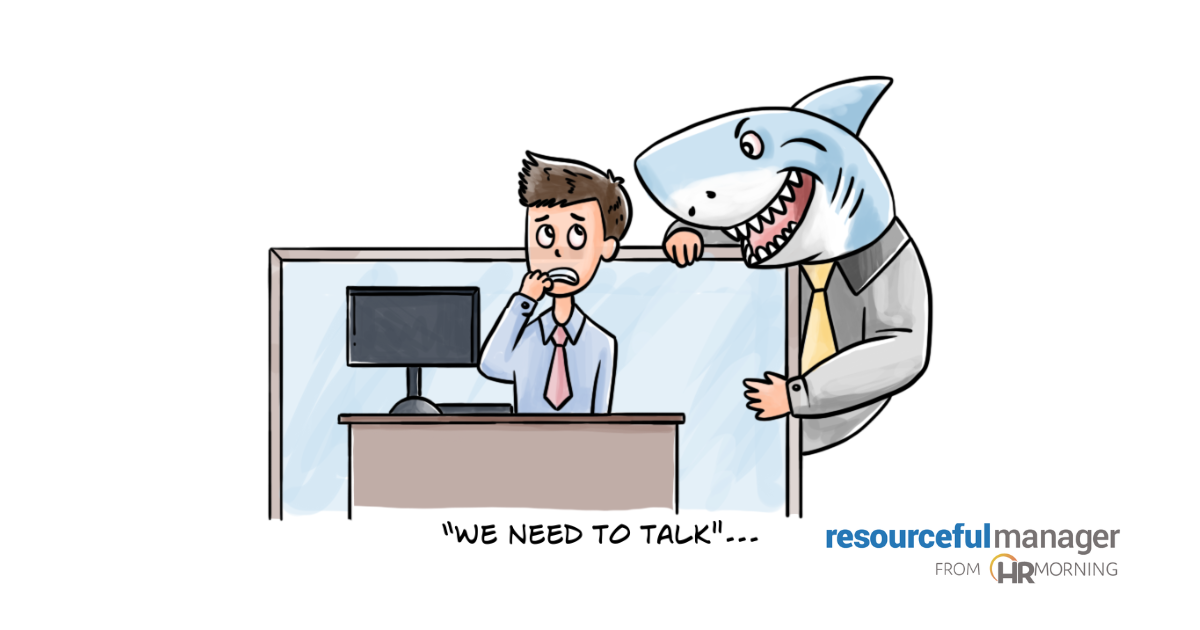
1. ‘We Have to Talk’

… sometimes referred to the four worst words in the English language. Its similar cousins are just as bad: “We need to talk” and “Let’s talk.”

Anything like this without context suggests you have bad news.

Better: Always give context — even if it is bad news. “Sheree, I’d like to talk with you about XYZ. It’ll likely take 30 minutes. What time are you available this morning?”

2. ‘Hey …’

This is commonly referred to as the “Hey hanger.” You drop a “Hey” and let it hang. Meanwhile, the employee’s anxiety rises because they anticipate the worst.

“When it comes to internal communication, managers who send a ‘Hey’ or ‘Hi’ to an employee without any context can trigger a heightened feeling of anxiety as they wonder what message will follow,” says Rosencrans. “While Hey Hanging may not feel intentionally harmful, managers must ensure they’re effectively communicating with their teams so there is little room for misunderstanding. Clear communication is also key to positive work culture and sets the standard for transparency and meaningful feedback.”

Better: Don’t leave them hanging. Use full, clear sentences. “Hey, Robert. It looks like we’ll need to speed up work on the Simpson account. Can we both explore ideas this morning and come to a conclusion on what to do by 1 p.m.?”

3. ‘Got a Minute?’

Although this can bring on similar trepidation as “We have to talk,” the problem with this phrase is that “a minute” is never 60 seconds.

It’s usually many minutes and involves something that’s unpleasant to employees — more work, chastising, bad news, etc.

Better: Be realistic about time. “Vernon, I’d like to talk with you about the Anderson project. Can you step away from what you’re doing for 15 minutes, and no more?”

4. ‘Can We Step into a Meeting Real Quick?’

Similar to the “Got a minute?” this phrase raises questions like, “Oh boy, what’s going on that the boss can’t say it in front of everyone else here?” So the employee hearing it sweats bullets on the way to the meeting room.

Better: Give context. “Dominque, are you available to meet today at 2 p.m. I’d like to discuss the feedback I received from the client.”

5. ‘Would You Be Able to Say a Few Words on …?’

Asking unsuspecting employees to talk in front of a group — even if it’s just your team — with little or no warning can send some people off the deep end. Many people aren’t comfortable with public speaking. Some aren’t naturally prepared to speak off the cuff.

Better: Give them notice. “Jean, I’d like you to speak at our next group meeting about how you adopted the new AI tool. Can you give us 15 minutes?”

6. ‘You’re in Charge of …’

When some people get new or different responsibilities dumped on them, they go into panic mode. They’re worried they won’t know how to handle it, have the time and resources to do it, or will simply fail.

Better: Ask employees, “I think you’d be able to do X. Would you be interested in being in charge of …?”

7. ‘What Were You Thinking?’

Even if you’re trying to get into their mindset — and not being accusatory — this phrase will put employees on the defensive immediately. And that makes sense because you’re essentially asking them to defend their thoughts, ideas and actions.

Better: Clarify that you need clarity. “I’m trying to understand what’s happened and why. Can we talk about the process you went through to get to this point?”

8. ‘That’s a Great Idea, But …’

You can substitute lots of things at the beginning of this sentence — for instance, “It could work, but …,” “You have a point, but …” or “We’d consider it, but …”

Point is, “but” negates everything you’ve said before it. So when a boss says something that starts positive, all the employee hears is that it’s not.

Better: Replace “but” with “and” all the time. “That’s a great idea, and I’d like to hear more.” “It could work, and I’d like to see an outline of the plan.” “We’d consider it, and when you have all the supporting data, we’ll add it to the agenda.”

9. ‘Let Me Be Honest’

Similar: “In all honesty” or “To be honest …” These are similar to the “but” phrases. When you qualify your next statements with honesty, it suggests you aren’t always telling the full truth.

Better: First off, always be honest. From there, give feedback that is clear and seeks to clarify. “What I’ve noticed is X. What I think is Y. Tell me what you think.”

Filed under
RM Logo
  • Performance Management
  • Share on

Get the HRMorning Newsletter

With HRMorning arriving in your inbox, you will never miss critical stories on labor laws, benefits, retention and onboarding strategies.

  • This field is for validation purposes and should be left unchanged.
  • This field is hidden when viewing the form
  • This field is hidden when viewing the form
  • This field is hidden when viewing the form
  • This field is hidden when viewing the form
  • This field is hidden when viewing the form
  • This field is hidden when viewing the form
  • This field is hidden when viewing the form
  • This field is hidden when viewing the form
  • This field is hidden when viewing the form
  • This field is hidden when viewing the form
  • This field is hidden when viewing the form
  • This field is hidden when viewing the form
  • This field is hidden when viewing the form
  • This field is hidden when viewing the form
  • This field is hidden when viewing the form
  • This field is hidden when viewing the form
  • This field is hidden when viewing the form
  • This field is hidden when viewing the form
  • This field is hidden when viewing the form
  • This field is hidden when viewing the form
  • This field is hidden when viewing the form
  • This field is hidden when viewing the form
  • This field is hidden when viewing the form
  • This field is hidden when viewing the form
  • This field is hidden when viewing the form
  • This field is hidden when viewing the form
  • This field is hidden when viewing the form
  • This field is hidden when viewing the form
  • This field is hidden when viewing the form
  • This field is hidden when viewing the form
  • This field is hidden when viewing the form
  • This field is hidden when viewing the form
  • This field is hidden when viewing the form
  • This field is hidden when viewing the form
  • This field is hidden when viewing the form
  • This field is hidden when viewing the form
  • This field is hidden when viewing the form
  • This field is hidden when viewing the form
  • This field is hidden when viewing the form
  • This field is hidden when viewing the form
  • This field is hidden when viewing the form
  • This field is hidden when viewing the form
  • This field is hidden when viewing the form
  • This field is hidden when viewing the form
  • This field is hidden when viewing the form
  • This field is hidden when viewing the form
  • This field is hidden when viewing the form
  • This field is hidden when viewing the form
  • This field is hidden when viewing the form
  • This field is hidden when viewing the form
  • This field is hidden when viewing the form
  • This field is hidden when viewing the form
  • This field is hidden when viewing the form
  • This field is hidden when viewing the form
  • This field is hidden when viewing the form
  • This field is hidden when viewing the form

Free Training & Resources

White Papers

How Gwinnett County Strengthens Employee Wellbeing with Maven

Provided by Maven Clinic

White Papers

Remote Work Requests Are Testing Your ADA Process, Are You Ready?

Provided by AbsenceSoft

Webinars

5 Strategies to Help Employees Understand Total Rewards

Provided by Paycom

White Papers

2026 State of Leave and Accommodations

Provided by AbsenceSoft

SPONSORED CONTENT

HR Technology

sponsored content
The Best AI Software for HR Automation

Courtesy of G-P

Talent Management

sponsored content
Powerful Employee Retention Strategies for 2025: How to Keep Your Best People

Courtesy of PEOPLEGURU

Benefits

Health Care

Wellness

sponsored content
Proven Results: 5 Ways Teladoc Health Chronic Condition Management Transforms HR Outcomes

Courtesy of TELADOC HEALTH

Further Reading

  • Performance Management
6 Huge Employee Egos in the Workplace and How to Handle Them

As a manager, it can be difficult to mold competing personalities into a cohesive team — especially if your team is riddled with some...

  • Performance Management
7 Keys to Give Feedback That’ll Help Employees Grow

Most bosses want to give feedback that helps employees do better. Unfortunately, many give feedback that makes employees feel worse about t...

  • Performance Management
6 of the Most Annoying Employees & How to Handle Them

Whiners. Cynics. Bullies. Complainers. They’re some of the most annoying employees (if not THE most annoying). Your workplace is p...

  • Performance Management
Toughest employees to coach — and 6 steps to get through to them today

Of all the employees you’ll ever have, those who think they aren’t doing anything wrong could be the toughest employees to coach. ...

  • Performance Management
Microbreaks: 1 Fast Tactic to Cut Stress, Boost Productivity | 2-Minute Video

Take a break. It’s easier — and better — than you might think for you and your staff. Hear us out: If you want to...

  • Performance Management
7 Keys to Help Employees Navigate Change in Uncertain Times

Change is about the only certain thing in the workplace today. So HR pros need to help employees navigate change year-round.  In fa...

Get the latest from HRMorning in your inbox PLUS immediately access 10 FREE HR guides.

I WANT MY FREE GUIDES
HR Morning Logo
  • Facebook
  • Linked In
  • ABOUT HRMORNING
  • ADVERTISE WITH US
  • WRITE FOR US
  • CONTACT
  • Employment Law
  • Benefits
  • Recruiting
  • Talent Management
  • Performance Management
  • HR Technology
  • Leadership & Strategy
  • Compensation
  • Policy & Procedures
  • Wellness
  • Staff Departure
  • HR Career & Self-Care
  • Health Care
  • Retirement Plans
  • DEI

HRMorning, part of the Rover Insights Network, provides the latest HR and employment law news for HR professionals in the trenches of small-to-medium-sized businesses. Rather than simply regurgitating the day's headlines, HRMorning delivers actionable insights, helping HR execs understand what HR trends mean to their business.

Powered By Rover Insights
Privacy Policy | Terms of Service
Copyright© 2026 Rover Insights
HRMorning Logo

WELCOME BACK!

Enter your username and password below to log in

Forget Your Username or Password?

Reset Password

Lost your password? Please enter your username or email address. You will receive a link to create a new password via email.

Log In

Why do we need your credit card for a free trial?

We ask for your credit card to allow your subscription to continue should you decide to keep your membership beyond the free trial period.  This prevents any interruption of content access.

Your card will not be charged at any point during your 21 day free trial
and you may cancel at any time during your free trial.

During your free trial, you can cancel at any time with a single click on your “Account” page.  It’s that easy.