• Skip to primary navigation
  • Skip to main content

HRMorning

  • FREE RESOURCES
  • PREMIUM CONTENT
  • HR DEEP DIVES
  • PODCASTS
    • VOICES OF HR
    • WOMEN’S LEADERSHIP TODAY
  • LOGIN
  • GET STARTED
  • Employment Law
  • Benefits
  • Recruiting
  • HR Technology
  • Payroll
  • Management
  • Women’s Leadership
  • More
    • Talent Management
    • Performance Management
    • Leadership & Strategy
    • Compensation
    • Policy & Procedures
    • Wellness
    • Staff Departure
    • HR Career & Self-Care
    • Health Care
    • Retirement Plans
WLT Logo
  • Leadership & Strategy

4 Stages of an Emotional Hijack — and How to Regain Control When It Happens

Michele McGovern
By: Michele McGovern
Read it on Beacon
  • Share on

About the Author

Michele McGovern writes. A lot. These days, she covers HR, digging deep into company culture, DEI, leadership, management and the everchanging world of work. In the years between getting a BA in journalism from a state school and writing about HR, she wrote about big-city crime for a wire service and small-town life for local newspapers. She’s a mediocre mom, decent wife, wannabe athlete and consummate pursuer of fun - on land, snow and water. Find her on LinkedIn @michele-mcgovern-writer.

Show Less
Last Updated: February 19, 2026
3 minute engagement
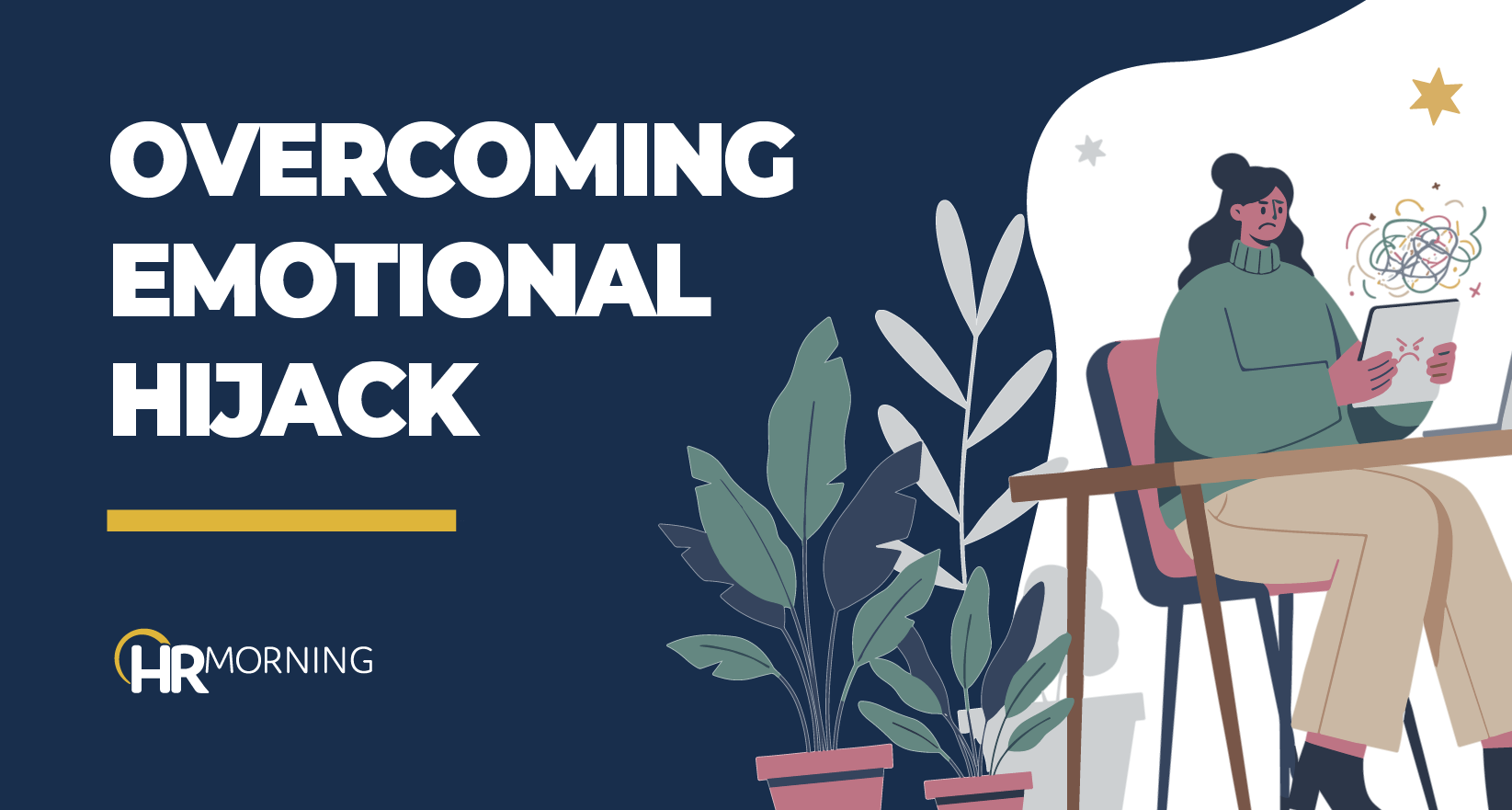
HR Morning blog graphic titled “Overcoming Emotional Hijack” with an illustration of a stressed employee at a desk using a laptop.
You read HRMorning's newsletter. Beacon's Daily Brief is the version tuned to you: it skips what you've already read and leads with what you've asked Beacon about. Get your Daily Brief →

We’ve all been there – that moment when emotions take over and we react without thinking.

This experience — known as “emotional hijack” — can have significant consequences in the workplace if not managed properly.

Understanding what drives these moments and learning preventative strategies are key to maintaining healthy working relationships.

What is Emotional Hijack?

Emotional hijack refers to a strong emotional reaction that overrides rational thinking and self-control. Common behaviors during a hijack include:

  • Jumping to conclusions
  • Experiencing a racing heart
  • Tensing up
  • Bursting out in anger
  • Struggling to think clearly
  • Shutting down, or
  • Demonstrating other extreme emotional reactions.

What often follows is regret, embarrassment, confusion and apologies once the moment has passed.

Emotional hijacks are intense experiences where we act compulsively without consideration of long-term impacts. The reaction often feels automatic and beyond our control in the heat of the moment, even though we later wish we had responded differently. Sometimes emotional hijacks build up over time if frustrations aren’t properly addressed.

The 4 Stages of Emotional Hijack

Emotional hijack often follows a common pattern:

  1. Identifying the trigger: The hijack begins with an event that acts as a “trigger,” sparking a strong emotion like anger, anxiety or humiliation. For example, a co-worker publicly criticizing your work can initiate feelings of anger or inadequacy.
  2. Feeling a strong emotion: The emotion intensifies rapidly, building in the body and mind. Heart rates spike, face flush, thoughts narrow. As emotion strengthens, rational perspectives diminish.
  3. Automatically reacting: We react compulsively to the emotion rather than responding thoughtfully. Reactions might include yelling, criticism, stonewalling or even aggression. We operate in survival mode without considering long-term consequences.
  4. Regret: After the moment passes, a sense of regret often follows. We may feel embarrassed by an aggressive outburst or disappointed in ourselves for losing control.

Developing Emotional Intelligence to Prevent Hijacks

Low emotional intelligence can lead to more instances of emotional hijacking. When we’re unable to self-regulate emotions, trivial triggers can escalate into disproportionate reactions. Communication shuts down. Teams fracture. Over time, negative patterns erode workplace relationships and performance.

Emotional intelligence requires self-awareness, self-control, empathy, and relationship skills. Strategies like the ones below build capacity.

1. Name Your Emotions

Name specific emotions in the moment rather than reacting blindly. Some researchers say that if you label your emotions accurately, it helps lessen the impulsive reactions.

For instance, try to figure out if you’re frustrated, hurt, disappointed, betrayed or overwhelmed. Research from UCLA has shown that naming emotions decreases amygdala activity and increases prefrontal cortex control.

2. Note Your Cues

Notice physical cues, like tense muscles, clenched fists, shallow breathing, increased heart or tightening. If you catch these early enough, you can prevent escalation.

Try a quick body scan for soft shoulders, relaxed jaw, open hands, and slow breathing. 

3. Pause

Pause before responding to let intensity pass. The pause is a micro-strategy for regaining executive control. It interrupts emotional momentum and gives your nervous system time to settle.

When triggered, say nothing for a beat. Take one deep breath. Even better, if needed, ask to revisit the conversation later: “I want to think about that before I respond.”

4. Step Back

Put yourself in others’ shoes during conflicts.  Emotional hijacks often narrow perspective; empathy widens it. 

After you pause, silently ask, “What might they be feeling or needing right now?” This not only softens your response but helps you communicate in ways that de-escalate and repair trust.

Use Emotional Intelligence to Navigate

Collective emotional intelligence also matters. Workplace norms around communication, rules, and understanding leadership dynamics determine how well companies navigate tense situations. Emotionally intelligent cultures value respect, accountability and resilience.

Without emotional intelligence, trivial matters detonate more easily while underlying issues go unaddressed. Companies must prioritize training and norms that proactively shape response patterns. The baseline begins with each employee’s commitment to self-awareness, empathy, and relationship maintenance. It ends with healthier, higher-performing teams.

Read it on Beacon
Open this article in Beacon, from HRMorning, and ask how it applies to your company. Every answer names its source.
Read it on Beacon
Get HRMorning's newsletter tuned to you every morning: your Daily Brief on Beacon →
Filed under
WLT Logo
  • Leadership & Strategy
  • Share on

Get the HRMorning Newsletter

With HRMorning arriving in your inbox, you will never miss critical stories on labor laws, benefits, retention and onboarding strategies.

Get it free with a Beacon account. Beacon keeps your company's HR context at hand, and every answer names its source.
Create my free account

Free Training & Resources

White Papers

State of Women’s and Family Health Benefits 2026

Provided by Maven Clinic

White Papers

The Open Enrollment Communication Toolkit: Every Message, Ready to Send

White Papers

The High-Risk Pregnancy Gap: Catch Complications Before They Become Claims

Provided by Maven Clinic

White Papers

Uncovering the Real Value of Discount Shopping Programs

Provided by PerkSpot

SPONSORED CONTENT

Compensation

Recruiting

sponsored content
Salary Benchmarking: 6 Choices That Decide Whether Your Pay Data Holds Up

Courtesy of MARSH

Employment Law

Policy & Procedures

sponsored content
Policy Rollout: 4 Checkpoints That Show Employees Got the Message

Courtesy of NAVEX

Benefits

Staff Administration

sponsored content
PEO ROI: 3 Numbers to Know Before You Leave Patchwork HR

Courtesy of TRINET

Further Reading

  • Leadership & Strategy
The Power of Resolve: 7 Ways to Make This Trait Work Better for You

From subtle biases to outright discrimination, women leaders often face obstacles their male counterparts do not. Cultivating an unshakable...

  • Leadership & Strategy
7 Steps to Build a Team That Outperforms the in Critical Time

A team that succeeds is more than just a group of skilled individuals; it is a cohesive unit that collaborates effectively, adapts to chall...

  • Leadership & Strategy
6 Keys to Lead with Authenticity in Today’s Workplace

Authenticity in leadership is no longer just a buzzword: It’s a necessity. With the rise of social media, transparent corporate c...

  • Leadership & Strategy
Remembering Dianne Feinstein: A Trailblazer for Women’s Leadership and Empowerment 

The recent passing of Senator Dianne Feinstein at age 90 marks the end of an era in American politics. For over 30 years, Feinstein serv...

  • Leadership & Strategy
Creativity in the Workplace: 8 Ways to Inspire Innovation in Your Team

Creativity isn’t just reserved for artists and visionaries: It’s a vital force in every workplace, driving innovation, solving complex ...

  • Leadership & Strategy
Turn Stress Into Strength: A New Outlook for Women Leaders

We’re often told stress is a liability – a fast track to burnout or poor performance. But for women in leadership, shifting that minds...

Get the latest from HRMorning in your inbox PLUS Beacon, free. Check it before you say it.

GET STARTED FREE
HR Morning Logo
  • Facebook
  • Linked In
  • ABOUT HRMORNING
  • ADVERTISE WITH US
  • WRITE FOR US
  • CONTACT
  • Employment Law
  • Benefits
  • Recruiting
  • Talent Management
  • Performance Management
  • HR Technology
  • Leadership & Strategy
  • Compensation
  • Policy & Procedures
  • Wellness
  • Staff Departure
  • HR Career & Self-Care
  • Health Care
  • Retirement Plans
  • DEI

HRMorning provides the latest HR and employment law news for HR professionals in the trenches of small-to-medium-sized businesses. Rather than simply regurgitating the day's headlines, HRMorning delivers actionable insights, helping HR execs understand what HR trends mean to their business.

Privacy Policy | Terms of Service | HRMorning Insider? Manage your subscription
Copyright© 2026 Rover Insights
HRMorning Logo

WELCOME BACK!

Enter your username and password below to log in

Forget Your Username or Password?

Reset Password

Lost your password? Please enter your username or email address. You will receive a link to create a new password via email.

Log In

Why do we need your credit card for a free trial?

We ask for your credit card to allow your subscription to continue should you decide to keep your membership beyond the free trial period.  This prevents any interruption of content access.

Your card will not be charged at any point during your 21 day free trial
and you may cancel at any time during your free trial.

During your free trial, you can cancel at any time with a single click on your “Account” page.  It’s that easy.