Sick of Whining Employees? 6 Better Ways to Handle Their Gripes

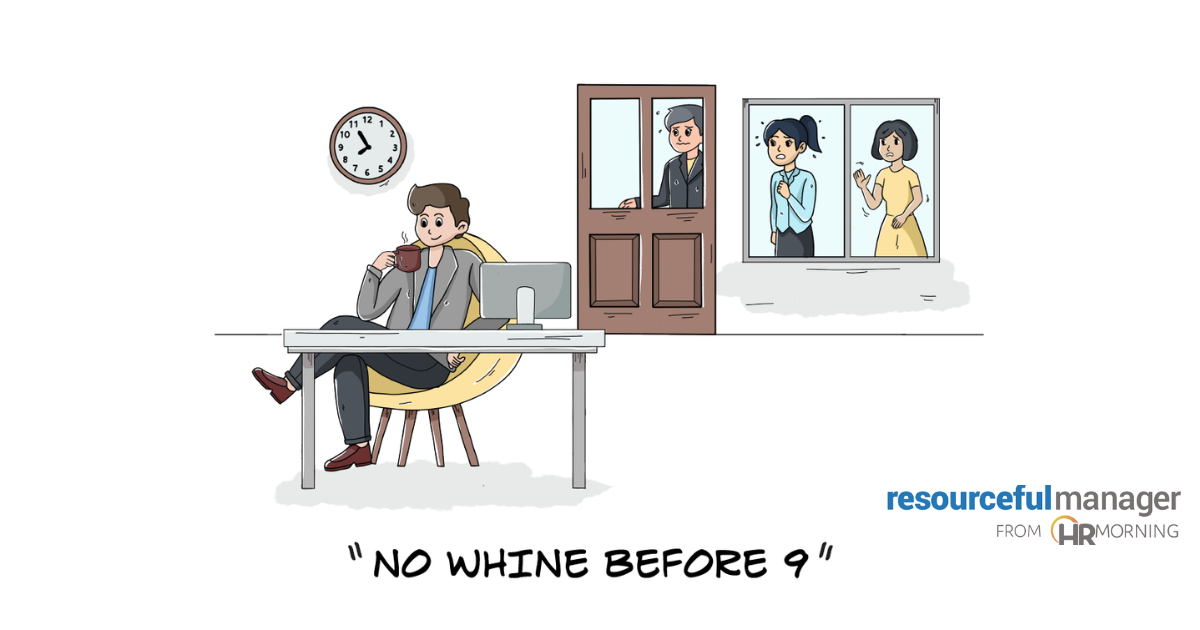
When you’re a manager, it can be difficult to escape the whining these days.
From the moment you walk in the door or turn on your computer, you probably hear something: Maureen complains about trying to get to work when she has to keep up with a toddler. Drew doesn’t want to hear it – he has to pick up the slack for her. Cameron thinks they’re both selfish – and expresses it loudly. And Jules’ gripe: Everyone picks on me!
Research proves this isn’t just your problem. Employees hate a lot of things about co-workers – from their work ethic to negative personalities to their lack of organization – according to a KickResume study. Ironically, they complained about … complainers!
And they dislike workplace issues, too – from communication protocols to micromanagement to pay policies, according to the National Business Research Institute.
Can’t Avoid Whining Employees
So as a leader, you pretty much can’t avoid whining employees.
But you can be a leader who helps employees solve issues, accept differences and work together effectively.
“Companies should also create an office environment where employees want to work and can be their best,” says Niamh Graham, SVP of Global Human Experience at Workhuman. “It starts by demonstrating to employees that they are valued.”
When employees feel valued, they work toward the common goals, rather than whine about what makes them different.
Here are six ways to deal with whining employees and their latest workplace gripes:
1. Hear It Out
As much as you’d like to tune out a chronic complainer or a seemingly minor gripe, don’t. Treat every complaint that comes your way as a legitimate one that warrants a management solution.
And don’t put off action. Small complaints can turn big and lawsuit-worthy if solutions are delayed.
2. Connect First
First action step: Step back!
When employees thrust into complaining mode, managers often react in one of two ways: dismissing or problem-solving. Neither is helpful at first.
Instead, reflect to connect, suggests David Dye, president of Let’s Grow Leaders and host of the podcast, “Leadership without Losing Your Soul.”
Lean in and listen. Then remove some intensity by recognizing the emotion. Say, “It sounds like you’re frustrated. Do I have that right?”
From there, you can move toward a productive conversation without validating or condemning how the employee feels.
3. Ask Questions
If you ask these three questions early in the conversation, you might uncover if you even need to step in, and if you do, how to move forward.
- What do you want me to know?
- How might I help here?
- Should we talk more privately with anyone else?
4. Take It to the Next Level (or Not)
With the answers to those three questions, you can probably figure out if the whining employee is:
- Just venting
- Experiencing a misunderstanding
- Battling opposing priorities or differing goals
- Dealing with a personality conflict, or
- The victim of toxic behavior or of being toxic.
Each of these situations calls for different solutions – some you definitely need to be involved in, some you need to give direction and one you can let be.
5. Move On a Solution
For the five abovementioned complaints, consider these tips for immediate action (and recognize you’ll need to do more when the complaint involves any potential level of harassment):
- Venting: Let employees get it out. Recognize their frustration and encourage everyone to move on.
- Misunderstandings: Ask employees to gather all pertinent information and review it together to find where the issues bubbled up and how they can be avoided going forward.
- Priorities or goals: Step back to stated and unstated expectations. Then work to identify an agreed-upon, shared goal going forward.
- Personality conflicts: You might want to get HR involved in this, as it could escalate. But if it’s at a low level, work with employees to arrange work so they interact less.
- Toxic behavior: Get HR involved. This is a dangerous, potentially litigious area.
6. Schedule a Finish
Aside from venting, set up a time in the future when you can talk about what was happening and how it’s changed since you worked together on it.
If it’s not resolved – and employees continue to whine – you might need to go back to the root cause analysis.

- Share on


Free Training & Resources
White Papers
Provided by Maven Clinic
White Papers
Provided by Maven Clinic



