• Skip to primary navigation
  • Skip to main content

HRMorning

  • FREE RESOURCES
  • PREMIUM CONTENT
  • HR DEEP DIVES
  • PODCASTS
    • VOICES OF HR
    • WOMEN’S LEADERSHIP TODAY
  • LOGIN
  • GET STARTED
  • Employment Law
  • Benefits
  • Recruiting
  • HR Technology
  • Payroll
  • Management
  • Women’s Leadership
  • More
    • Talent Management
    • Performance Management
    • Leadership & Strategy
    • Compensation
    • Policy & Procedures
    • Wellness
    • Staff Departure
    • HR Career & Self-Care
    • Health Care
    • Retirement Plans
  • Recruiting

Skills Flipping: 3 Things HR Needs to Know About Job Candidates’ New Trick

Michele McGovern
By: Michele McGovern
Read it on Beacon
  • Share on

About the Author

Michele McGovern writes. A lot. These days, she covers HR, digging deep into company culture, DEI, leadership, management and the everchanging world of work. In the years between getting a BA in journalism from a state school and writing about HR, she wrote about big-city crime for a wire service and small-town life for local newspapers. She’s a mediocre mom, decent wife, wannabe athlete and consummate pursuer of fun - on land, snow and water. Find her on LinkedIn @michele-mcgovern-writer.

Show Less
Last Updated: August 31, 2026
4 minute engagement
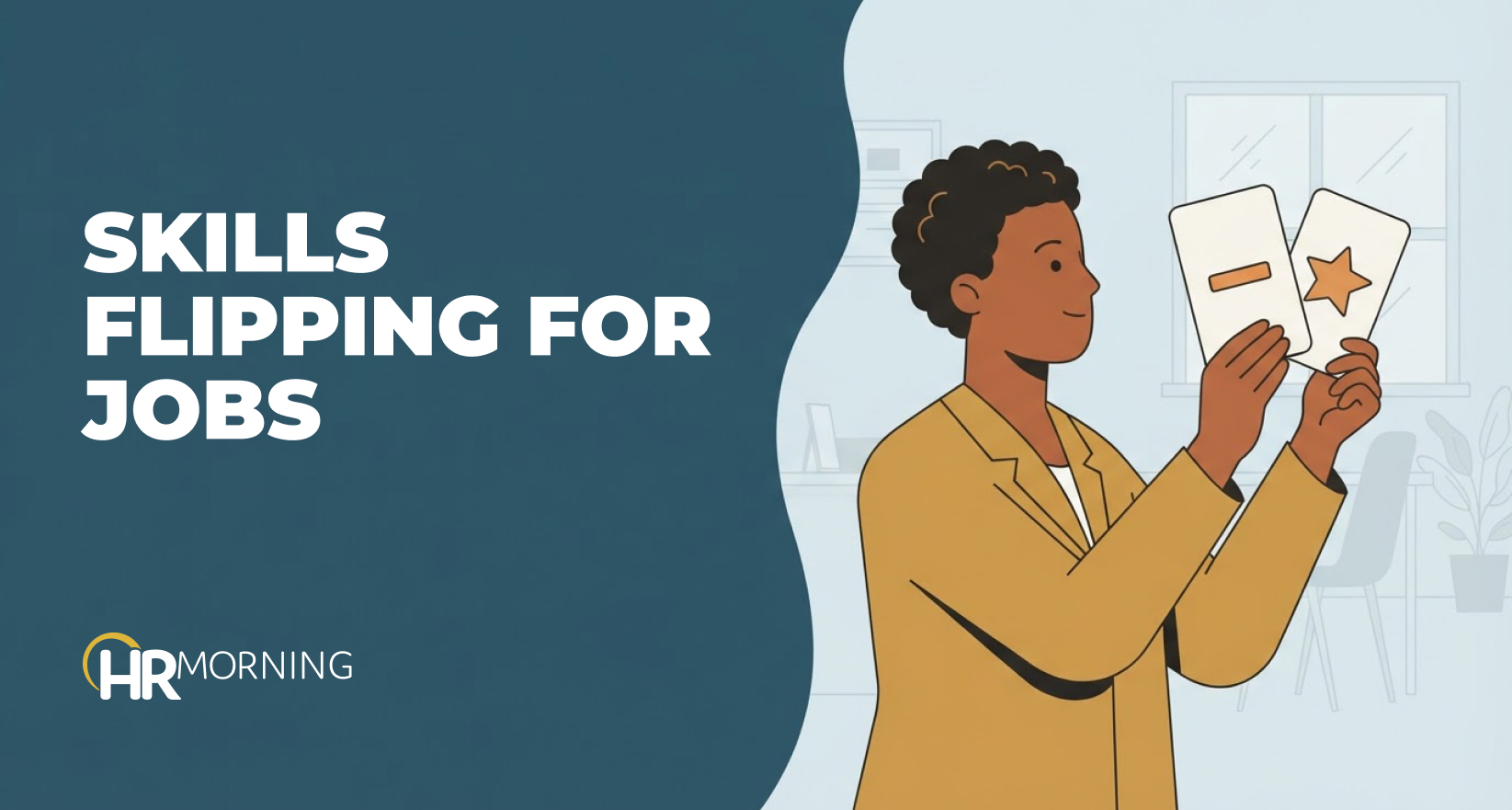
Illustration of a job candidate flipping a card from a minus to a star, reframing a weakness as a strength in skills-based hiring.
You read HRMorning's newsletter. Beacon's Daily Brief is the version tuned to you: it skips what you've already read and leads with what you've asked Beacon about. Get your Daily Brief →

Skills-based hiring calls for a new trend that will help employers and employees get hiring even closer to perfect:

Job candidates are “skills flipping” — turning what might be considered negative traits into strengths. It’s causing employers to reconsider how that trait could work in the increasingly skills-based hiring environment.

That’s reflected in job postings: 51% of Indeed postings didn’t mention formal education requirements.

Skills Flipping for Skills-Based Hiring

To counter the drop in degree requirements, many organizations have shifted hiring priorities. More than 75% of employers used personality and skills tests for hiring in 2025, according to data from TestGorilla.

Both sides of the hiring equation are still a bit uncertain on how to make it work best, according to Adam Stamm, Managing Partner at Online DISC Profile.

“I’ve noticed a tension with hiring managers. They are feeling the pressure to fill roles faster than ever, but the reality is that they are short on people whom they feel confident inviting to interview,” says Stamm. “Formal qualifications may all be there, but the candidate’s behavior patterns and practical skillset just don’t align.”

Meanwhile, for job seekers, “skills-based hiring that feels deeply alien to them, having been reassured by college professors that a good degree will help them stand out from the crowd,” Stamm says. “This shift to skills-based hiring has candidates putting their personalities under a microscope and looking for ways to counteract any negatives.”

And that’s where skills flipping comes in: Job candidates will likely work toward making their skills — the good and bad — work for the role they want. That’s not terrible, either. Hiring managers likely want adaptable employees.

What Skills Flipping Can’t Replace

Of course, not everyone can or should adapt.

“I’m not saying that downright toxic or difficult behavior can be explained away as a secret strength,” says Stamm. “But I do feel there’s a middle ground where a trait that might have traditionally caused friction could be reset to be thought of as valuable.”

Even when you’re balancing skills, the role and personality traits, three important factors in every job placement remain the same:

  1. Can they do the job?
  2. How do they behave working in a team?
  3. Will their style of working help or hinder the existing team?

With that in mind, here are three tips to keep in mind when hiring based on skills as job candidates start to practice more skills flipping:

1. Reimagine Candidate Traits, Behaviors

Take a contrary perspective on behavioral signs when talking or meeting with job candidates.

For instance, perhaps the person who seems a bit too chatty won’t be a distraction or office gossip. Perhaps that person will be a great communicator at a time when AI makes soft skills a lost art.

Another example: the apparent introvert.

“Someone who describes themselves as cautious or introverted may be highlighting the attention to detail and consistency required for compliance, quality assurance, finance or operations roles,” says Danielle Balow, Vice President of Customer Transformation at Click Boarding. “The idea of ‘skills flipping’ isn’t necessarily about changing who you are. It’s about learning how to market your strengths in a way that connects to the needs of an employer.”

So when you reimagine candidates’ traits, you may find they’d be a good fit for a different role. This is especially important when you’re hiring from within.

“This reframing is very useful for HR professionals because it helps to make personality ‘labels’ very role-relevant,” says DISC Profile’s Stamm.

2. Look Beyond Resumes 

Lots of resumes look perfect for the job. That’s because these days, many candidates get AI to adapt their resume to align perfectly for a job description.

Don’t let the perfect resume sway you to the wrong candidates.

Jason Rodgers, a content writer at PepThrive involved in hiring for his team, has found that some candidates he didn’t expect to be good outperform those with stronger resumes when tested on the actual work.

“Over the course of my career, I’ve watched biology graduates outperform marketing graduates in content roles,” says Rodgers. “In our last hiring round at PepThrive, the candidates who passed a written test on an unfamiliar topic were the ones who hit full output in their first three weeks. The ones with stronger resumes took twice as long.” 

When possible, have job candidates produce samples of their work or have them demonstrate their skills through simulated work.

3. Consider Alternative Work Arrangements

Some employers immediately discard applications if the candidate doesn’t fit the job schedule mold.

For instance, a candidate might want part-time work because they’re working another job. But their skills are just right. If you say no, you might be turning down someone who can bring more to the role part-time than someone who is full-time but doesn’t have the skills you need.

“Someone who can balance multiple jobs, or who has caregiving responsibilities and passion projects outside of their career, will often have developed time management skills and a genuine resilience that someone with no other demands on their time can’t match,” says Tabby Farrar, Head of Search and hiring manager at marketing agency Candour.

In this case, you may gain an employee who is incredible at time management, focused work and adaptability — skills they can help other employees develop.

Read it on Beacon
Open this article in Beacon, from HRMorning, and ask how it applies to your company. Every answer names its source.
Read it on Beacon
Get HRMorning's newsletter tuned to you every morning: your Daily Brief on Beacon →
Filed under
  • Recruiting
  • Share on

Get the HRMorning Newsletter

With HRMorning arriving in your inbox, you will never miss critical stories on labor laws, benefits, retention and onboarding strategies.

Get it free with a Beacon account. Beacon keeps your company's HR context at hand, and every answer names its source.
Create my free account

Free Training & Resources

White Papers

The True Cost of a Delayed Diagnosis

Provided by Maven Clinic

Webinars

Upskill, Reskill and Retain: How to Future-Proof Your Workforce

Provided by PAYCOM

White Papers

Are Your ADA and PWFA Processes Putting You at Risk?

Provided by AbsenceSoft

White Papers

Uncovering the Real Value of Discount Shopping Programs

Provided by PerkSpot

SPONSORED CONTENT

Compensation

Recruiting

sponsored content
Salary Benchmarking: 6 Choices That Decide Whether Your Pay Data Holds Up

Courtesy of MARSH

Employment Law

Policy & Procedures

sponsored content
Policy Rollout: 4 Checkpoints That Show Employees Got the Message

Courtesy of NAVEX

Benefits

Staff Administration

sponsored content
PEO ROI: 3 Numbers to Know Before You Leave Patchwork HR

Courtesy of TRINET

Further Reading

  • Recruiting
Something’s Wrong With Hiring, and It’s Not AI: 2 Reasons Buried in the Data

Many employers claim they’ve cut back on hiring because AI can do the job entry-level work employees once did. But a new report fr...

  • Recruiting
The complete guide to effective employee referral programs

Once referred to as the “holy grail of hiring” by Forbes, employee referral programs are one of the most productive ways to find high-q...

  • Recruiting
The Rise of the Freelance Economy: HR’s New Responsibility

The way that businesses fundamentally operate is evolving, and HR needs to adapt. For example, companies are increasingly leveraging freela...

  • Recruiting
Posting Ghost Jobs Could Be Illegal: 7 Better Ways to Recruit

Lawmakers in several states have proposed bills targeting Ghost Jobs – roles posted that don’t exist or employers don’t intend to fil...

  • Recruiting
Gen Z Alienated by Hiring Pain Points, Age Bias: How HR Can Turn It Around

Johns Hopkins University predicts Gen Z will comprise 30% of the workforce by 2030. Figuring out how to engage this generation is going to ...

  • HR Technology
  • Recruiting
AI Hiring Bias: How HR Can Understand and Mitigate Potential Pitfalls

The rapid adoption of artificial intelligence (AI) can bring major benefits for HR pros to help save time and put effort into what really m...

Get the latest from HRMorning in your inbox PLUS Beacon, free. Check it before you say it.

GET STARTED FREE
HR Morning Logo
  • Facebook
  • Linked In
  • ABOUT HRMORNING
  • ADVERTISE WITH US
  • WRITE FOR US
  • CONTACT
  • Employment Law
  • Benefits
  • Recruiting
  • Talent Management
  • Performance Management
  • HR Technology
  • Leadership & Strategy
  • Compensation
  • Policy & Procedures
  • Wellness
  • Staff Departure
  • HR Career & Self-Care
  • Health Care
  • Retirement Plans
  • DEI

HRMorning provides the latest HR and employment law news for HR professionals in the trenches of small-to-medium-sized businesses. Rather than simply regurgitating the day's headlines, HRMorning delivers actionable insights, helping HR execs understand what HR trends mean to their business.

Privacy Policy | Terms of Service
Copyright© 2026 HRMorning
HRMorning Logo

WELCOME BACK!

Enter your username and password below to log in

Forget Your Username or Password?

Reset Password

Lost your password? Please enter your username or email address. You will receive a link to create a new password via email.

Log In

Why do we need your credit card for a free trial?

We ask for your credit card to allow your subscription to continue should you decide to keep your membership beyond the free trial period.  This prevents any interruption of content access.

Your card will not be charged at any point during your 21 day free trial
and you may cancel at any time during your free trial.

During your free trial, you can cancel at any time with a single click on your “Account” page.  It’s that easy.