Why Managers Are Getting Ticked Off (and How To Engage Them Again) | 2-Minute Video

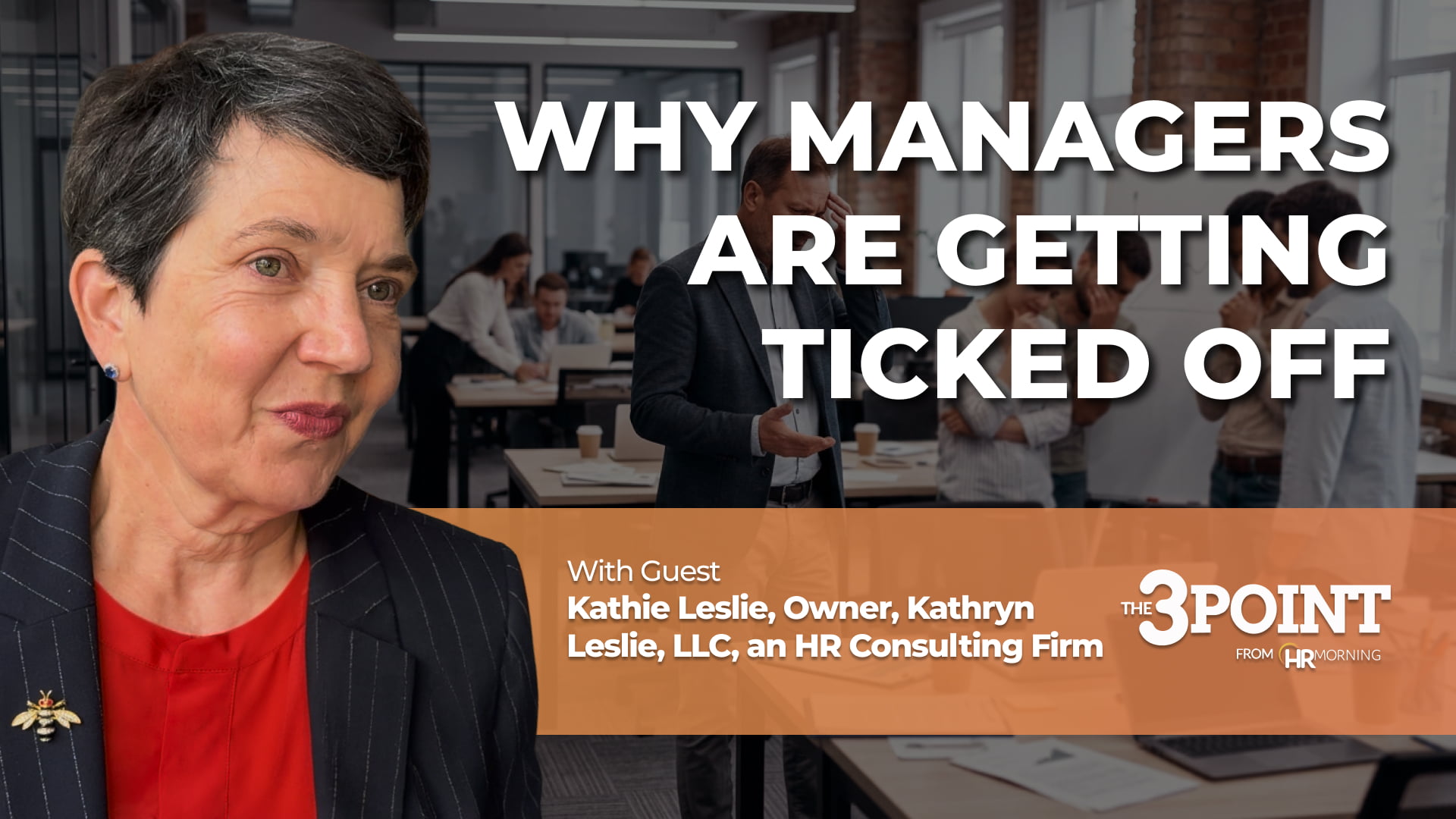
Your managers aren’t just disengaged. Many are ticked off.
They might not want to leave you. But they don’t necessarily want to stay.
And the main reasons will likely surprise you.
What’s Up in This Episode: Engage Ticked Off Managers
In this episode of HRMorning’s 3-Point, Kathie Leslie, Owner of Kathryn Leslie, LLC, an HR consulting firm, explains why managers are getting ticked off these days. More importantly, she’ll share ideas on what employers can do to stop the disengagement and how to get employees engaged again.
Click, watch and listen for more details on what’s hurting management disengagement and how to fix it.
Transcript (edited for clarity):
Employee engagement – or the lack of it – has been all the rage for years. But guess who’s really disengaged? You’ll find out in this episode of the 3-Point. Plus, our expert is going to explain why this group is ticked off … and what you can do to make things right again. Let’s dive in.
Kathie Leslie, Owner, Kathryn Leslie, LLC: “One of the interesting things about disengagement is, who is disengaged? Right now, some of the lowest disengagement scores that we’re seeing, and this is from the Gallup poll, are with first-level managers and younger workers. So these may be people who have recently entered the workforce and their managers.
“And a lot of times their managers may be frustrated because they’re stuck in a system where maybe the people who they feel should be promoted or should be moved up, but the higher-ups say, ‘No, no, no, not that person.’ And they’re like, ‘What’s the point? I invested all this time and energy into this person to develop this person and trying to get them ready and I get shut down by the system.”
Oftentimes, the old system kills engagement. So then the manager starts to wonder?
Leslie: “‘What? Do I need to be an asshole to get promoted?’ Because what they were seeing was that this individual was achieving some great results, but at the cost of a lot of angst from the team around them and perhaps negative behavior. And those are harder to measure.
Why? It’s because we just expect people to know how to behave. But if there’s no expectation, then people will almost always be disappointed. That’s why …
Leslie: “You have to do the work up front to make sure you are providing a balanced viewpoint of not just measuring the right outcomes, and outcomes that matter to the business, but also the right behaviors.”
So, we want to get our managers engaged. Or avoid letting them become disengaged. To do that:
- Recognize the issue. Managers are frustrated over systems that make them feel hand-tied. Find out what limits your managers.
- Set new expectations. Leslie told me workplaces need standards of behavior for how we treat one another and respect different viewpoints.
- Measure both standards. When it comes to performance, balance performance results and behavior. They impact the workplace and its people.
Remember, managers are employees, too. They could be your most vulnerable when it comes to engagement. You can find even more tools to support them on the HRMorning website under our ResourcefulManager tab. Thanks for joining me in this episode.
- Share on


Free Training & Resources
White Papers
Provided by AbsenceSoft
White Papers
Provided by PerkSpot