• Skip to primary navigation
  • Skip to main content

HRMorning

  • FREE RESOURCES
  • PREMIUM CONTENT
  • HR DEEP DIVES
  • PODCASTS
    • VOICES OF HR
    • WOMEN’S LEADERSHIP TODAY
  • LOGIN
  • SIGN UP FREE
  • Employment Law
  • Benefits
  • Recruiting
  • HR Technology
  • Payroll
  • Management
  • Women’s Leadership
  • More
    • Talent Management
    • Performance Management
    • Leadership & Strategy
    • Compensation
    • Policy & Procedures
    • Wellness
    • Staff Departure
    • HR Career & Self-Care
    • Health Care
    • Retirement Plans
  • Performance Management

Change Fatigue is Real: 4 Ways to Build Change-Ready, Resilient Teams

Dave Barnett, HR Expert Contributor
By: Dave Barnett, HR Expert Contributor
  • Share on

About the Author

Dave Barnett is the Chief Administrative Officer for DeVry University. In this role, Barnett is focused on aligning DeVry leadership and talent to achieving the university’s most important work, while also helping its partners with talent strategies to do the same. He has responsibility for leading our DeVryWorks partnership strategy, while also driving the direction of Human Resources, Diversity Equity & Inclusion, Public Relations, Communications and Alumni Relations efforts for the University.

Show Less
Last Updated: March 9, 2026
4 minute engagement
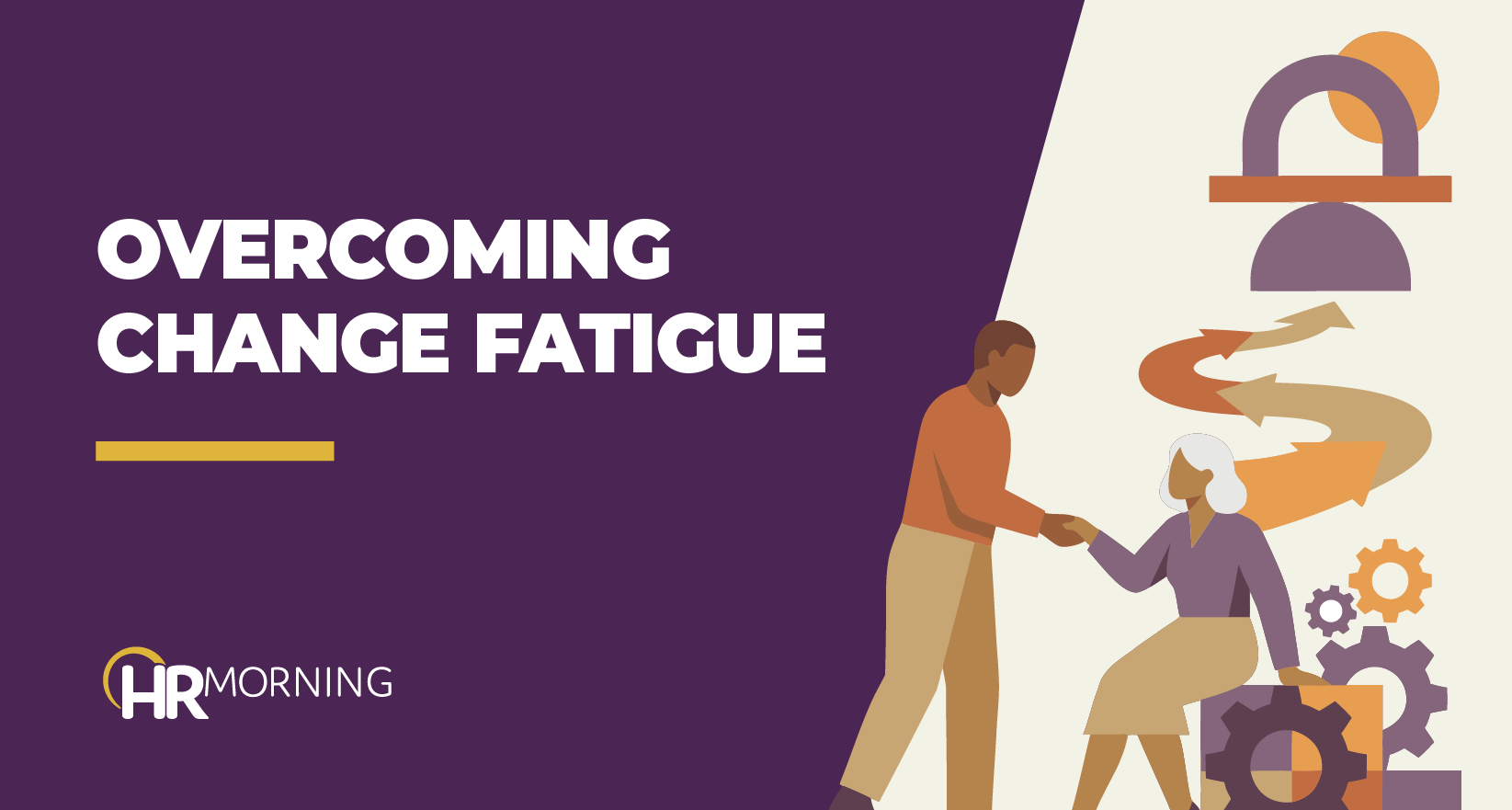
HR Morning graphic titled “Overcoming Change Fatigue,” featuring coworkers supporting each other with arrows and gears to represent workplace change management, resilience, and organizational transformation.

The pace of change in today’s workplace isn’t just accelerating — it’s becoming relentless. From shifting workplace expectations to the rapid deployment of emerging technologies and ongoing business transformations, employees are under constant pressure to adapt. 

According to Gartner’s HR Trends report, 73% of HR leaders say employees suffer change fatigue, caused by the constant transformation occurring around them. Nearly 75% say managers are not equipped to lead that change effectively. That gap is not just a performance issue. It’s a well-being issue. As HR leaders, we need to address it with urgency as we move into 2026.

I’ve had the opportunity to speak at both SHRM Talent 2025 and SHRM25 last year, where the dominant theme among leaders was clear: employees are overwhelmed. From AI upskilling to new business models, transformation is everywhere but support isn’t always keeping pace. What many organizations are discovering is that you can’t drive change sustainably without trust, reliable leadership and employee buy-in.

Change Fatigue Is a Human Response, Not a Resistance

One of the biggest misconceptions about change fatigue is that it’s simply resistance. In reality, it’s a response to prolonged uncertainty and unmanaged pressure.  Employees don’t resist change because they’re unwilling; they often resist because they don’t feel equipped, supported or seen.

In a conversation with Training Industry, I discussed how organizations frequently focus on cognitive competence, delivering training and upskilling programs, without addressing emotional confidence. Employees need to believe in the change, feel psychologically safe to engage with it and see leaders modeling the behavior themselves.

Change without belief is simply compliance. And compliance doesn’t scale resilience.

1. Equip Managers to Lead, Not Just Manage

Gartner research also showed that nearly three-quarters of managers feel unprepared to lead change. That’s not surprising. Oftentimes, many managers were promoted based on technical skill, not people leadership. But in high-change environments, technical ability is not enough.

To support employees through change, managers need more than operational know-how; they need tools, communication skills and confidence to lead people through uncertainty. That includes:  

  • Setting clear expectations
  • Navigating challenges with care and empathy  
  • Reinforcing small wins to sustain momentum, and
  • Fostering transparency by sharing what’s known and what’s evolving.

Transparency builds trust. And trust expands capacity. When managers understand not only how to lead but why their leadership matters, their teams feel more anchored even during disruption.

2. Build Capacity with Incremental, Purposeful Change

High-performing organizations don’t overwhelm teams with sweeping changes. They introduce change incrementally with purpose, clarity and reinforcement.  

Think about change this way: When filling a bucket with water, blasting it with a fire hose leads to most water spilling out (and perhaps a broken bucket), but slowly adding water allows you to fill the bucket to the very top. Introducing change incrementally allows employees to process change gradually and increases overall capacity.

This is especially critical in the context of emerging technologies like generative AI. If we introduce new tools without connecting them to people’s daily work, or without giving them space to ask questions and make mistakes, we risk turning innovation into anxiety. In that respect, DeVry’s 2024 report revealed security concerns, ethical questions and practical skills gaps around the proper use of AI.

The research underscored that many employers underestimate how extensively employees have already adopted AI tools, and if these gaps in understanding and support were left unaddressed, organizations and workers could put themselves at risk. Instead, organizations should prioritize job-relevant training and consistent reinforcement. Highlight not just the tool but the reason behind it. And always communicate the “why now.” Urgency without context can erode confidence.

3. Empower Teams Through Change Ownership

A mindset shift I often emphasize is to frame transformation not as something done to employees but with them. The more teams feel they can shape, influence or contribute to change, even in small ways, the less likely they are to experience fatigue.

At DeVry, for example, we’ve made a deliberate effort to localize transformation by giving departments the flexibility to implement change in ways that work best for their teams. Whether that means piloting new technology in one segment or workflow first or involving front-line employees in feedback loops, participation changes perception. Change stops feeling like a top-down mandate and it starts feeling like a shared journey.

Leaders can go one step further by recognizing change contributions just as visibly as business outcomes. When employees are acknowledged for their adaptability, not just their results, it reinforces the idea that transformation is a collective win, not a personal cost.

4. Overcome Change Fatigue by Supporting Employees

Combatting change fatigue isn’t about slowing down innovation. It’s about supporting the people asked to power it.

The organizations best positioned for the future will be those that invest in manager readiness, build psychological safety into transformation and equip their teams with both skill and belief. When change is treated as both a business process and a human experience, organizations can build more unified, resilient and change-ready workforces.

Remember, change is inevitable. How we support employees through it is a choice.

Filed under
  • Performance Management
  • Share on

Get the HRMorning Newsletter

With HRMorning arriving in your inbox, you will never miss critical stories on labor laws, benefits, retention and onboarding strategies.

  • This field is for validation purposes and should be left unchanged.
  • This field is hidden when viewing the form
  • This field is hidden when viewing the form
  • This field is hidden when viewing the form
  • This field is hidden when viewing the form
  • This field is hidden when viewing the form
  • This field is hidden when viewing the form
  • This field is hidden when viewing the form
  • This field is hidden when viewing the form
  • This field is hidden when viewing the form
  • This field is hidden when viewing the form
  • This field is hidden when viewing the form
  • This field is hidden when viewing the form
  • This field is hidden when viewing the form
  • This field is hidden when viewing the form
  • This field is hidden when viewing the form
  • This field is hidden when viewing the form
  • This field is hidden when viewing the form
  • This field is hidden when viewing the form
  • This field is hidden when viewing the form
  • This field is hidden when viewing the form
  • This field is hidden when viewing the form
  • This field is hidden when viewing the form
  • This field is hidden when viewing the form
  • This field is hidden when viewing the form
  • This field is hidden when viewing the form
  • This field is hidden when viewing the form
  • This field is hidden when viewing the form
  • This field is hidden when viewing the form
  • This field is hidden when viewing the form
  • This field is hidden when viewing the form
  • This field is hidden when viewing the form
  • This field is hidden when viewing the form
  • This field is hidden when viewing the form
  • This field is hidden when viewing the form
  • This field is hidden when viewing the form
  • This field is hidden when viewing the form
  • This field is hidden when viewing the form
  • This field is hidden when viewing the form
  • This field is hidden when viewing the form
  • This field is hidden when viewing the form
  • This field is hidden when viewing the form
  • This field is hidden when viewing the form
  • This field is hidden when viewing the form
  • This field is hidden when viewing the form
  • This field is hidden when viewing the form
  • This field is hidden when viewing the form
  • This field is hidden when viewing the form
  • This field is hidden when viewing the form
  • This field is hidden when viewing the form
  • This field is hidden when viewing the form
  • This field is hidden when viewing the form
  • This field is hidden when viewing the form
  • This field is hidden when viewing the form
  • This field is hidden when viewing the form
  • This field is hidden when viewing the form
  • This field is hidden when viewing the form

Free Training & Resources

Webinars

Decision Fatigue: How Too Many Choices Disrupt Business

Provided by Paycom

White Papers

Modernize Your FMLA Management

Provided by AbsenceSoft

Webinars

Support your employees as they emerge from the pandemic cocoon

Webinars

Give Your Employees Meaningful Benefits – TalentCulture

SPONSORED CONTENT

HR Technology

sponsored content
The Best AI Software for HR Automation

Courtesy of G-P

Talent Management

sponsored content
Powerful Employee Retention Strategies for 2025: How to Keep Your Best People

Courtesy of PEOPLEGURU

Benefits

Health Care

Wellness

sponsored content
Proven Results: 5 Ways Teladoc Health Chronic Condition Management Transforms HR Outcomes

Courtesy of TELADOC HEALTH

Further Reading

  • Performance Management
  • Staff Administration
Employee relations: Overcoming common challenges and fostering a positive workplace

In today’s dynamic and ever-evolving workplace, employee relations has emerged as a critical function for organizations seeking to fo...

  • Performance Management
Quick Trick to Help Every Employee Do Better| 2-Minute Video

If there was one thing you could do to help every employee do better at their job, you’d likely do it, right? And if there was one...

  • Performance Management
3 Ways to Help Employees Waste Time to Improve Productivity

It’s no shock that employees wasting time is a touchy subject at work. Whether you’re a salaried or hourly employee, it’s inevitable ...

  • Performance Management
3 Ways to Build a Bridge Over the Generation Gap | 2-Minute Video

From grandmas to grandkids, you probably have several generations in your workplace. And they don’t always see eye to eye. There̵...

  • Performance Management
5 Ways to Harness the Power of Recognition

HR leaders don’t let good work and extra efforts go unnoticed. But your front-line managers might not recognize the power of recognit...

  • Performance Management
Debunk Neurodivergent Myths at Work: 5 Solutions

There’s a stubborn myth still floating around many workplaces. It’s time we let it go with the same energy as a karaoke night that got ...

Get the latest from HRMorning in your inbox PLUS immediately access 10 FREE HR guides.

I WANT MY FREE GUIDES
HR Morning Logo
  • Facebook
  • Linked In
  • ABOUT HRMORNING
  • ADVERTISE WITH US
  • WRITE FOR US
  • CONTACT
  • Employment Law
  • Benefits
  • Recruiting
  • Talent Management
  • Performance Management
  • HR Technology
  • Leadership & Strategy
  • Compensation
  • Policy & Procedures
  • Wellness
  • Staff Departure
  • HR Career & Self-Care
  • Health Care
  • Retirement Plans
  • DEI

HRMorning, part of the Rover Insights Network, provides the latest HR and employment law news for HR professionals in the trenches of small-to-medium-sized businesses. Rather than simply regurgitating the day's headlines, HRMorning delivers actionable insights, helping HR execs understand what HR trends mean to their business.

Powered By Rover Insights
Privacy Policy | Terms of Service
Copyright© 2026 Rover Insights
HRMorning Logo

WELCOME BACK!

Enter your username and password below to log in

Forget Your Username or Password?

Reset Password

Lost your password? Please enter your username or email address. You will receive a link to create a new password via email.

Log In

Why do we need your credit card for a free trial?

We ask for your credit card to allow your subscription to continue should you decide to keep your membership beyond the free trial period.  This prevents any interruption of content access.

Your card will not be charged at any point during your 21 day free trial
and you may cancel at any time during your free trial.

During your free trial, you can cancel at any time with a single click on your “Account” page.  It’s that easy.