• Skip to primary navigation
  • Skip to main content

HRMorning

  • FREE RESOURCES
  • PREMIUM CONTENT
  • HR DEEP DIVES
  • PODCASTS
    • VOICES OF HR
    • WOMEN’S LEADERSHIP TODAY
  • LOGIN
  • SIGN UP FREE
  • Employment Law
  • Benefits
  • Recruiting
  • HR Technology
  • Payroll
  • Management
  • Women’s Leadership
  • More
    • Talent Management
    • Performance Management
    • Leadership & Strategy
    • Compensation
    • Policy & Procedures
    • Wellness
    • Staff Departure
    • HR Career & Self-Care
    • Health Care
    • Retirement Plans
RM Logo
  • Performance Management

Why We Say Dumb Things at Work: Understanding Office Speak

Michele McGovern
By: Michele McGovern
  • Share on

About the Author

Michele McGovern writes. A lot. These days, she covers HR, digging deep into company culture, DEI, leadership, management and the everchanging world of work. In the years between getting a BA in journalism from a state school and writing about HR, she wrote about big-city crime for a wire service and small-town life for local newspapers. She’s a mediocre mom, decent wife, wannabe athlete and consummate pursuer of fun - on land, snow and water. Find her on LinkedIn @michele-mcgovern-writer.

Show Less
Last Updated: May 15, 2026
5 minute engagement

Did you ever wonder why our “thought leaders” try to “run it up the flagpole” and every once in a while tell us there’s no need to “boil the ocean?”

I did.

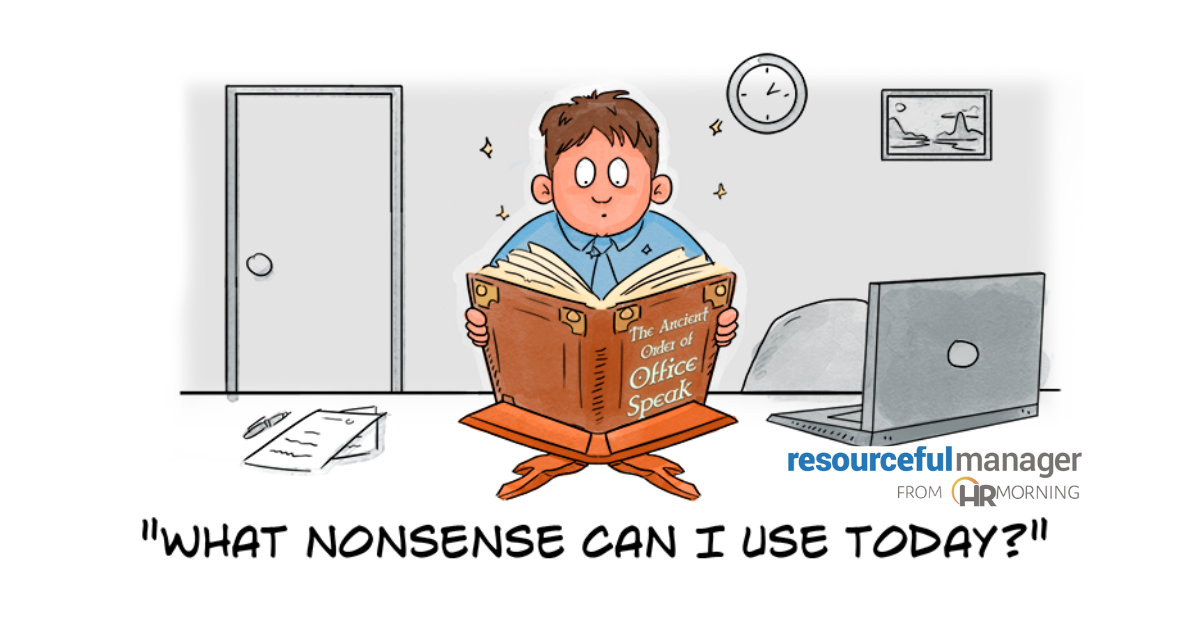
And that put me in “hot pursuit” of the reasons we say some dumb things at work. Or, to put it more diplomatically — why do we use office speak so much?

Office Speak Gone Wild

I’m not just talking about the latest office buzzwords and silly jargon that gets overused.

I’m talking about phrases and vernacular that are so common we probably don’t recognize that they’re a nod to the past — and possibly a nod to things we best avoid.

Not to say office speak and jargon are all bad. In fact, they can be helpful.

“In its best form, jargon is used to convey a complex set of principles in a shorthand way that all insiders instantly get,” says Tessa West, author of Jerks at Work: Toxic Coworkers and What to Do About Them. “But once it’s used to replace already existing shorthand phrases to make a simple and clear concept become unclear, it’s dumb!”

It’s definitely dumb when it’s overused and/or under-explained. In fact, office speak can either diminish importance when people hear it too much or complicate a message when people don’t understand it, according to time-honored research in The American Journal of Industrial and Business Management.

So let’s take a look at where some of the most prevalent office speak comes from – a bit of a background check on the everyday jargon we know, love and love to hate.

1. Office Speak from Advertising, Marketing

Some of the most used and prolific workplace vernacular was born in advertising. And Mad Men’s cigarette-smoking, whiskey-drinking philanderer Don Draper made it look so cool!

  • Run it up the flagpole. It came straight out of the 1950s Madison Avenue admen’s offices – and was completed with the phrase “… and see if anyone salutes.” It’s basically asking if others like the idea.
  • Thought leader. A relatively new phrase, it bubbled up in 1994 and took hold of offices more recently. It’s someone or some organization that is thought to be an expert on a given subject.
  • Ideation. This is the process of working to come up with good new ideas. It’s actually old, having evolved from a word in Plato’s 1800 philosophy, “ideate.” But as advertisers and marketers needed new ideas, they also created new words to describe their work – brainstorming, blue-sky thinking, to name a couple more.

2. Office Speak from Sales

Salespeople often talk in sales speak. But their language has long bubbled over into the everyday workplace. Some of the most popular:

  • A hard sell. This came of the 1950s to describe aggressive or forceful selling tactics to get people to buy quickly. Today, it’s often flipped, describing someone who is hard to sell an idea to.
  • Low-hanging fruit. This could be one of the most enduring pieces of office talk with origins in sales. It comes from Peter Drucker’s 1980s problem-solving plans and refers to problems that were easy to solve. (Note, other jargon from that plan didn’t survive as well – rattlers were obvious problems and pythons were big problems built by bureaucracy.)

3. Office Speak from Finance

We often characterize our bean counters as stoic and less creative than their ad or marketing colleagues. But they developed some office speak we all continue to use:

  • Bean counters. Let’s start with what we sometimes call the CFOs, controllers, finance managers and accountants. It gained popularity in the 1970s, and its origin is linked back to a German term that meant pea counter.
  • Bottom line. It was originally coined in corporate America in the 1960s, describing the physical bottom line of a profit and loss statement – showing if they made a profit or took a loss. Today, the bottom line seems to be the final answer in most workplace situations.
  • Leverage: Today we leverage everything – information, status, resources, weight, etc. But it became typical speak from Wall Street in the 1980s.

4. Office Speak from Tech

The tech sector gives us the latest technology developments peppered with plenty of office speak. The tech jargon with endurance:

  • Disrupt. Harvard Business School professor Clayton Christensen first used “disruptive innovation” in the mid-1990s, and it became synonymous with the tech industry. Now “disrupt” seems to cover any change in the workplace.
  • Bandwidth. While it was first used in the late 1800s in science, it became office fodder in the 1990s as “the capacity for data transfer of an electronic communications system.” Now, it covers how much capacity a person has to handle anything.

5. Office Speak from Consultants

Consultants often make an impact with a unique perspective. And they’ve created quite a bit of unique, enduring office speak over the years.

  • Boil the ocean. It means to take on an impossible task or project or make a project more difficult than it has to be – and we’ve been telling people to avoid boiling the ocean since Will Rogers made an off-handed remark about it during WWII.
  • Think outside the box. Scientists had used this for decades, referring to a brain-teaser exercise to connect nine dots without lifting a pencil, before consultants brought it to company leaders.

Office Speak that We Don’t Want to Use Today

Unfortunately, some office speak – and everyday phrases – comes from darker places, and really don’t belong in the workplace.

Dr. Molly Pennington, a culture researcher, identifies these three phrases to kick to the curb:

  • Basket case. It comes from WWI slang, referring to soldiers who were so seriously injured they’d fit in a basket. It’s an uncompassionate term.
  • Rule of thumb. It supposedly goes back to English and American laws from the 1600s that said a man could beat his wife with any stick no wider than his thumb. Not appropriate then or today.
  • Grandfathered in. The grandfather clause usually refers to someone getting a benefit that others won’t because of an earlier generation or their long-time loyalty. It came from privileged voters in southern states with a grandpa who had voted before 1867 – before Black voters had rights. Not right to be used today.
Filed under
RM Logo
  • Performance Management
  • Share on

Get the HRMorning Newsletter

With HRMorning arriving in your inbox, you will never miss critical stories on labor laws, benefits, retention and onboarding strategies.

  • This field is for validation purposes and should be left unchanged.
  • This field is hidden when viewing the form
  • This field is hidden when viewing the form
  • This field is hidden when viewing the form
  • This field is hidden when viewing the form
  • This field is hidden when viewing the form
  • This field is hidden when viewing the form
  • This field is hidden when viewing the form
  • This field is hidden when viewing the form
  • This field is hidden when viewing the form
  • This field is hidden when viewing the form
  • This field is hidden when viewing the form
  • This field is hidden when viewing the form
  • This field is hidden when viewing the form
  • This field is hidden when viewing the form
  • This field is hidden when viewing the form
  • This field is hidden when viewing the form
  • This field is hidden when viewing the form
  • This field is hidden when viewing the form
  • This field is hidden when viewing the form
  • This field is hidden when viewing the form
  • This field is hidden when viewing the form
  • This field is hidden when viewing the form
  • This field is hidden when viewing the form
  • This field is hidden when viewing the form
  • This field is hidden when viewing the form
  • This field is hidden when viewing the form
  • This field is hidden when viewing the form
  • This field is hidden when viewing the form
  • This field is hidden when viewing the form
  • This field is hidden when viewing the form
  • This field is hidden when viewing the form
  • This field is hidden when viewing the form
  • This field is hidden when viewing the form
  • This field is hidden when viewing the form
  • This field is hidden when viewing the form
  • This field is hidden when viewing the form
  • This field is hidden when viewing the form
  • This field is hidden when viewing the form
  • This field is hidden when viewing the form
  • This field is hidden when viewing the form
  • This field is hidden when viewing the form
  • This field is hidden when viewing the form
  • This field is hidden when viewing the form
  • This field is hidden when viewing the form
  • This field is hidden when viewing the form
  • This field is hidden when viewing the form
  • This field is hidden when viewing the form
  • This field is hidden when viewing the form
  • This field is hidden when viewing the form
  • This field is hidden when viewing the form
  • This field is hidden when viewing the form
  • This field is hidden when viewing the form
  • This field is hidden when viewing the form
  • This field is hidden when viewing the form
  • This field is hidden when viewing the form
  • This field is hidden when viewing the form

Free Training & Resources

White Papers

Ultimate Guide to Selecting a Managed Service Provider (MSP)

Provided by Magnit

Webinars

Unlock Employee Satisfaction and Loyalty: The ROI of Fertility Benefits

White Papers

CSR Industry Review

Provided by Blackbaud

White Papers

9 Questions to Determine if It is Time to Reboot Your Employee Discount Program

Provided by PerkSpot

SPONSORED CONTENT

HR Technology

sponsored content
The Best AI Software for HR Automation

Courtesy of G-P

Talent Management

sponsored content
Powerful Employee Retention Strategies for 2025: How to Keep Your Best People

Courtesy of PEOPLEGURU

Benefits

Health Care

Wellness

sponsored content
Proven Results: 5 Ways Teladoc Health Chronic Condition Management Transforms HR Outcomes

Courtesy of TELADOC HEALTH

Further Reading

  • Performance Management
Bad Managers Cause Turnover: 5 Tips to Prevent It

If you have turnover, you have bad managers. Unfortunately, you likely have some bad managers: Almost 75% of employees have either left ...

  • Performance Management
Toughest employees to coach — and 6 steps to get through to them today

Of all the employees you’ll ever have, those who think they aren’t doing anything wrong could be the toughest employees to coach. ...

  • Performance Management
What’s Wrong with Annual Reviews – and 6 Tips to Improve Them

Annual reviews are far more dreaded than revered. Yet, despite the bad rap, companies continue to schedule performance reviews once a year....

  • Performance Management
17 Dumb Writing Mistakes You Want to Avoid

You’re a smart leader. You don’t make dumb writing mistakes, right? Or do you? Here’s the problem with management ...

  • Performance Management
Effective Upskilling: 4 Ways to Cure the ‘Silent Standoff’

Technology is moving faster than ever before. As innovations and applications emerge, it’s more critical than ever to build resilient tec...

  • Performance Management
4 Ways to Avoid Difficult Conversation Traps

Some conversations are difficult before they start. They become even more of a nightmare when they take a turn for the worse — and yo...

Get the latest from HRMorning in your inbox PLUS immediately access 10 FREE HR guides.

I WANT MY FREE GUIDES
HR Morning Logo
  • Facebook
  • Linked In
  • ABOUT HRMORNING
  • ADVERTISE WITH US
  • WRITE FOR US
  • CONTACT
  • Employment Law
  • Benefits
  • Recruiting
  • Talent Management
  • Performance Management
  • HR Technology
  • Leadership & Strategy
  • Compensation
  • Policy & Procedures
  • Wellness
  • Staff Departure
  • HR Career & Self-Care
  • Health Care
  • Retirement Plans
  • DEI

HRMorning, part of the Rover Insights Network, provides the latest HR and employment law news for HR professionals in the trenches of small-to-medium-sized businesses. Rather than simply regurgitating the day's headlines, HRMorning delivers actionable insights, helping HR execs understand what HR trends mean to their business.

Powered By Rover Insights
Privacy Policy | Terms of Service
Copyright© 2026 Rover Insights
HRMorning Logo

WELCOME BACK!

Enter your username and password below to log in

Forget Your Username or Password?

Reset Password

Lost your password? Please enter your username or email address. You will receive a link to create a new password via email.

Log In

Why do we need your credit card for a free trial?

We ask for your credit card to allow your subscription to continue should you decide to keep your membership beyond the free trial period.  This prevents any interruption of content access.

Your card will not be charged at any point during your 21 day free trial
and you may cancel at any time during your free trial.

During your free trial, you can cancel at any time with a single click on your “Account” page.  It’s that easy.