• Skip to primary navigation
  • Skip to main content

HRMorning

  • FREE RESOURCES
  • PREMIUM CONTENT
  • HR DEEP DIVES
  • PODCASTS
    • VOICES OF HR
    • WOMEN’S LEADERSHIP TODAY
  • LOGIN
  • SIGN UP FREE
  • Employment Law
  • Benefits
  • Recruiting
  • HR Technology
  • Payroll
  • Management
  • Women’s Leadership
  • More
    • Talent Management
    • Performance Management
    • Leadership & Strategy
    • Compensation
    • Policy & Procedures
    • Wellness
    • Staff Departure
    • HR Career & Self-Care
    • Health Care
    • Retirement Plans
RM Logo
  • Performance Management

4 Ways to Avoid Difficult Conversation Traps

Michele McGovern
By: Michele McGovern
  • Share on

About the Author

Michele McGovern writes. A lot. These days, she covers HR, digging deep into company culture, DEI, leadership, management and the everchanging world of work. In the years between getting a BA in journalism from a state school and writing about HR, she wrote about big-city crime for a wire service and small-town life for local newspapers. She’s a mediocre mom, decent wife, wannabe athlete and consummate pursuer of fun - on land, snow and water. Find her on LinkedIn @michele-mcgovern-writer.

Show Less
Last Updated: October 6, 2025
5 minute engagement

Some conversations are difficult before they start. They become even more of a nightmare when they take a turn for the worse — and you end up in difficult conversation traps.

It’s so bad, some leaders would rather not face difficult conversations head-on. Instead, nearly two-thirds are willing to go out of their way to make difficult conversations more comfortable for the other person, according to research from Fractl.

While that’s an interesting tactic, most difficult conversations usually never enter the comfort zone.

Say or do the wrong thing in the heat of the moment, and your employees’ emotions might escalate. And no one can easily dig out of a difficult conversation trap.

“Even with the best of intentions, conversations about performance or behavior can provoke defensiveness and veer off track,” says Marlene Chism, author of From Conflict to Courage, in her blog.

Address Difficult Conversation Traps

Despite the uncomfortable verbal volley that can follow, it’s still better to address difficult subjects than ignore them.

Several researchers and professors from the Harvard Kennedy School find that the benefits of addressing awkward, difficult and uncomfortable subjects outweigh the short-term comfort of ignoring the issue.

“That means that we need to enter into these conversations with a high level of sensitivity, realizing that not everyone stands on the same ground,” says Cornell William Brooks, the Professor of the Practice of Public Leadership and Social Justice at HKS, in a panel discussion on the research.

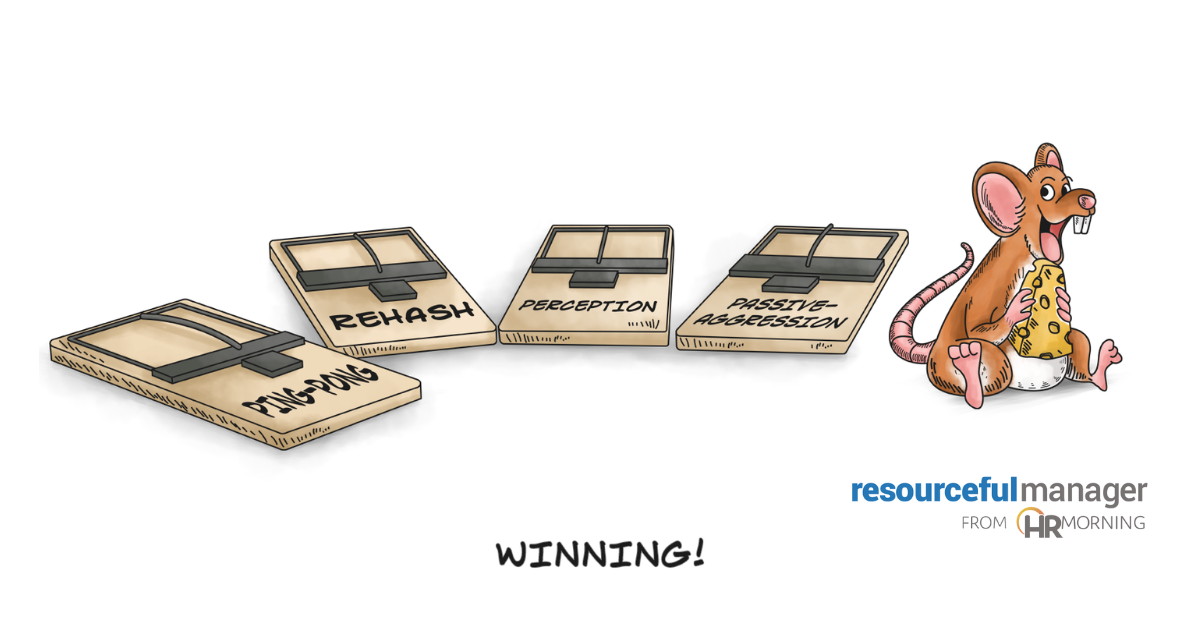
So address the issues that feel weird to bring up. But be prepared to avoid the four biggest difficult conversation traps.

No. 1: A Rehash of the Past

  • What it is: You or the other person starts to slowly or quickly bring up a laundry list of infractions from the past, whether they were previously addressed or not.
  • Why it happens: It often happens because you never addressed issues that should’ve been handled (so, yes, the boss is sometimes partly to blame for this trap). At the same time, the other person in the difficult conversation might bring up old issues in defense of the current situation.
  • How to escape: Assuming you set the intention, you can continue to give honest, difficult feedback without digging up bones. How? “Talk about what you want rather than what you don’t want,” says Chism. Instead of saying, “I don’t want you to arrive late anymore,” say, “I want you to arrive on time and ready to greet clients.” Or instead of, “I don’t want you missing goals anymore,” say, “I want you to hit the goal this quarter and surpass it next quarter. Now let’s devise the plan.”

No. 2: The Perception Game

  • What it is: You and your employee (or colleague) enter the difficult conversation assuming you both know why the other has come to this point and what the other will say, do or expect.
  • Why it happens: It’s often fueled by resentment. Perhaps you resent the behavior or situation you want to correct because it directly affects you. Or maybe the other person resents you for even bringing it up or trying to change him or her.
  • How to escape: Address the observed behavior or situation — not why you think it exists. And ask the employee or colleague to also address the exact behaviors. For instance, instead of, “You’re lazy and everyone has to pick up the slack for you,” say, “You’ve been late four days this week and Janice had to take your first 10 calls.” Or avoid something like, “Your lack of attention to detail caused you to miss goals.” Instead, say, “There were 14 miscalculations on the Smith report, so we had to scrap the deal.”

No. 3: Passive Aggressiveness

  • What it is: You say there’s a problem and you express some discontent about it. But you don’t lay out what is really bothering you, and indirectly express negative feelings through disregard.
  • Why it happens: You’re still afraid to have the difficult conversation and address the real issues. Or you think the other person should know what’s wrong and should be doing more to address it without you having to spell it out.
  • How to escape: Try this three-step approach:
    • Be curious. Ask a point-blank question such as, “Is there a reason you arrived late four days this week?” You might get a legitimate answer that leads to a quick, legitimate solution.
    • Share your perspective. Let the other person know why it bothers you. For instance, “I understand you’ve had a transportation glitch, but it’s frustrating for me and members of the team who have to answer your calls.”
    • Make a firm request. Ask for compliance with exactly what you need. Say, “Since we all have demanding schedules, please make arrangements to be on time and ready to work.”

No. 4: Verbal Ping Pong

  • What it is: It’s a back and forth of accusations and defenses — and it’s usually off the intended subject.
  • Why it happens: The person on the other end of the difficult conversation triggers you — perhaps pointing out a shortcoming, accusing you of causing the problem or getting irrationally defensive. So you start to defend yourself, and the other person continues a defense, too.
  • How to escape: Start difficult conversations with an intention — and if you veer away from it into a trap, you can reiterate the intention and get back to it. Examples: “My intention is for us to discuss why you’ve been late 10 times this month and what we can do to help you arrive on time and ready to work.” “The intention for our discussion is to get realigned on your goals and ways to achieve them.”
Filed under
RM Logo
  • Performance Management
  • Share on

Get the HRMorning Newsletter

With HRMorning arriving in your inbox, you will never miss critical stories on labor laws, benefits, retention and onboarding strategies.

  • This field is for validation purposes and should be left unchanged.
  • This field is hidden when viewing the form
  • This field is hidden when viewing the form
  • This field is hidden when viewing the form
  • This field is hidden when viewing the form
  • This field is hidden when viewing the form
  • This field is hidden when viewing the form
  • This field is hidden when viewing the form
  • This field is hidden when viewing the form
  • This field is hidden when viewing the form
  • This field is hidden when viewing the form
  • This field is hidden when viewing the form
  • This field is hidden when viewing the form
  • This field is hidden when viewing the form
  • This field is hidden when viewing the form
  • This field is hidden when viewing the form
  • This field is hidden when viewing the form
  • This field is hidden when viewing the form
  • This field is hidden when viewing the form
  • This field is hidden when viewing the form
  • This field is hidden when viewing the form
  • This field is hidden when viewing the form
  • This field is hidden when viewing the form
  • This field is hidden when viewing the form
  • This field is hidden when viewing the form
  • This field is hidden when viewing the form
  • This field is hidden when viewing the form
  • This field is hidden when viewing the form
  • This field is hidden when viewing the form
  • This field is hidden when viewing the form
  • This field is hidden when viewing the form
  • This field is hidden when viewing the form
  • This field is hidden when viewing the form
  • This field is hidden when viewing the form
  • This field is hidden when viewing the form
  • This field is hidden when viewing the form
  • This field is hidden when viewing the form
  • This field is hidden when viewing the form
  • This field is hidden when viewing the form
  • This field is hidden when viewing the form
  • This field is hidden when viewing the form
  • This field is hidden when viewing the form
  • This field is hidden when viewing the form
  • This field is hidden when viewing the form
  • This field is hidden when viewing the form
  • This field is hidden when viewing the form
  • This field is hidden when viewing the form
  • This field is hidden when viewing the form
  • This field is hidden when viewing the form
  • This field is hidden when viewing the form
  • This field is hidden when viewing the form
  • This field is hidden when viewing the form
  • This field is hidden when viewing the form
  • This field is hidden when viewing the form
  • This field is hidden when viewing the form
  • This field is hidden when viewing the form
  • This field is hidden when viewing the form

Free Training & Resources

White Papers

Unconventional Benefits: An Employer’s Guide

Provided by Paycom

Webinars

Taking Action: Purposeful Steps in Building an Inclusive Workplace

Webinars

When AI Meets Performance Management: Using Technology Without Losing the Human Touch

Provided by Trinet

White Papers

Are Your ADA and PWFA Processes Putting You at Risk?

Provided by AbsenceSoft

SPONSORED CONTENT

HR Technology

sponsored content
The Best AI Software for HR Automation

Courtesy of G-P

Talent Management

sponsored content
Powerful Employee Retention Strategies for 2025: How to Keep Your Best People

Courtesy of PEOPLEGURU

Benefits

Health Care

Wellness

sponsored content
Proven Results: 5 Ways Teladoc Health Chronic Condition Management Transforms HR Outcomes

Courtesy of TELADOC HEALTH

Further Reading

  • Performance Management
Employee Recognition Letters: 6 Examples and Templates

When to Use Each Employee Recognition Letter [id] { scroll-margin-top: 160px; } Performance Recognition Letter – Reinforce res...

  • Performance Management
Why Jack Dorsey axed annual performance reviews – and what that means for you

Annual review season is here, but are performance reviews all they’re cracked up to be? More and more, leaders and workers alike are ques...

  • Performance Management
8 Worst Co-Workers and How to Handle Them Without Losing Your Cool

There’s the employee who knows it all. Or the manager who steals your great ideas. Then there’s the guy who leaves a mess every...

  • Performance Management
5 Warning Signs You Just Might Be A Micromanager

If you’re like most managers, you came into the role in one of two ways. You aspired to be a manager so you could move up in your...

  • Performance Management
5 Cool Ways to Celebrate Employee Appreciation Day

Employee Appreciation Day is March 6th this year, and it’s one of the best opportunities to convey value, support and recognition to the ...

  • Performance Management
Debunk Neurodivergent Myths at Work: 5 Solutions

There’s a stubborn myth still floating around many workplaces. It’s time we let it go with the same energy as a karaoke night that got ...

Get the latest from HRMorning in your inbox PLUS immediately access 10 FREE HR guides.

I WANT MY FREE GUIDES
HR Morning Logo
  • Facebook
  • Linked In
  • ABOUT HRMORNING
  • ADVERTISE WITH US
  • WRITE FOR US
  • CONTACT
  • Employment Law
  • Benefits
  • Recruiting
  • Talent Management
  • Performance Management
  • HR Technology
  • Leadership & Strategy
  • Compensation
  • Policy & Procedures
  • Wellness
  • Staff Departure
  • HR Career & Self-Care
  • Health Care
  • Retirement Plans
  • DEI

HRMorning, part of the Rover Insights Network, provides the latest HR and employment law news for HR professionals in the trenches of small-to-medium-sized businesses. Rather than simply regurgitating the day's headlines, HRMorning delivers actionable insights, helping HR execs understand what HR trends mean to their business.

Powered By Rover Insights
Privacy Policy | Terms of Service
Copyright© 2026 Rover Insights
HRMorning Logo

WELCOME BACK!

Enter your username and password below to log in

Forget Your Username or Password?

Reset Password

Lost your password? Please enter your username or email address. You will receive a link to create a new password via email.

Log In

Why do we need your credit card for a free trial?

We ask for your credit card to allow your subscription to continue should you decide to keep your membership beyond the free trial period.  This prevents any interruption of content access.

Your card will not be charged at any point during your 21 day free trial
and you may cancel at any time during your free trial.

During your free trial, you can cancel at any time with a single click on your “Account” page.  It’s that easy.
