• Skip to primary navigation
  • Skip to main content

HRMorning

  • FREE RESOURCES
  • PREMIUM CONTENT
  • HR DEEP DIVES
  • PODCASTS
    • VOICES OF HR
    • WOMEN’S LEADERSHIP TODAY
  • LOGIN
  • SIGN UP FREE
  • Employment Law
  • Benefits
  • Recruiting
  • HR Technology
  • Payroll
  • Management
  • Women’s Leadership
  • More
    • Talent Management
    • Performance Management
    • Leadership & Strategy
    • Compensation
    • Policy & Procedures
    • Wellness
    • Staff Departure
    • HR Career & Self-Care
    • Health Care
    • Retirement Plans
  • Talent Management

Where Will Employees Displaced by AI Go? A Unique Look at Re-Skilling the Workforce

Stephen Tucker, HR Expert Contributor
By: Stephen Tucker, HR Expert Contributor
  • Share on

About the Author

Stephen Tucker is President & CEO of the Northland Workforce Training Center and Executive Director of the WNY Manufacturing & Tech Workforce Coalition. He is a nationally recognized workforce development leader focused on building employer-driven talent pipelines, advancing economic mobility, and preparing workers for careers in advanced manufacturing, clean energy, and emerging technologies.

Show Less
Last Updated: August 17, 2026
4 minute engagement
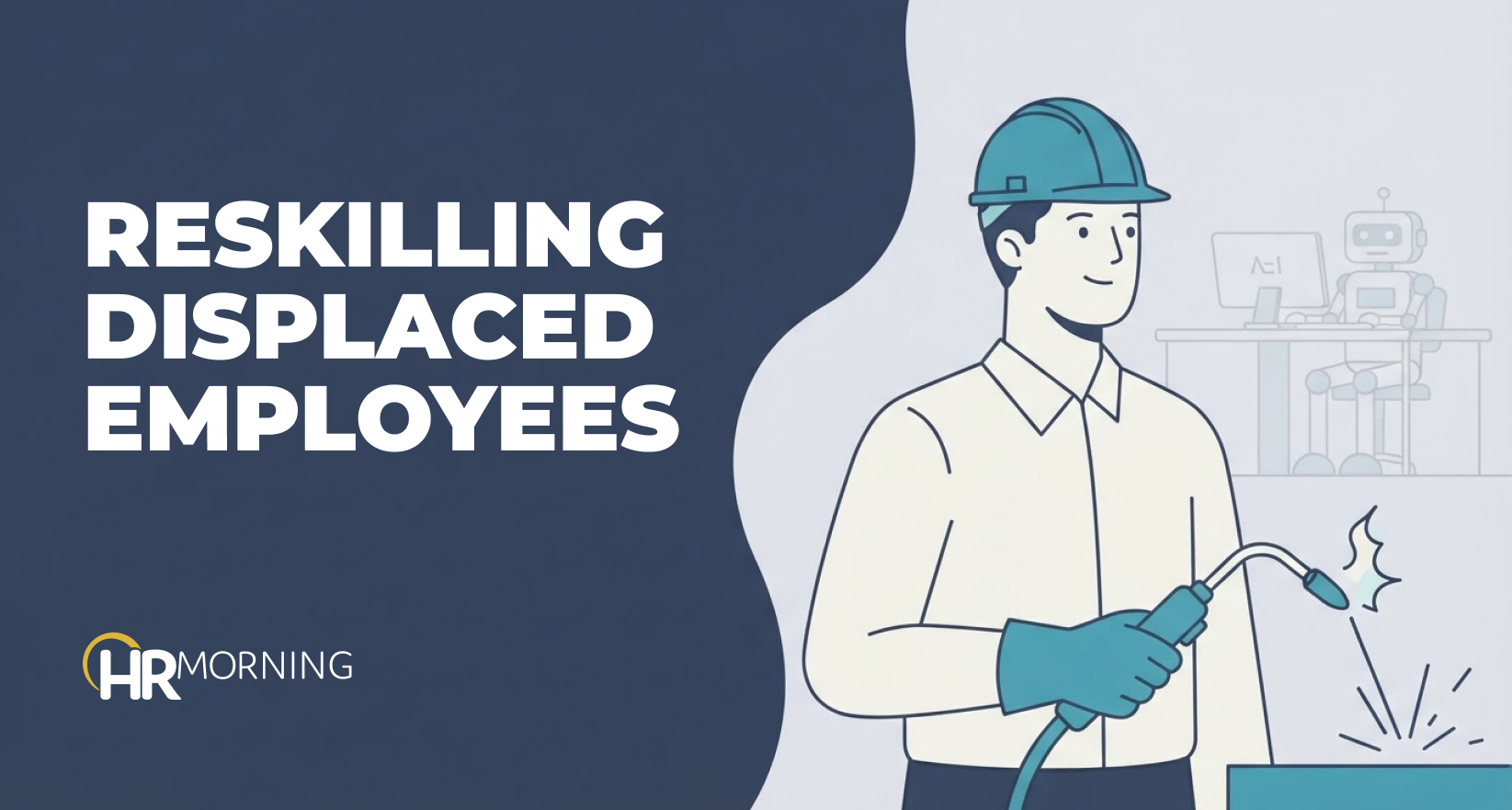
A displaced office worker reskilling into a skilled trade — hard hat and welding torch — as AI takes over their old desk job

Much has been made about the future of the workforce in the AI debate, with many acknowledging that emerging technologies could displace a massive number of employees.

In fact, some estimates suggest upwards of 300 million global workers, about 9% of the workforce, could be displaced by AI and related technologies in the coming years.

These shifts are expected to disproportionately impact white-collar roles, particularly in administrative support, customer service, and even portions of finance, legal and marketing.

Much of the discussion has focused on what jobs will be impacted. Far less attention has been paid to where displaced employees will go next.

The answer won’t come from any single solution. Instead, it requires looking toward resilient industries and developing strategies to equip workers to transition into those roles.

What Fields Will Be Resilient?

While AI excels at recognizing patterns, analyzing large datasets, and generating content, there has been limited success in automating physical work environments. Roles that require real-time decision-making, spatial reasoning and hands-on technical expertise remain difficult to automate.

Electricians, welders, HVAC technicians, machinists, maintenance technicians and advanced manufacturing professionals, what I refer to as skilled technicians, operate in dynamic environments that demand adaptability and human judgment.

These careers combine technical knowledge, problem-solving, and hands-on expertise, capabilities that AI is unlikely to fully replicate anytime soon.

At the same time, investment in domestic manufacturing, infrastructure, clean energy and reshoring initiatives is accelerating demand for these roles. The U.S. Bureau of Labor Statistics projects continued growth across many of these technical occupations.

This creates a unique opportunity: a growing pool of displaced employees on one side and expanding demand for skilled technicians on the other.

Retooling Displaced White-Collar Workers

The challenge lies in how we help displaced professionals transition into these careers.

Shifting careers is not simply about finding open positions. It requires retraining, career navigation and often a shift in professional identity.

Professionals impacted by AI face several barriers, including:

  • Lack of technical experience
  • Limited awareness of training opportunities
  • Financial constraint, and
  • Uncertainty about which career path to pursue.

Without structured pathways, many displaced workers risk falling into unemployment or underemployment.

Effective retooling programs address these challenges holistically. They combine accelerated, hands-on training with wraparound support services such as career coaching, financial assistance and job placement.

An Existing Example

The Northland Workforce Training Center in Buffalo, NY, is one example of this approach. As an industry-driven training center, Northland prepares individuals from diverse backgrounds for technical careers in advanced manufacturing and clean energy.

Through my role as Executive Director of the WNY Manufacturing & Tech Workforce Coalition, we work directly with employers across Western New York to identify workforce needs and develop training pathways aligned with real-world demand. This employer-driven approach ensures that training leads directly to employment opportunities.

Training programs are developed with direct input from industry partners to ensure participants gain the most relevant and practical skills. Instruction emphasizes hands-on learning, with more time spent applying skills and less time in traditional classroom settings.

For instance, someone enrolling in a welding program at Northland would:

  • Start their instruction in a classroom, learning the principles of the trade as well as safety methods, required math and related skills, welding codes and standards, testing and more
  • Have the tools of the trade be placed directly in their hands, with students training according to the American Welding Society’s standards for an entry-level welder in the first year of a two-year program, with the second bringing them up to more advanced techniques
  • Be given instruction from knowledgeable instructors who have done the work in the field every step of the way, and
  • Be given career guidance services upon completion of the program, helping graduates land meaningful jobs related to what they practiced.

When combined with flexible scheduling, financial support, and career services, these models create new pathways for individuals looking to transition into resilient careers.

This approach is scalable and adaptable to regions across the country. As workforce disruption accelerates, these types of training ecosystems will play a critical role in helping workers transition into new careers while meeting growing employer demand.

Looking Ahead: Building a More Resilient Workforce

As AI continues to evolve, workforce disruption is likely to accelerate. That means organizations want to take proactive steps now. This includes investing in training models that are:

  • Flexible
  • Inclusive
  • Employer-driven, and
  • Aligned with labor market demand.

Economic development organizations, workforce leaders, educational institutions and employers all have a role to play. By working collaboratively, they can create ecosystems that support lifelong learning and career mobility.

Programs like those at Northland Workforce Training Center and initiatives led by regional workforce coalitions demonstrate what this can look like in practice.

The broader lesson is clear: The future of work will require new partnerships, new strategies and a willingness to rethink traditional career pathways.

The question is not whether change is coming; it’s whether we are prepared to meet it.

Filed under
  • Talent Management
  • Share on

Get the HRMorning Newsletter

With HRMorning arriving in your inbox, you will never miss critical stories on labor laws, benefits, retention and onboarding strategies.

  • This field is for validation purposes and should be left unchanged.
  • This field is hidden when viewing the form
  • This field is hidden when viewing the form
  • This field is hidden when viewing the form
  • This field is hidden when viewing the form
  • This field is hidden when viewing the form
  • This field is hidden when viewing the form
  • This field is hidden when viewing the form
  • This field is hidden when viewing the form
  • This field is hidden when viewing the form
  • This field is hidden when viewing the form
  • This field is hidden when viewing the form
  • This field is hidden when viewing the form
  • This field is hidden when viewing the form
  • This field is hidden when viewing the form
  • This field is hidden when viewing the form
  • This field is hidden when viewing the form
  • This field is hidden when viewing the form
  • This field is hidden when viewing the form
  • This field is hidden when viewing the form
  • This field is hidden when viewing the form
  • This field is hidden when viewing the form
  • This field is hidden when viewing the form
  • This field is hidden when viewing the form
  • This field is hidden when viewing the form
  • This field is hidden when viewing the form
  • This field is hidden when viewing the form
  • This field is hidden when viewing the form
  • This field is hidden when viewing the form
  • This field is hidden when viewing the form
  • This field is hidden when viewing the form
  • This field is hidden when viewing the form
  • This field is hidden when viewing the form
  • This field is hidden when viewing the form
  • This field is hidden when viewing the form
  • This field is hidden when viewing the form
  • This field is hidden when viewing the form
  • This field is hidden when viewing the form
  • This field is hidden when viewing the form
  • This field is hidden when viewing the form
  • This field is hidden when viewing the form
  • This field is hidden when viewing the form
  • This field is hidden when viewing the form
  • This field is hidden when viewing the form
  • This field is hidden when viewing the form
  • This field is hidden when viewing the form
  • This field is hidden when viewing the form
  • This field is hidden when viewing the form
  • This field is hidden when viewing the form
  • This field is hidden when viewing the form
  • This field is hidden when viewing the form
  • This field is hidden when viewing the form
  • This field is hidden when viewing the form
  • This field is hidden when viewing the form
  • This field is hidden when viewing the form
  • This field is hidden when viewing the form
  • This field is hidden when viewing the form

Free Training & Resources

Webinars

Authenticity at Work with Robin Roberts

White Papers

Compliance First: Avoid Costly Payroll Risks While Strengthening Operations

Provided by Paypro

White Papers

TriNet AI in HR eGuide 2026

White Papers

Remarkable Workforce Management Made Surprisingly Easy

Provided by WorkEasy

SPONSORED CONTENT

HR Technology

sponsored content
The Best AI Software for HR Automation

Courtesy of G-P

Talent Management

sponsored content
Powerful Employee Retention Strategies for 2025: How to Keep Your Best People

Courtesy of PEOPLEGURU

Benefits

Health Care

Wellness

sponsored content
Proven Results: 5 Ways Teladoc Health Chronic Condition Management Transforms HR Outcomes

Courtesy of TELADOC HEALTH

Further Reading

  • Talent Management
What We Miss When We Aren’t Together: 4 Arguments for a Return to Office

Many high-profile executives and big-name companies have done more than make arguments for a return to office (RTO): They’ve demanded...

  • Talent Management
What You Can Do About the Great Detachment: 8 Critical Responses

Employees have increasingly become detached from their work, many holding on by a thread. Gallup researchers coined it the Great Detachm...

  • Leadership & Strategy
  • Talent Management
When Full-Time Headcount Isn’t the Answer: How Contract Talent Is Closing Execution Gaps

In many organizations, workforce planning still follows a familiar pattern. A business need arises, a requisition is opened, and HR teams b...

  • Talent Management
Financial Stress Is Showing Up at Work: How HR Can Respond

Financial stress knows no income boundaries. Bank of America research shows that even among families earning more than $150,000 a year, one...

  • Leadership & Strategy
  • Staff Administration
Why It Pays to Praise: 20 Ways to Say ‘Good Job’

You probably realize how powerful your words can be when you praise someone for a job well done. By recognizing an employee at just the ...

  • Talent Management
3 strategies to build cohesive teams — straight out of the World Cup

HR executives and managers need look no further than to the World Cup to find effective ways to build cohesive teams. French National Te...

Get the latest from HRMorning in your inbox PLUS immediately access 10 FREE HR guides.

I WANT MY FREE GUIDES
HR Morning Logo
  • Facebook
  • Linked In
  • ABOUT HRMORNING
  • ADVERTISE WITH US
  • WRITE FOR US
  • CONTACT
  • Employment Law
  • Benefits
  • Recruiting
  • Talent Management
  • Performance Management
  • HR Technology
  • Leadership & Strategy
  • Compensation
  • Policy & Procedures
  • Wellness
  • Staff Departure
  • HR Career & Self-Care
  • Health Care
  • Retirement Plans
  • DEI

HRMorning, part of the Rover Insights Network, provides the latest HR and employment law news for HR professionals in the trenches of small-to-medium-sized businesses. Rather than simply regurgitating the day's headlines, HRMorning delivers actionable insights, helping HR execs understand what HR trends mean to their business.

Powered By Rover Insights
Privacy Policy | Terms of Service
Copyright© 2026 Rover Insights
HRMorning Logo

WELCOME BACK!

Enter your username and password below to log in

Forget Your Username or Password?

Reset Password

Lost your password? Please enter your username or email address. You will receive a link to create a new password via email.

Log In

Why do we need your credit card for a free trial?

We ask for your credit card to allow your subscription to continue should you decide to keep your membership beyond the free trial period.  This prevents any interruption of content access.

Your card will not be charged at any point during your 21 day free trial
and you may cancel at any time during your free trial.

During your free trial, you can cancel at any time with a single click on your “Account” page.  It’s that easy.