• Skip to primary navigation
  • Skip to main content

HRMorning

  • FREE RESOURCES
  • PREMIUM CONTENT
  • HR DEEP DIVES
  • PODCASTS
    • VOICES OF HR
    • WOMEN’S LEADERSHIP TODAY
  • LOGIN
  • SIGN UP FREE
  • Employment Law
  • Benefits
  • Recruiting
  • HR Technology
  • Payroll
  • Management
  • Women’s Leadership
  • More
    • Talent Management
    • Performance Management
    • Leadership & Strategy
    • Compensation
    • Policy & Procedures
    • Wellness
    • Staff Departure
    • HR Career & Self-Care
    • Health Care
    • Retirement Plans
WLT Logo
  • Leadership & Strategy

Emotional Intelligence: A Key Ingredient for Great Leadership

Audrey Halpern
By: Audrey Halpern, HR Expert Contributor
  • Share on

About the Author

Audrey Halpern has a 20+ year career developing employee soft skills training programs. She is a faculty member of the American Management Association. Since 1992, Audrey has consulted with corporate clients, developing customized content and facilitating soft skills, emotional intelligence, leadership, and communication content.

Show Less
Last Updated: January 6, 2026
3 minute engagement
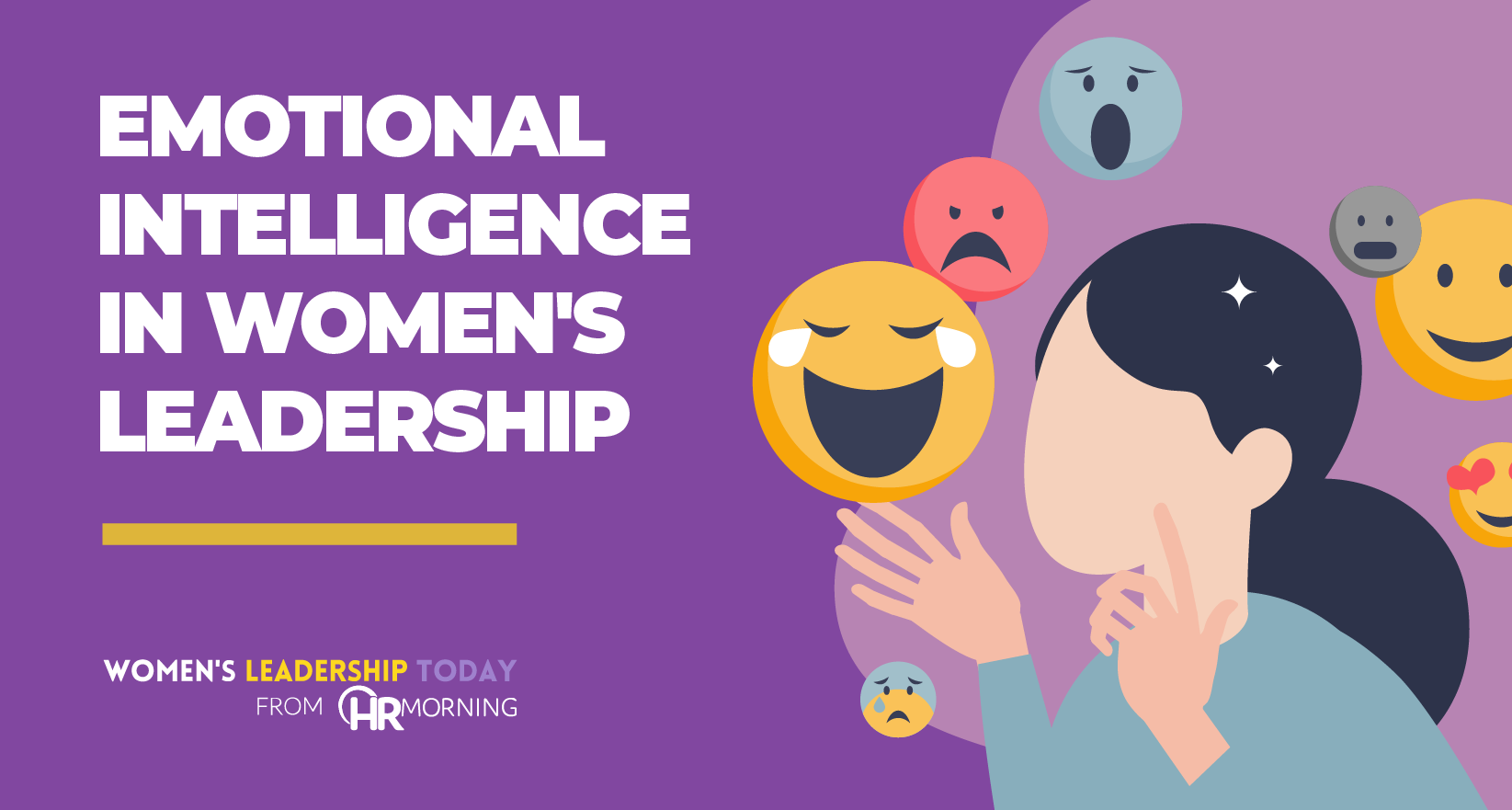
Women’s Leadership Today from HR Morning graphic titled “Emotional Intelligence in Women’s Leadership,” showing a woman surrounded by different emotion icons.

Emotional Intelligence (EI) also known as Emotional Quotient (EQ) is the ability to understand your own and others’ emotions and how they drive behavior.

This capacity to relate appropriately with others and engage constructively with their emotions is a vital trait for every successful female leader.

History of Emotional Intelligence

In the 1960s, and by the 1980s psychologists were starting to compare Emotional Intelligence to other intelligence types, such as IQ. The idea of EQ in business was popularized by Daniel Goleman’s Ph. D in his book, “Emotional Intelligence: Why It Can Matter More Than IQ.”

 Goleman argues that emotional intelligence accounts for 67% of the abilities deemed necessary for superior performance in business, mattering twice as much as IQ and technical skills.

He outlines the following four pillars of EI/EQ: 

  1. Self-awareness- identify and manage one’s own emotions
  2. Self-regulation- identify and understand someone else’s emotions
  3. Empathy- relating well to others personally and professionally even under the most stressful situations.
  4. Social Skills- the skills needed to manage and influence other people’s emotions effectively.

And yes, it has been noted that men and women have different inherent abilities when dealing with emotions. Relationship-based skills are ones wherein women certainly excel. As women, having a healthy understanding of our own emotions is helpful in terms of interacting with others positively.  Improving emotional intelligence is fundamental to improving personal communication and strengthens the efficacy of your communication strategy.

EI plays a huge role in how leaders address critical challenges and opportunities. And yet women tend to undervalue their skills competency and performance while men will typically overvalue themselves.

To be perceived as leaders, women need to adapt and exhibit more male-specific EQ attributes as they rise to the ranks of leadership. Challenging the status quo is just one task faced by most women in business.

Dr. Richard E. Boyatzis, Distinguished University Professor, CWRU, suggests that “Research shows, however, that the reality is often the opposite. If more men acted like women in employing their emotional and social competencies, they would be substantially and distinctly more effective in their work.”

A 2001 study carried out at the Johnson & Johnson Consumer & Personal Care Group found that women with higher EI were better at practicing self-awareness and self-management, while also scoring higher than average in the areas of self-confidence, achievement orientation, leadership, initiative, and influence. This same study found that female-identifying business leaders scored higher than their male counterparts in the areas of emotional self-awareness, conscientiousness, service orientation, and communication.

Emotional intelligence and leadership are closely related concepts. So, it is no wonder that Emotional intelligence is an important indicator of women’s success in organizations.

How Can Women Use EI Skills to Become Better Leaders?

First, women are more often motivated by empathy than men when it comes to affecting their decision-making processes. Empathy helps women to see problems from other people’s perspectives which makes them less self-centered and more flexible in problem-solving. To become an empathetic leader is to become more patient, aware, and considerate to not just your employees but also yourself.

Becoming a “people developer” can help inspire and motivate employees to grow. Women leaders build trust by sharing big decisions and inviting their team to voice questions, concerns, and ideas. Transformational leaders excel at turning their vision into an actionable plan and they are strong role models. Being a role model means exhibiting a passion for your work. Women leaders who can identify and manage emotions are also able to motivate others — not just the people who work for you, but those who work around you, from colleagues to clients to people who share common areas!

Filed under
WLT Logo
  • Leadership & Strategy
  • Share on

Get the HRMorning Newsletter

With HRMorning arriving in your inbox, you will never miss critical stories on labor laws, benefits, retention and onboarding strategies.

  • This field is for validation purposes and should be left unchanged.
  • This field is hidden when viewing the form
  • This field is hidden when viewing the form
  • This field is hidden when viewing the form
  • This field is hidden when viewing the form
  • This field is hidden when viewing the form
  • This field is hidden when viewing the form
  • This field is hidden when viewing the form
  • This field is hidden when viewing the form
  • This field is hidden when viewing the form
  • This field is hidden when viewing the form
  • This field is hidden when viewing the form
  • This field is hidden when viewing the form
  • This field is hidden when viewing the form
  • This field is hidden when viewing the form
  • This field is hidden when viewing the form
  • This field is hidden when viewing the form
  • This field is hidden when viewing the form
  • This field is hidden when viewing the form
  • This field is hidden when viewing the form
  • This field is hidden when viewing the form
  • This field is hidden when viewing the form
  • This field is hidden when viewing the form
  • This field is hidden when viewing the form
  • This field is hidden when viewing the form
  • This field is hidden when viewing the form
  • This field is hidden when viewing the form
  • This field is hidden when viewing the form
  • This field is hidden when viewing the form
  • This field is hidden when viewing the form
  • This field is hidden when viewing the form
  • This field is hidden when viewing the form
  • This field is hidden when viewing the form
  • This field is hidden when viewing the form
  • This field is hidden when viewing the form
  • This field is hidden when viewing the form
  • This field is hidden when viewing the form
  • This field is hidden when viewing the form
  • This field is hidden when viewing the form
  • This field is hidden when viewing the form
  • This field is hidden when viewing the form
  • This field is hidden when viewing the form
  • This field is hidden when viewing the form
  • This field is hidden when viewing the form
  • This field is hidden when viewing the form
  • This field is hidden when viewing the form
  • This field is hidden when viewing the form
  • This field is hidden when viewing the form
  • This field is hidden when viewing the form
  • This field is hidden when viewing the form
  • This field is hidden when viewing the form
  • This field is hidden when viewing the form
  • This field is hidden when viewing the form
  • This field is hidden when viewing the form
  • This field is hidden when viewing the form
  • This field is hidden when viewing the form
  • This field is hidden when viewing the form

Free Training & Resources

Webinars

Grow Your Future Workforce from Within

Webinars

From Manual to Modern: Rethinking AP Fraud Prevention for a Leaner, Safer Finance Operation

Provided by Yooz

Webinars

The Big Quit: How to Prepare for the Resignation Surge in 2022

Webinars

The Fundamentals of Benefits & Compensation

SPONSORED CONTENT

HR Technology

sponsored content
The Best AI Software for HR Automation

Courtesy of G-P

Talent Management

sponsored content
Powerful Employee Retention Strategies for 2025: How to Keep Your Best People

Courtesy of PEOPLEGURU

Benefits

Health Care

Wellness

sponsored content
Proven Results: 5 Ways Teladoc Health Chronic Condition Management Transforms HR Outcomes

Courtesy of TELADOC HEALTH

Further Reading

  • Leadership & Strategy
Grit: The Secret Ingredient for Long-Term Success

It’s common knowledge that employers and management teams see value in professionals who show up with a “can-do” spirit. But ther...

  • Leadership & Strategy
“Ride Your Own Ride” : A Lesson in Authenticity

Steve Jobs is quoted as saying, “Your time is limited, so don’t waste it living someone else’s life.” I think of...

  • Leadership & Strategy
Insightful Interviewing: 10 Unique Questions to Help You Hire the Right People

Hiring the right people for a position can be tough, especially in a competitive industry. Interviews do not give hiring managers a lot of ...

  • Leadership & Strategy
Unleashing Your Inner Leader: Insights from the Barbie Movie  

As an undeniable “Barbie Girl,” my childhood was filled with an abundance of Barbies — more than any little girl could ne...

  • Leadership & Strategy
7 Steps to Build a Team That Outperforms the in Critical Time

A team that succeeds is more than just a group of skilled individuals; it is a cohesive unit that collaborates effectively, adapts to chall...

  • Leadership & Strategy
Mastering Your Work Personality (Take the quiz now!)

What are your co-workers known for? Maybe Susan is the person you go to when you need a task done quickly, but Michael is the person you go ...

Get the latest from HRMorning in your inbox PLUS immediately access 10 FREE HR guides.

I WANT MY FREE GUIDES
HR Morning Logo
  • Facebook
  • Linked In
  • ABOUT HRMORNING
  • ADVERTISE WITH US
  • WRITE FOR US
  • CONTACT
  • Employment Law
  • Benefits
  • Recruiting
  • Talent Management
  • Performance Management
  • HR Technology
  • Leadership & Strategy
  • Compensation
  • Policy & Procedures
  • Wellness
  • Staff Departure
  • HR Career & Self-Care
  • Health Care
  • Retirement Plans
  • DEI

HRMorning, part of the Rover Insights Network, provides the latest HR and employment law news for HR professionals in the trenches of small-to-medium-sized businesses. Rather than simply regurgitating the day's headlines, HRMorning delivers actionable insights, helping HR execs understand what HR trends mean to their business.

Powered By Rover Insights
Privacy Policy | Terms of Service
Copyright© 2026 Rover Insights
HRMorning Logo

WELCOME BACK!

Enter your username and password below to log in

Forget Your Username or Password?

Reset Password

Lost your password? Please enter your username or email address. You will receive a link to create a new password via email.

Log In

Why do we need your credit card for a free trial?

We ask for your credit card to allow your subscription to continue should you decide to keep your membership beyond the free trial period.  This prevents any interruption of content access.

Your card will not be charged at any point during your 21 day free trial
and you may cancel at any time during your free trial.

During your free trial, you can cancel at any time with a single click on your “Account” page.  It’s that easy.
