• Skip to primary navigation
  • Skip to main content

HRMorning

  • FREE RESOURCES
  • PREMIUM CONTENT
  • HR DEEP DIVES
  • PODCASTS
    • VOICES OF HR
    • WOMEN’S LEADERSHIP TODAY
  • LOGIN
  • SIGN UP FREE
  • Employment Law
  • Benefits
  • Recruiting
  • HR Technology
  • Payroll
  • Management
  • Women’s Leadership
  • More
    • Talent Management
    • Performance Management
    • Leadership & Strategy
    • Compensation
    • Policy & Procedures
    • Wellness
    • Staff Departure
    • HR Career & Self-Care
    • Health Care
    • Retirement Plans
  • Employment Law

New DOL Opinion Letter: Is Commute Time Compensable for Partial Day Remote Work?

Carol Warner
By: Carol Warner
  • Share on

About the Author

For nearly two decades, Carol Warner has analyzed the legal and financial realities behind workplace decisions, covering employment law, benefits, payroll and HR technology. She translates complex legal updates, regulatory shifts and vendor claims into plain language that HR teams can act on. Her focus is simple: What does this mean for employers, and what should they do next? Connect with her on LinkedIn.

Show Less
Last Updated: July 29, 2026
2 minute engagement
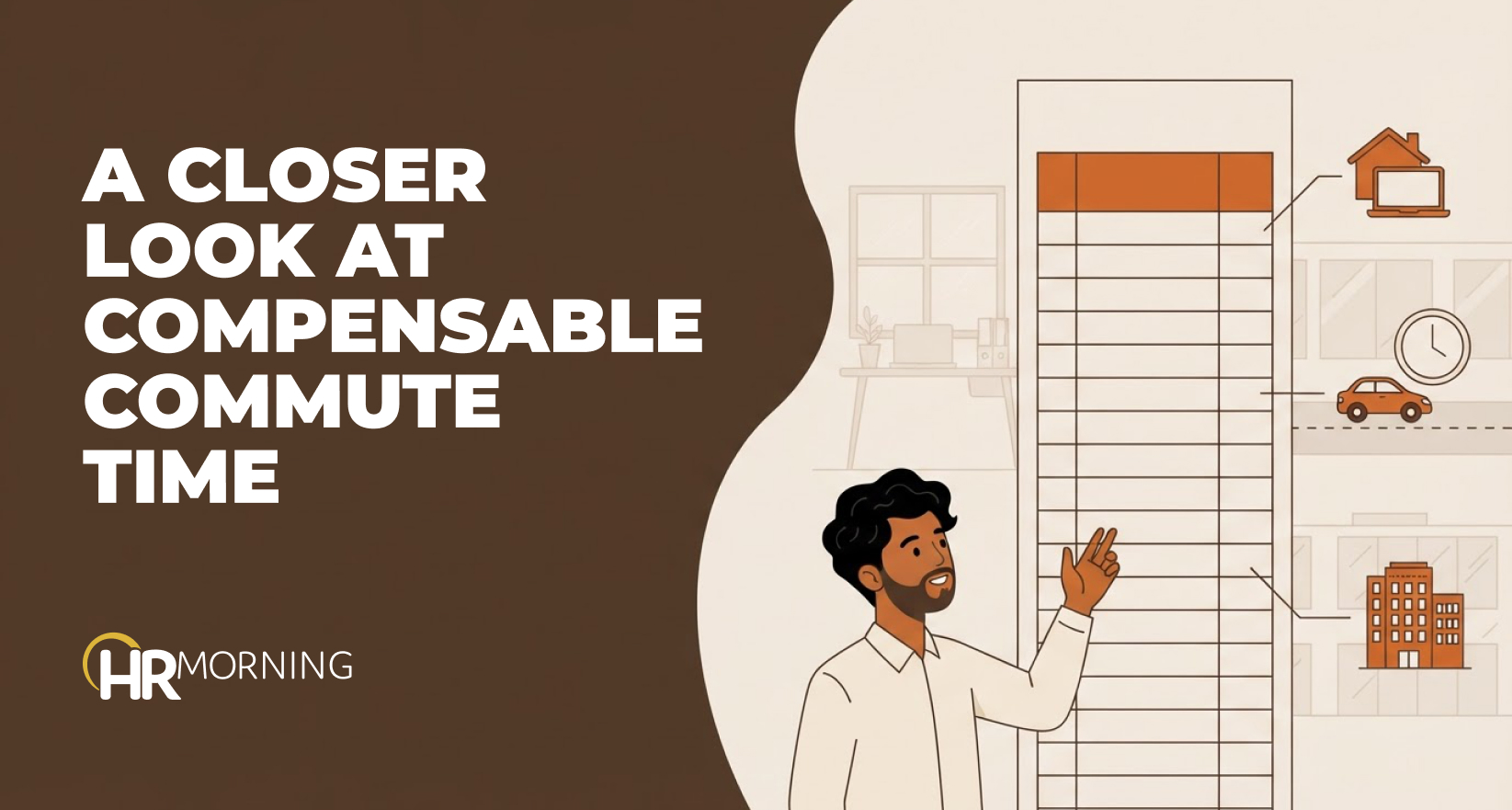
Illustrated time card linking a home laptop, a car on a road and an office building, showing unpaid commute time under new DOL guidance.

Hybrid schedules are now a standard part of many workplaces, but payroll teams are still sorting out when a commute during the workday belongs on the timesheet. The Department of Labor (DOL) recently addressed a recurring question: When a nonexempt employee works both at home and onsite in the same day, is the travel time compensable?

In a July 22, 2026, opinion letter, the agency analyzed three specific situations involving voluntary hybrid schedules. It concluded that the travel remained an ordinary commute that primarily benefited the employee, so employers generally would not have to count the time as hours worked.

The DOL considered three scenarios:

  • An employee works from home in the morning, drives in after rush hour, drives home before the evening rush, then finishes the day at home.
  • An employee takes on extra project work but wants to do it from home before her regular commute, instead of arriving early or staying late at the office.
  • An employee who relies on public transportation leaves work in time to catch the last bus, then finishes his assigned work, including overtime, once he’s home.

In each scenario, the travel was voluntary, and no work was performed while traveling.

A Closer Look at Compensable Commute Time

The DOL emphasized an important distinction for payroll purposes: Travel between job sites during the workday generally must be paid. However, an employee’s home does not become a second job site simply because the employee performs some work there.

Instead, the agency said ordinary home-to-work travel remains noncompensable, even when the employee works at home before or after the commute, so long as the travel is voluntary and primarily benefits the employee.

Applying this standard, the DOL determined that each of the three employees was engaged in an ordinary commute rather than travel that counted as work under the FLSA.

Moreover, the DOL clarified that “ordinary home-to-work travel that occurs during the workday constitutes a third category of time during the workday, in addition to bona fide meal breaks and off-duty time, that is not considered ‘hours worked’ under the FLSA.”

Practical Takeaways

This DOL opinion letter is limited to voluntary commutes that replace part of an employee’s existing trip to or from work. It doesn’t cover:

  • Travel between two work locations
  • Time spent working during the commute, and
  • Schedule changes required by the employer, not requested by the employee.

To apply this guidance:

  • Get the employee’s request for a split schedule in writing, and
  • Keep timekeeping in place for all work performed before and after the commute.

More info: FLSA2026-9.

Filed under
  • Employment Law
  • Share on

Get the HRMorning Newsletter

With HRMorning arriving in your inbox, you will never miss critical stories on labor laws, benefits, retention and onboarding strategies.

  • This field is for validation purposes and should be left unchanged.
  • This field is hidden when viewing the form
  • This field is hidden when viewing the form
  • This field is hidden when viewing the form
  • This field is hidden when viewing the form
  • This field is hidden when viewing the form
  • This field is hidden when viewing the form
  • This field is hidden when viewing the form
  • This field is hidden when viewing the form
  • This field is hidden when viewing the form
  • This field is hidden when viewing the form
  • This field is hidden when viewing the form
  • This field is hidden when viewing the form
  • This field is hidden when viewing the form
  • This field is hidden when viewing the form
  • This field is hidden when viewing the form
  • This field is hidden when viewing the form
  • This field is hidden when viewing the form
  • This field is hidden when viewing the form
  • This field is hidden when viewing the form
  • This field is hidden when viewing the form
  • This field is hidden when viewing the form
  • This field is hidden when viewing the form
  • This field is hidden when viewing the form
  • This field is hidden when viewing the form
  • This field is hidden when viewing the form
  • This field is hidden when viewing the form
  • This field is hidden when viewing the form
  • This field is hidden when viewing the form
  • This field is hidden when viewing the form
  • This field is hidden when viewing the form
  • This field is hidden when viewing the form
  • This field is hidden when viewing the form
  • This field is hidden when viewing the form
  • This field is hidden when viewing the form
  • This field is hidden when viewing the form
  • This field is hidden when viewing the form
  • This field is hidden when viewing the form
  • This field is hidden when viewing the form
  • This field is hidden when viewing the form
  • This field is hidden when viewing the form
  • This field is hidden when viewing the form
  • This field is hidden when viewing the form
  • This field is hidden when viewing the form
  • This field is hidden when viewing the form
  • This field is hidden when viewing the form
  • This field is hidden when viewing the form
  • This field is hidden when viewing the form
  • This field is hidden when viewing the form
  • This field is hidden when viewing the form
  • This field is hidden when viewing the form
  • This field is hidden when viewing the form
  • This field is hidden when viewing the form
  • This field is hidden when viewing the form
  • This field is hidden when viewing the form
  • This field is hidden when viewing the form
  • This field is hidden when viewing the form

Free Training & Resources

Webinars

Future of Work – Digitizing Workplace Experience

Webinars

Multi-State Compliance in 2026: Staying Ahead of a Moving Target

Provided by TriNet

White Papers

Uncovering the Real Value of Discount Shopping Programs

Provided by PerkSpot

Webinars

Boost and Maintain Your Learner Engagement

SPONSORED CONTENT

HR Technology

sponsored content
The Best AI Software for HR Automation

Courtesy of G-P

Talent Management

sponsored content
Powerful Employee Retention Strategies for 2025: How to Keep Your Best People

Courtesy of PEOPLEGURU

Benefits

Health Care

Wellness

sponsored content
Proven Results: 5 Ways Teladoc Health Chronic Condition Management Transforms HR Outcomes

Courtesy of TELADOC HEALTH

Further Reading

  • Employment Law
Huge holiday rush doesn’t excuse legal obligations under Title VII: Employer pays $25K

A recently shuttered restaurant has agreed to pay $25,000 and provide other relief to settle a Title VII lawsuit filed on behalf of an empl...

  • Employment Law
  • Policy & Procedures
FMLA Compliance: How and When to Use Enhanced Fitness-for-Duty Certifications

FMLA compliance can be full of potential missteps, so when the DOL releases updated guidance, it’s a good opportunity to revisit your app...

  • Employment Law
State Slams Costco With Six-Figure Misclassification Penalty

State regulators in California have imposed a substantial misclassification penalty on a global employer. It’s yet another reminder f...

  • Employment Law
EEOC updates COVID-19 guidance: What you need to know

Saying it is the “capstone” of its resources on the subject, the EEOC has issued another update to its COVID-19 guidance. Demonstrat...

  • Employment Law
Misclassification Mistake Leads to $19M Payout by Lyft

It’s a wildly astronomical number, and we’re not trying to scare anyone – but a recent case from New Jersey shows that employee miscl...

  • Employment Law
Is this a racially derogatory nickname? Black worker says ‘yes’

What’s solid evidence of race bias, and what’s not? In this lawsuit, a Black worker claimed that the use of the nickname “Sly,” tog...

Get the latest from HRMorning in your inbox PLUS immediately access 10 FREE HR guides.

I WANT MY FREE GUIDES
HR Morning Logo
  • Facebook
  • Linked In
  • ABOUT HRMORNING
  • ADVERTISE WITH US
  • WRITE FOR US
  • CONTACT
  • Employment Law
  • Benefits
  • Recruiting
  • Talent Management
  • Performance Management
  • HR Technology
  • Leadership & Strategy
  • Compensation
  • Policy & Procedures
  • Wellness
  • Staff Departure
  • HR Career & Self-Care
  • Health Care
  • Retirement Plans
  • DEI

HRMorning, part of the Rover Insights Network, provides the latest HR and employment law news for HR professionals in the trenches of small-to-medium-sized businesses. Rather than simply regurgitating the day's headlines, HRMorning delivers actionable insights, helping HR execs understand what HR trends mean to their business.

Powered By Rover Insights
Privacy Policy | Terms of Service
Copyright© 2026 Rover Insights
HRMorning Logo

WELCOME BACK!

Enter your username and password below to log in

Forget Your Username or Password?

Reset Password

Lost your password? Please enter your username or email address. You will receive a link to create a new password via email.

Log In

Why do we need your credit card for a free trial?

We ask for your credit card to allow your subscription to continue should you decide to keep your membership beyond the free trial period.  This prevents any interruption of content access.

Your card will not be charged at any point during your 21 day free trial
and you may cancel at any time during your free trial.

During your free trial, you can cancel at any time with a single click on your “Account” page.  It’s that easy.