• Skip to primary navigation
  • Skip to main content

HRMorning

  • FREE RESOURCES
  • PREMIUM CONTENT
  • HR DEEP DIVES
  • PODCASTS
    • VOICES OF HR
    • WOMEN’S LEADERSHIP TODAY
  • LOGIN
  • SIGN UP FREE
  • Employment Law
  • Benefits
  • Recruiting
  • HR Technology
  • Payroll
  • Management
  • Women’s Leadership
  • More
    • Talent Management
    • Performance Management
    • Leadership & Strategy
    • Compensation
    • Policy & Procedures
    • Wellness
    • Staff Departure
    • HR Career & Self-Care
    • Health Care
    • Retirement Plans
WLT Logo
  • Business Skills

Setting Healthy Boundaries: 8 Steps to Communicate What You Want

Michelle Myers
By: Michelle Myers
  • Share on

About the Author

Michelle Myers is a dedicated Creative Content Production Manager overseeing the content strategy and execution for Women's Leadership, HRMorning, and Resourceful Finance Pro. With a keen eye for detail and a passion for creating engaging and informative content, Michelle plays a vital role in delivering high-quality resources to professionals in HR, finance, and women's leadership. Her expertise spans across various content formats, ensuring that each platform provides valuable insights and fosters professional growth. Michelle's commitment to excellence and her ability to manage complex production workflows make her an invaluable asset to her team.

Show Less
Last Updated: May 28, 2026
2 minute engagement
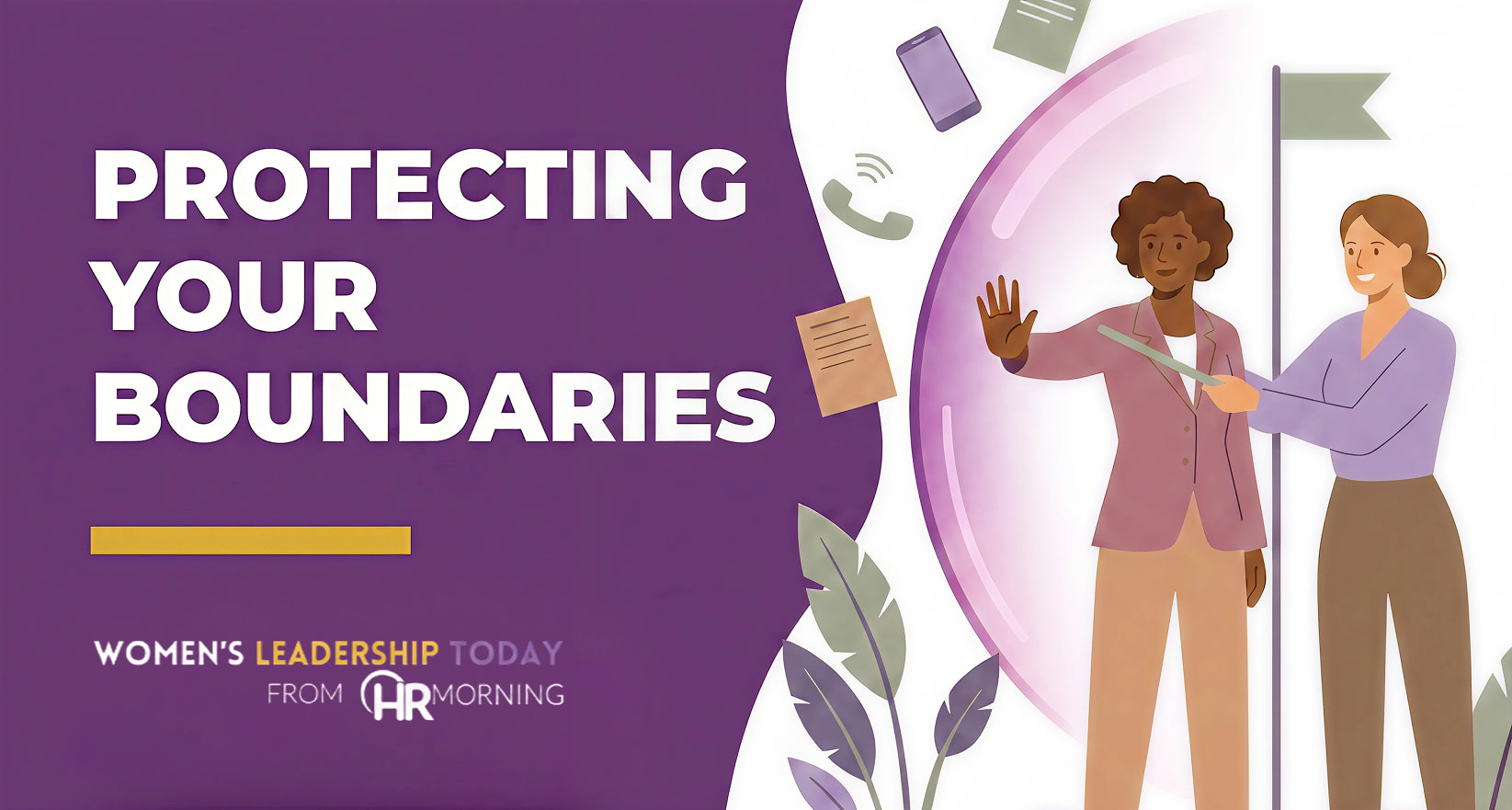
A Corporate Memphis style promotional graphic for a Women's Leadership Today from HRMorning article titled "PROTECTING YOUR BOUNDARIES." The text is displayed in bold white typography on a deep purple background. On the right, the illustration portrays a woman standing protectively inside a large lavender shield bubble, raising her hand in a "stop" motion to deflect floating corporate distractions, including a smartphone, files, and a ringing telephone. A second professional stands outside the bubble holding a grey flagpole, pointing a tool to highlight the barrier. Large botanical leaves accent the base, creating a visual metaphor for maintaining healthy limits, psychological safety, and focus in a demanding corporate environment.

A boundary is a figurative line an individual draws that makes the limits of what they will and won’t tolerate.

Healthy boundaries directly improve your mental, physical or emotional well-being and develop respect in the workplace.

To set healthy boundaries, you need to be aware of what you expect from other people as well as yourself by developing a strong sense of self-awareness. Take time to think about what you are and are not comfortable with in various aspects of your life.

Setting Boundaries at Work

Setting boundaries in the workplace can be particularly difficult. If you’re interviewing for a new position, if your working conditions aren’t benefiting you, or even just working with your team every day, setting boundaries right away is essential and it is never the wrong time to do so.

When you know exactly what you want to communicate, take these steps:

  • Practice good communication and be as clear as possible about your message.
  • Make a list of the terms you need to function and do your best at work. Think about the structure of your workday and timelines of your projects, and how your boundaries will benefit the organization by increasing your productivity and efficiency.
  • Remain professional in your relationships while at work. Blurring the lines between being friends and colleagues can make boundary-setting more complicated.
  • Learn how to assert yourself and say “no” when needed. The focus is to communicate your needs, prioritize your projects and say it without fearing backlash.
  • Use straightforward terms. For example, start with “I need…” or “I will not…” instead of leaving your needs up to interpretation.
  • Avoid saying things like, “I’m not really okay with…” or “I don’t really like…”
  • Be prepared for the different responses you may receive. Your boundaries may be well-received, or you may need to accept dissatisfaction from others.
  • Be ready to compromise or negotiate. Understand where you can and can’t have flexibility – and be firm in communicating this when finding a middle ground.

This last point is particularly difficult for people who aim to please others but remember that just because someone does not like a boundary you’ve set doesn’t mean you’re in the wrong. Know what you need and what you deserve, and be ready to communicate those needs clearly.

Remember – remain firm, yet professional, as the boundaries you set aim to improve your sense of well-being.

Filed under
WLT Logo
  • Business Skills
  • Share on

Get the HRMorning Newsletter

With HRMorning arriving in your inbox, you will never miss critical stories on labor laws, benefits, retention and onboarding strategies.

  • This field is for validation purposes and should be left unchanged.
  • This field is hidden when viewing the form
  • This field is hidden when viewing the form
  • This field is hidden when viewing the form
  • This field is hidden when viewing the form
  • This field is hidden when viewing the form
  • This field is hidden when viewing the form
  • This field is hidden when viewing the form
  • This field is hidden when viewing the form
  • This field is hidden when viewing the form
  • This field is hidden when viewing the form
  • This field is hidden when viewing the form
  • This field is hidden when viewing the form
  • This field is hidden when viewing the form
  • This field is hidden when viewing the form
  • This field is hidden when viewing the form
  • This field is hidden when viewing the form
  • This field is hidden when viewing the form
  • This field is hidden when viewing the form
  • This field is hidden when viewing the form
  • This field is hidden when viewing the form
  • This field is hidden when viewing the form
  • This field is hidden when viewing the form
  • This field is hidden when viewing the form
  • This field is hidden when viewing the form
  • This field is hidden when viewing the form
  • This field is hidden when viewing the form
  • This field is hidden when viewing the form
  • This field is hidden when viewing the form
  • This field is hidden when viewing the form
  • This field is hidden when viewing the form
  • This field is hidden when viewing the form
  • This field is hidden when viewing the form
  • This field is hidden when viewing the form
  • This field is hidden when viewing the form
  • This field is hidden when viewing the form
  • This field is hidden when viewing the form
  • This field is hidden when viewing the form
  • This field is hidden when viewing the form
  • This field is hidden when viewing the form
  • This field is hidden when viewing the form
  • This field is hidden when viewing the form
  • This field is hidden when viewing the form
  • This field is hidden when viewing the form
  • This field is hidden when viewing the form
  • This field is hidden when viewing the form
  • This field is hidden when viewing the form
  • This field is hidden when viewing the form
  • This field is hidden when viewing the form
  • This field is hidden when viewing the form
  • This field is hidden when viewing the form
  • This field is hidden when viewing the form
  • This field is hidden when viewing the form
  • This field is hidden when viewing the form
  • This field is hidden when viewing the form
  • This field is hidden when viewing the form
  • This field is hidden when viewing the form

Free Training & Resources

White Papers

Budgeting for a Successful Rewards and Recognition Program

Provided by Inspirus

White Papers

Uncovering the Real Value of Discount Shopping Programs

Provided by PerkSpot

White Papers

Remote Work Requests Are Testing Your ADA Process, Are You Ready?

Provided by AbsenceSoft

White Papers

2026 Fertility Vendor Evaluation Guide for Benefits Leaders

Provided by Maven Clinic

SPONSORED CONTENT

Employment Law

Policy & Procedures

sponsored content
Policy Rollout: 4 Checkpoints That Show Employees Got the Message

Courtesy of NAVEX

Benefits

Staff Administration

sponsored content
PEO ROI: 3 Numbers to Know Before You Leave Patchwork HR

Courtesy of TRINET

Talent Management

sponsored content
Employee Retention Strategies: 5 That Work When You Can’t Pay More

Courtesy of INSPIRUS

Further Reading

  • Business Skills
What’s Your Conflict Style? Take the Quiz!

Not everybody handles conflict the same way. While some are confident and assertive, others might want to avoid conflict like it’s co...

  • Business Skills
6 Quick Tips for Powerful Presentations

Presenting live in front of colleagues can be a valuable career opportunity, but it can also be stressful. A great deck can truly suppo...

  • Business Skills
Empowering Women in the Hybrid Era: 4 Proven Strategies for Leadership Success

Empowering women toward leadership opportunities is a growing objective for many organizations, especially those that are trying to bring d...

  • Business Skills
Create an Impactful Elevator Pitch: 3 Steps to Put Your Personal Brand in a Nutshell

When you’re networking or engaging with other professionals who might present valuable opportunities, there never seems to be enough ...

  • Business Skills
7 Critical Points to Inclusive Language at Work (Plus an Infographic to Share)

Inclusive language is a way of speaking that aims to keep conversations more general and welcoming to a wider audience. Using gender-ne...

  • Business Skills
Own Your Voice in the Boardroom: 6 Tips to Handle Interruptions

Have you ever spoken up in a meeting, only to be interrupted or dismissed? If so, you’re far from alone. Research confirms women ...

Get the latest from HRMorning in your inbox PLUS immediately access 10 FREE HR guides.

I WANT MY FREE GUIDES
HR Morning Logo
  • Facebook
  • Linked In
  • ABOUT HRMORNING
  • ADVERTISE WITH US
  • WRITE FOR US
  • CONTACT
  • Employment Law
  • Benefits
  • Recruiting
  • Talent Management
  • Performance Management
  • HR Technology
  • Leadership & Strategy
  • Compensation
  • Policy & Procedures
  • Wellness
  • Staff Departure
  • HR Career & Self-Care
  • Health Care
  • Retirement Plans
  • DEI

HRMorning, part of the Rover Insights Network, provides the latest HR and employment law news for HR professionals in the trenches of small-to-medium-sized businesses. Rather than simply regurgitating the day's headlines, HRMorning delivers actionable insights, helping HR execs understand what HR trends mean to their business.

Powered By Rover Insights
Privacy Policy | Terms of Service
Copyright© 2026 Rover Insights
HRMorning Logo

WELCOME BACK!

Enter your username and password below to log in

Forget Your Username or Password?

Reset Password

Lost your password? Please enter your username or email address. You will receive a link to create a new password via email.

Log In

Why do we need your credit card for a free trial?

We ask for your credit card to allow your subscription to continue should you decide to keep your membership beyond the free trial period.  This prevents any interruption of content access.

Your card will not be charged at any point during your 21 day free trial
and you may cancel at any time during your free trial.

During your free trial, you can cancel at any time with a single click on your “Account” page.  It’s that easy.
