• Skip to primary navigation
  • Skip to main content

HRMorning

  • FREE RESOURCES
  • PREMIUM CONTENT
  • HR DEEP DIVES
  • PODCASTS
    • VOICES OF HR
    • WOMEN’S LEADERSHIP TODAY
  • LOGIN
  • SIGN UP FREE
  • Employment Law
  • Benefits
  • Recruiting
  • HR Technology
  • Payroll
  • Management
  • Women’s Leadership
  • More
    • Talent Management
    • Performance Management
    • Leadership & Strategy
    • Compensation
    • Policy & Procedures
    • Wellness
    • Staff Departure
    • HR Career & Self-Care
    • Health Care
    • Retirement Plans
WLT Logo
  • Leadership & Strategy

What 5 Great Female Leaders in History Can Teach Us About Today’s Workplace

Michelle Myers
By: Michelle Myers
  • Share on

About the Author

Michelle Myers is a dedicated Creative Content Production Manager overseeing the content strategy and execution for Women's Leadership, HRMorning, and Resourceful Finance Pro. With a keen eye for detail and a passion for creating engaging and informative content, Michelle plays a vital role in delivering high-quality resources to professionals in HR, finance, and women's leadership. Her expertise spans across various content formats, ensuring that each platform provides valuable insights and fosters professional growth. Michelle's commitment to excellence and her ability to manage complex production workflows make her an invaluable asset to her team.

Show Less
Last Updated: May 13, 2026
6 minute engagement
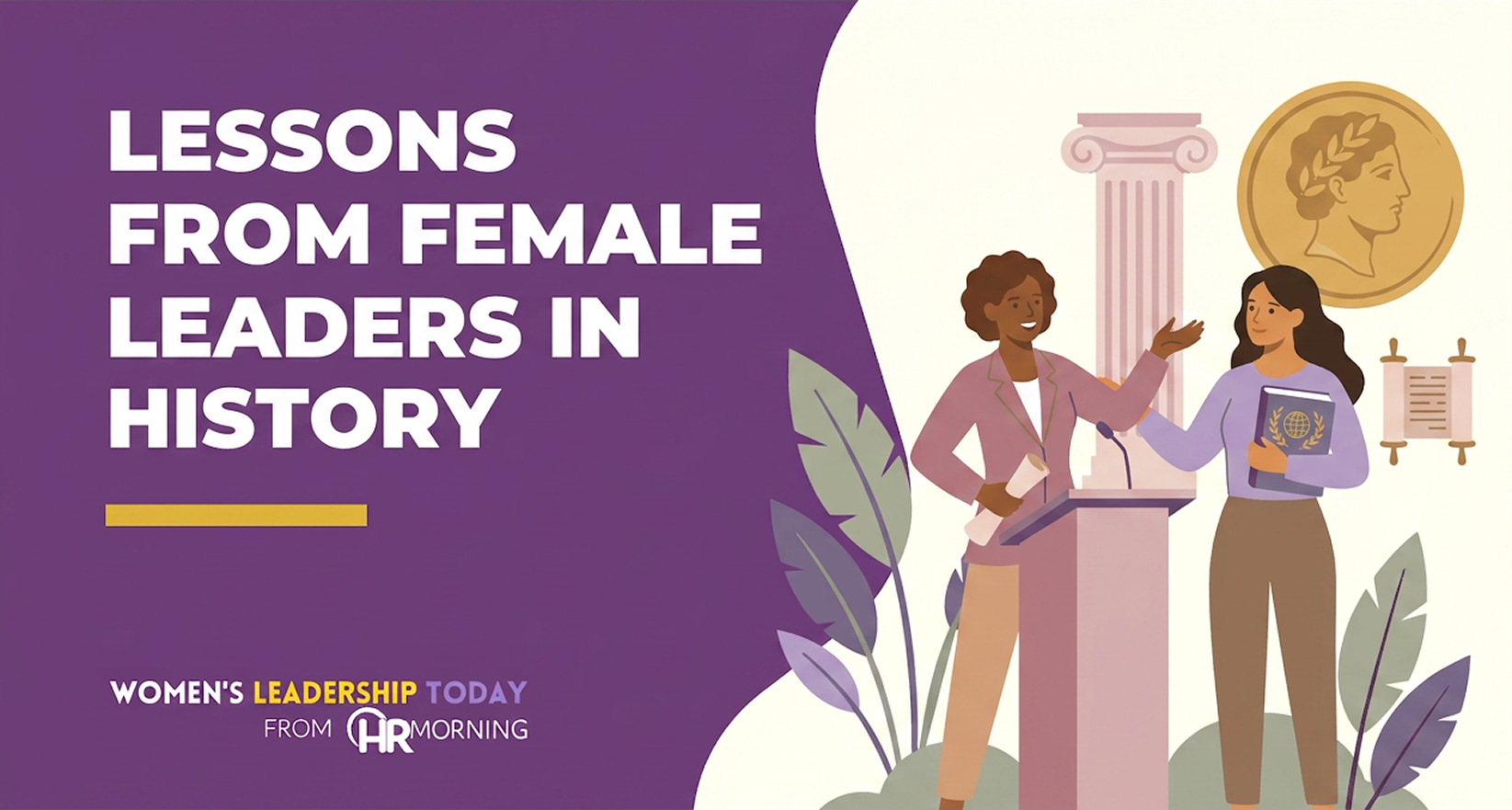
Women's Leadership Today (HRMorning) blog banner about lessons from female leaders in history, featuring an illustration of diverse women leaders with historical motifs like a podium, Greek column, and ancient coin.

In the 21st century, we tend to view women in the workplace and women’s leadership as unique to the modern era.

This is largely because of the influx of female workers during and after WWII, and the increase in women graduating from college and entering professional careers since the mid-20th century.

Female Leaders Ahead of Their Time

However, history is filled with innovative female leaders who rocked their respective epochs. They serve as shining examples of how we can move the women’s leadership movement forward today.

Here is our list of great female leaders in history.

Mary Wollstonecraft | Author | 1759-1797

Our first historical female leader is often cited as the “first feminist” or “mother of feminism,” Mary Wollstonecraft. Her most famous work, “A Vindication for the Rights of Women,” is one of the pillars of feminism and the women’s equality movement.

She lived and wrote at the tail end of the Age of Enlightenment. The ideals of humanism and natural rights at the time were only being applied to men – consider the American Revolution, which established that only men had the right to vote.

Her work dealt with expanding the idea of individual liberties towards women. She supported herself entirely on her own as her abusive father squandered the family wealth before she came of age. Her life and work remain a tremendous influence today.

Lesson: When confronted with the double standards and limited options, you must forge your own path.

Queen Elizabeth I | Queen of England | 1533-1603

Queen Elizabeth I is not only one of the greatest female leaders in history; she is one of the greatest leaders, period. Though her ascension to the throne was tumultuous, her 44-year reign was a period of peace, prosperity and art. When first coming to power, Elizabeth I successfully ended an active war with France and quelled many of the religious disputes still stemming from her father’s break with the Catholic Church.

During her reign, the British Navy defeated the infamous Spanish Armada. Her love of the arts helped spur an artistic renaissance in England, with notable playwrights and poets William Shakespeare, Christopher Marlowe and Edmund Spenser all producing work under her reign. Despite using potential marriage alliances as a political device, Elizabeth I never married, earning her the title “The Virgin Queen.”

More importantly, she never shared her regal power with a husband and king. As one of the greatest European monarchs, Elizabeth I has been honored in literature, song and film; she continues to inspire women and heads of state alike. Her most lasting legacy is her commitment to improving the lives of the people of England. The period of her reign is often called the Golden Age.

Lesson: Taking over management in a difficult time creates the opportunity to establish lasting success, but at times, compromise and strong will are necessary to achieve it.

Katherine Graham | Publisher, Chairwoman of the Board, CEO | 1917-2001

American publisher Katherine Graham was the first female CEO of a Fortune 500 company in history. Following the death of her husband and Washington Post president, Philip Graham, in 1962, Katherine took the reins of the paper. She ascended to de facto publisher in 1963, president in 1967, official publisher in 1969, CEO in 1972, and held the title “Chairwoman of the Board” from 1973 to 1997.

She guided the paper through the Watergate Scandal, which led to President Richard Nixon’s resignation when Post reporters Woodward and Bernstein broke the story. Graham was very involved with the day-to-day operations of the paper and was considered a “working publisher.” In addition to Watergate, the paper investigated Vietnam and other controversial issues of the day, earning the reputation of the second most respected paper in the country.

As the first and only female Fortune 500 CEO, Graham often felt that she had no role models to look up to. She also felt that many of her male staffers and competitors did not respect her because she was a woman. Her ascension to power coincided with the Women’s Liberation movement, and she took it upon herself to promote gender equality at the newspaper. In 1997, she published her memoir, Personal History, which won the Pulitzer Prize in 1998. She won numerous honors in life and in death and is considered to be one of America’s greatest publishers in the 20th century.

Lesson: Striving towards an objective standard of excellence regardless of others’ expectations changes expectations over time.

Hatshepsut | Queen/Pharaoh | 1508 BCE – 1458 BCE

Hatshepsut came into power as Queen of Egypt when she married her half-brother, Thutmose II. Following his death, she started acting as Queen Regent while holding the throne for her stepson Thutmose III, who was only an infant. However, around 1473 BCE, she took on the full powers as Pharaoh, co-ruling with her stepson and nephew. The move caused many objections, and she relied on her heritage and allies to secure her position.

She reinvented how the process of ascending to power worked in order to effectively rule her nation. Not as concerned with military conquest as other pharaohs of the time, she focused her time and energy on expanding Egypt’s trade, arts and construction. Her reign saw Egypt grow in power and influence. At her orders, artisans and craftsmen portrayed her as a male pharaoh. This is likely due to the lack of precedent for artistic regalia depicting a female pharaoh.

Following her death, Thutmose III ordered any depictions of her life and legacy removed, likely out of fear it would inspire other female leaders. It was not until the hieroglyphics on the walls of Deir el-Bari, her largest construction project and tomb, were deciphered in 1822 that her story was added to the history of Egyptian Pharaohs.

Lesson: At times, it is necessary to reinvent the status quo in order to earn the title you deserve and effectively do your job.

Elizabeth Blackwell | Medical Doctor | 1821 – 1910

Elizabeth Blackwell achieved the distinction of becoming the first female to earn a medical degree in the United States. Born in England, she moved to America at the age of 11 when her father emigrated to fight for the abolition of slavery. Despite her studies mostly focusing on history and metaphysics and an early aversion to medicine, she eventually decided to pursue a medical degree. However, in order to achieve this, Blackwell had to improvise a pathway to earning her degree.

After studying medicine independently for one year, she applied to numerous medical schools in Philadelphia and New York. She was accepted to Geneva Medical College in western New York. The faculty of the school allowed the student body to vote on her admittance, with the stipulation that if even one student voted no, they would not admit her. They voted yes unanimously, considering it a joke.

She graduated and earned her medical degree two years later in 1847. For much of her career, she experienced difficulty finding work on account of her gender, but she eventually opened her own practice in New York City. A staunch supporter of the Union and the abolition of slavery, she also gave aid and trained nurses during the Civil War. During her career, she also worked with other female doctors and wrote numerous books, including Medicine as a Profession For Women in 1860, Address on the Medical Education of Women in 1864 and Pioneer Work in Opening the Medical Profession to Women in 1895.

Lesson: Trailblazing a new standard reaches its greatest contribution when the newly forged path opens new roads for others to follow.

Throughout history, women have not only held important leadership positions but thrived in them, even when women in general were not allowed to be leaders. The lives and struggles of those women in power provide great insights into what it takes to overcome traditional barriers to women’s leadership.

Filed under
WLT Logo
  • Leadership & Strategy
  • Share on

Get the HRMorning Newsletter

With HRMorning arriving in your inbox, you will never miss critical stories on labor laws, benefits, retention and onboarding strategies.

  • This field is for validation purposes and should be left unchanged.
  • This field is hidden when viewing the form
  • This field is hidden when viewing the form
  • This field is hidden when viewing the form
  • This field is hidden when viewing the form
  • This field is hidden when viewing the form
  • This field is hidden when viewing the form
  • This field is hidden when viewing the form
  • This field is hidden when viewing the form
  • This field is hidden when viewing the form
  • This field is hidden when viewing the form
  • This field is hidden when viewing the form
  • This field is hidden when viewing the form
  • This field is hidden when viewing the form
  • This field is hidden when viewing the form
  • This field is hidden when viewing the form
  • This field is hidden when viewing the form
  • This field is hidden when viewing the form
  • This field is hidden when viewing the form
  • This field is hidden when viewing the form
  • This field is hidden when viewing the form
  • This field is hidden when viewing the form
  • This field is hidden when viewing the form
  • This field is hidden when viewing the form
  • This field is hidden when viewing the form
  • This field is hidden when viewing the form
  • This field is hidden when viewing the form
  • This field is hidden when viewing the form
  • This field is hidden when viewing the form
  • This field is hidden when viewing the form
  • This field is hidden when viewing the form
  • This field is hidden when viewing the form
  • This field is hidden when viewing the form
  • This field is hidden when viewing the form
  • This field is hidden when viewing the form
  • This field is hidden when viewing the form
  • This field is hidden when viewing the form
  • This field is hidden when viewing the form
  • This field is hidden when viewing the form
  • This field is hidden when viewing the form
  • This field is hidden when viewing the form
  • This field is hidden when viewing the form
  • This field is hidden when viewing the form
  • This field is hidden when viewing the form
  • This field is hidden when viewing the form
  • This field is hidden when viewing the form
  • This field is hidden when viewing the form
  • This field is hidden when viewing the form
  • This field is hidden when viewing the form
  • This field is hidden when viewing the form
  • This field is hidden when viewing the form
  • This field is hidden when viewing the form
  • This field is hidden when viewing the form
  • This field is hidden when viewing the form
  • This field is hidden when viewing the form
  • This field is hidden when viewing the form
  • This field is hidden when viewing the form

Free Training & Resources

Webinars

Gwyneth Paltrow on Challenging, Motivating and Inspiring Your Employees

White Papers

Inspirus — The Mid-Market Retention Playbook: 5 Strategies That Work When You Can’t Just Pay More

Provided by Inspirus

White Papers

Maven’s State of Women’s and Family Health Benefits — 2025 Report

Provided by Maven Clinic

Webinars

Support Your D&I Initiatives with Virtual Hiring Events

SPONSORED CONTENT

HR Technology

sponsored content
The Best AI Software for HR Automation

Courtesy of G-P

Talent Management

sponsored content
Powerful Employee Retention Strategies for 2025: How to Keep Your Best People

Courtesy of PEOPLEGURU

Benefits

Health Care

Wellness

sponsored content
Proven Results: 5 Ways Teladoc Health Chronic Condition Management Transforms HR Outcomes

Courtesy of TELADOC HEALTH

Further Reading

  • Leadership & Strategy
Don’t Waste Your Time, Own it: 4 Ways AI Can Actually Help

The demands of your career can easily start to feel all-consuming, making it difficult to find time for activities you truly enjoy. Between...

  • Leadership & Strategy
Resilience: 5 Strategies to Master Perseverance + Tenacity

At a recent college graduation I attended, the student speaker coined a word I found intriguing: “persevacity”. Persevacity,...

  • Leadership & Strategy
Top Reasons Your Team Isn’t Meeting Expectations

As leaders, we all have high expectations for our teams. We envision them operating like well-oiled machines, delivering outstanding res...

  • Leadership & Strategy
Leading with Heart: Lessons on Authenticity from Former Prime Minister Jacinda Ardern

This year at the Pennsylvania Conference for Women, we were honored to hear former New Zealand Prime Minister Jacinda Ardern share profound ...

  • Leadership & Strategy
7 Strategies to Smartly Set and Achieve Career Goals in Today’s Workplace

When it comes to your career, you want to set goals all the time – daily, weekly, monthly, quarterly … But one of the bigges...

  • Leadership & Strategy
5 Strategies to Help Women Thrive in Male-Dominated Industries

In many professional fields, women continue to be underrepresented, especially in industries traditionally dominated by men, such as techn...

Get the latest from HRMorning in your inbox PLUS immediately access 10 FREE HR guides.

I WANT MY FREE GUIDES
HR Morning Logo
  • Facebook
  • Linked In
  • ABOUT HRMORNING
  • ADVERTISE WITH US
  • WRITE FOR US
  • CONTACT
  • Employment Law
  • Benefits
  • Recruiting
  • Talent Management
  • Performance Management
  • HR Technology
  • Leadership & Strategy
  • Compensation
  • Policy & Procedures
  • Wellness
  • Staff Departure
  • HR Career & Self-Care
  • Health Care
  • Retirement Plans
  • DEI

HRMorning, part of the Rover Insights Network, provides the latest HR and employment law news for HR professionals in the trenches of small-to-medium-sized businesses. Rather than simply regurgitating the day's headlines, HRMorning delivers actionable insights, helping HR execs understand what HR trends mean to their business.

Powered By Rover Insights
Privacy Policy | Terms of Service
Copyright© 2026 Rover Insights
HRMorning Logo

WELCOME BACK!

Enter your username and password below to log in

Forget Your Username or Password?

Reset Password

Lost your password? Please enter your username or email address. You will receive a link to create a new password via email.

Log In

Why do we need your credit card for a free trial?

We ask for your credit card to allow your subscription to continue should you decide to keep your membership beyond the free trial period.  This prevents any interruption of content access.

Your card will not be charged at any point during your 21 day free trial
and you may cancel at any time during your free trial.

During your free trial, you can cancel at any time with a single click on your “Account” page.  It’s that easy.