Create an Anti-Fragile Workforce | 2-Minute Video

Shake-ups happen all the time at work — small and large.
A fragile workforce will crack under the smallest pressures. An anti-fragile workforce will not only survive the shock, but become better for it.
That is just one reason you want for building an anti-fragile workforce.
What’s Up in This Episode: Building an Anti-Fragile Workforce
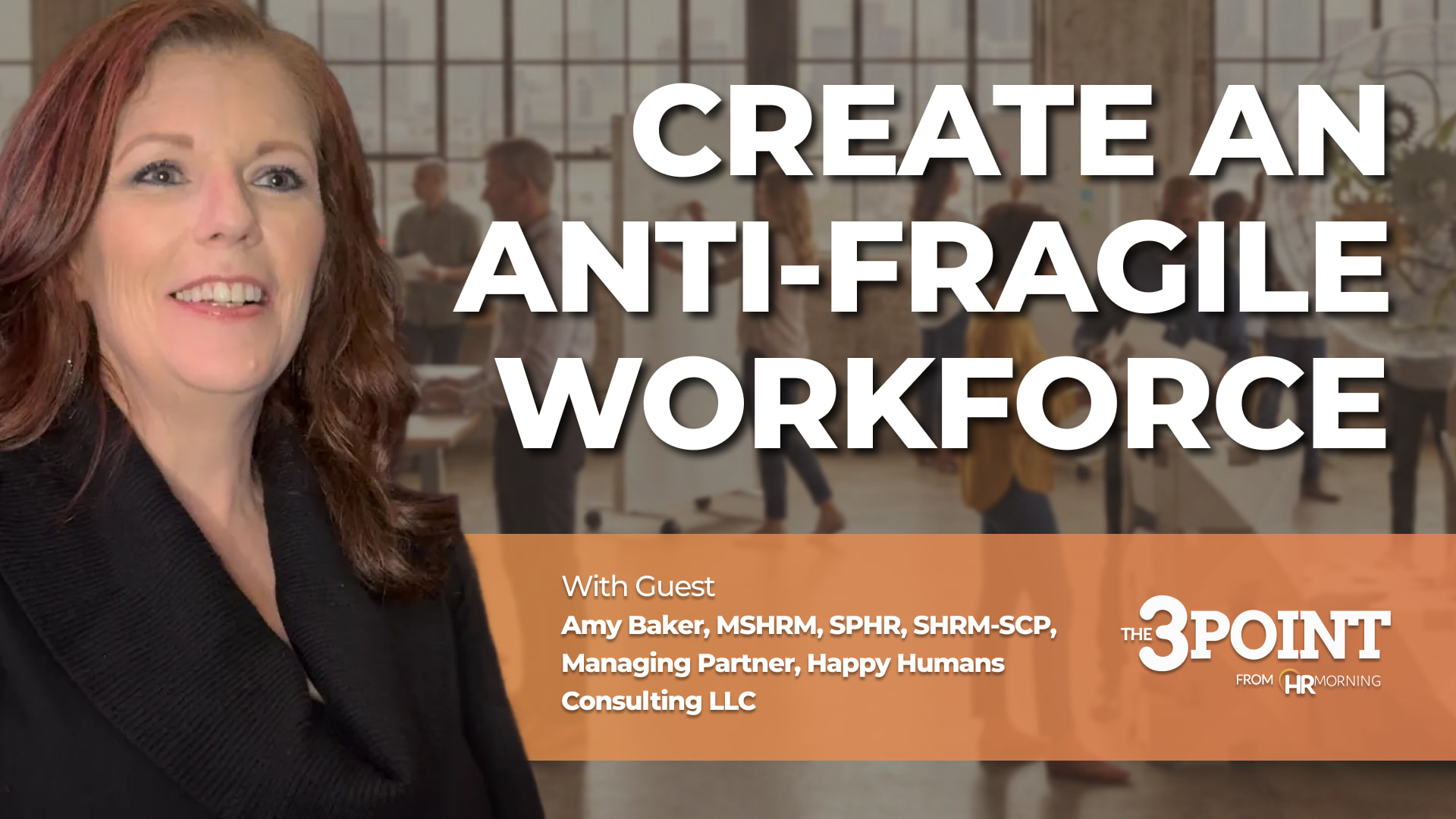
In this episode of HRMorning’s 3-Point, we’ll explore several reasons for building a more resilient workforce with Amy Baker, Managing Partner at Happy Humans Consulting LLC. She’ll explain the theory behind anti-fragility and how leaders can build teams that handle stress, adversity, and crisis to a degree that their teams become better for it.
Click, watch and listen for more on becoming an anti-fragile workforce.
Transcript (edited for clarity):
Amy Baker, MSHRM, SPHR, SHRM-SCP, Managing Partner, Happy Humans Consulting LLC: “Anti-fragility is about surviving shock and becoming better.“
Can you imagine? Having a team, a department or the whole company take a pretty big hit and become better for it? That’s what we’re going to try to help you do in this episode of HRMorning’s 3-Point as we look at how you create an anti-fragile workforce.
First, let’s take a closer look at what anti-fragile means:
Baker: “He (Nassim Nichols Talem) created this concept about companies that go through shock. And you’re either fragile and you break and you don’t make it through the shock. You’re resilient or robust, so you survive it, but you don’t become better as a result of it. And then there’s anti-fragile, which is you not only survive the shock, but through innovation and agility and other approaches and creativity, you become better as a result of it.“
But how do you get there?
Baker: “You need to get buy-in from the top. I think that you need to make sure that policies are more flexible. Obviously, compliance issues have to be maintained. But focus more on principles and values than rules, if you will. Additionally, making sure that leaders are trained to do more frequent check-ins.“
So when I talked with Baker about making anti-fragility work, we agreed that it has to do with breaking the rules, usually with respectful caution. And a good place to start is …
Baker: “You can’t change everything at one time. So I think the way to start is for senior leadership to decide this is what we really want to do, to commit to it, to start an appropriate communication exchange, to make sure they’re collecting feedback along the way and being willing to listen, right.“
Now, to build an anti-fragile work culture – or a place where people and teams can bounce back better when disrupted, you’ll want to:
- Work from the top-down. Changes will likely work best when leaders adopt them first.
- Be flexible. Remember when making changes, the focus is more on values, less on rules.
- Listen. While anti-fragility starts at the top, it’ll stay fueled by employee feedback.
We know, change isn’t easy, especially in the wake of something shocking. Another resource that can help: Check out this blueprint on the HRMorning website: The Accountable Workforce. Thanks for watching this episode.
- Share on


Free Training & Resources
Webinars
Provided by AbsenceSoft

Resources
The Cost of Noncompliance
What Would You Do?
Premium Articles
The Cost of Noncompliance



