Politics, Religion & Money: 4 Things To Do When Cringeworthy Topics Come Up at Work

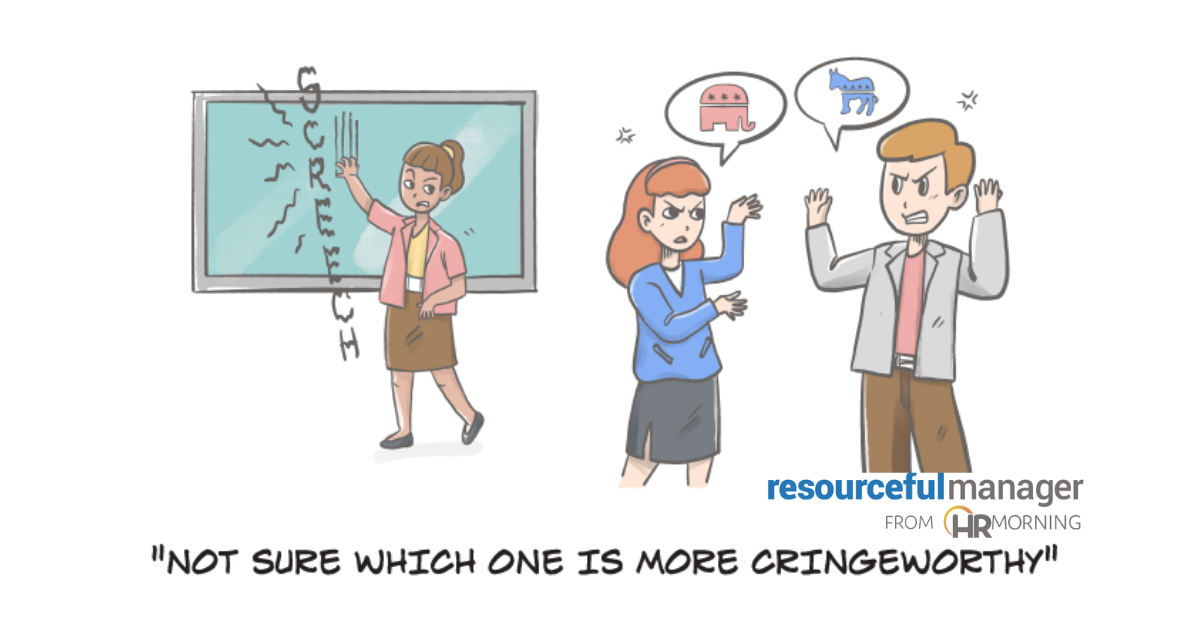
Don’t you hate it when someone gets on cringeworthy topics at work – such as politics, religion or money?
Most people want to walk away. Just a loud few want to discuss it. Problem is, most of us don’t know what to do when the topic is something we want to avoid.
Part of it is that we don’t want to make the matter worse, especially when things can get particularly heated around elections. Another part of the problem: We don’t want to risk letting our own opinions spill out and get verbally attacked.
Diverse Views on Cringeworthy Topics
But diverse views have a place in healthy work cultures. And leaders can help employees navigate conversations when the topic is taboo – or just uncomfortable. What’s more, when you help employees have respectful, professional conversations, you can improve engagement and stamp out another root of stress.
“To create a highly engaged and diverse culture, you need to build on a foundation of psychological safety, where employees feel safe to be themselves. This includes a humble acknowledgment that we often work with people who have different political beliefs than us,” says Adam Weber, an Executive Coach.
Here are four strategies to alleviate or navigate uncomfortable conversations and cringeworthy topics.
1. Be Proactive if the Topic is Taboo
Oftentimes, employers, HR leaders and front-line managers know something sensitive or contentious is in the making. And employees will likely talk about it in the workplace, despite any inappropriateness.
That’s the time to get ahead of it.
“It’s good to be proactive when possible,” Weber says. “For instance, we knew that the Supreme Court was deciding on the issue of Roe v. Wade weeks in advance, and we sent a message ahead of the decision.”
15Five used this formula when that happened several years ago, and it still works for almost any subject:
- Acknowledge that its a deeply personal issue that connects to personal lives, families and faith traditions
- Stress the importance of kindness and respect around the wide spectrum of beliefs on social and political issues.
- Explain how miscommunication can easily happen on forums like Slack and email, and
- Offer other communication outlets to discuss the issue such as with the leadership team or HR department, and mental health counseling.
2. React When Necessary
In some cases, you can alleviate difficult or contentious conversations in the workplace by addressing the issues head-on. When you acknowledge things are happening – without taking a side – you can put employees in a more comfortable place.
“It can be naïve and come across as aloof for leadership to fully ignore what is happening in the culture when it is significant,” says Weber. “Silence at times can make things worse.”
For instance, around the Jan. 6 riot at the Capitol, Weber recorded a video for employees. His guideline is helpful for similar situations:
- I encourage you to feel your feelings
- Take space and time if you need it
- Remember that part of being a diverse and caring community is that we all have different backgrounds and experiences, and
- Let’s do our part to be extra gentle with ourselves and with each other.
3. Address Unconscious Bias
Almost everyone brings biases to work – and they seldom recognize them. It’s the proverbial unconscious bias.
While you don’t need to point out biases – after all, telling people they’re racist, sexist, chauvinistic and beyond will likely spark more controversy – you want to help employees understand that unconscious biases poison relationships and culture.
“As we mature, we recognize that we know more today than yesterday, but lose sight that we still have so much to learn,” says Jenn Lim, CEO of Delivering Happiness and author of Beyond Happiness. “That’s how unconscious biases get stuck in our neurological pathways because somehow those thoughts have helped us survive. But our personal experiences don’t take into account all the other personal experiences that are now sitting together in one room, in your office, in your meetings or in Zoomland.”
HR likely hosts bias training at least once a year. To that, add an unconscious bias awareness element with exercises and self-evaluations.
“The more leaders are transparent about our inherent differences, the more we can focus on what unites us in productive, communal ways,” says Lim.
4. Refocus on Alignment
Opinions about politics, money and religion drive people apart. Conversations about cringeworthy topics are disruptive and sometimes hurtful. But you probably can’t eliminate them from the workplace.
You can counteract any negative effects by rallying around topics and causes that unify your people.
“What good can your company do in the world – whether it’’s perpetuating the mission of the company or donating and serving a cause that is universally impactful,” says Weber.
When you recognize something to rally around or an area where the group is aligned, try to:
- Find ways for everyone to participate to the degree each wants to (recognizing that some won’t want to participate at all)
- Give employees time to be involved and/or advocate for the good, and
- Share the positives. The more you can show good things happening within your organization – and their impact on people and causes – the less likely people will focus on negative topics.

- Share on


Free Training & Resources
White Papers
Provided by Maven Clinic
White Papers
Provided by Maven Clinic



