3 Ways to Help Employees Take Control of Their Well-Being | 2-Minute Video

Most companies care more than ever about their employees’ well-being.
You likely offer them opportunities to reduce stress or improve their overall health. But they may not take advantage of those.
This might help get more participation: Give employees more tools while you’re all at work.
What’s Up in This Episode: Employees Control Well-Being
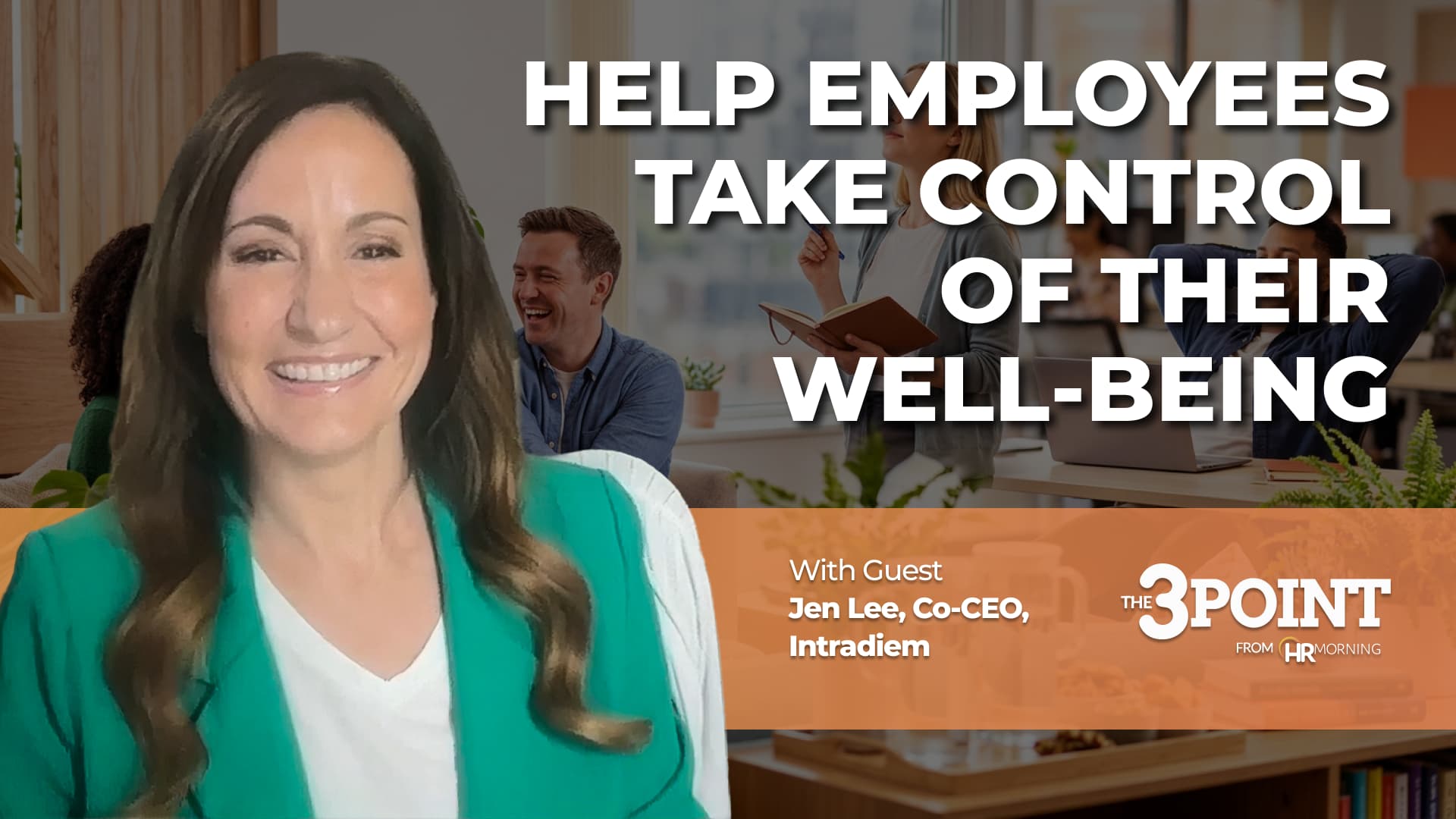
In this episode of HRMorning’s 3-Point, our expert, Jen Lee, Co-CEO of Intradiem, explains how her company has improved employee well-being so they stay healthier and more effective.
Click, watch and listen for more details on helping employees take control of their well-being.
Transcript (edited for clarity):
If your people are healthy, they’re better employees. You’ve probably seen research that shows it’s a fact. But can you make them well in the workplace? Jen Lee, the Co-CEO at Intradiem, argues “Yes, you can.” She’s done it, and in this episode of the 3-Point, she shares how you can do it. First, why is it important to help employees achieve healthy mental well-being?
Jen Lee, Co-CEO, Intradiem: “I don’t think anybody would say their work is less stressful today than it was a few years ago, 10 years ago. It’s certainly more stressful. Everybody’s focused on efficiency, and that compounds that stress. And so I think acknowledge it and then find tools and systems so that you can make it easy for people to de-stress.”
We’ve talked in another episode about one of those tools: Microbreaks. But you can tell employees to do this or that, and they might not bother. So, how did Jen Lee get her employees to try de-stressing tactics?
Lee: “So what I’ve done is I’ve shared that science with the company in my weekly newsletters, and then I reinforce it. I share examples every week when I send my newsletter out. I say, here – and I call it the Mindful Moment. Here’s a Mindful Moment: I found a video you can go look at and then do it in their teams, and then just, honestly, as a leader, showing a little bit of vulnerability and saying, ‘Hey, I need this, so I use it, and it works great for me, goes a long way.’”
So, now she’s convinced her people to take some personal control of stress. More importantly, they’re learning to get ahead of it.
Lee: “It’s that compounding effect you’re trying to get in front of and prevent. And so doing it once will help make a big difference. If you only do it once, it still has an impact. If you can do it a few times a day, and if you think about that as three to five minutes of the day, right, maybe 10 minutes if you’re doing slightly longer ones. We can all find that amount of time somewhere in our day, and it really does make a huge difference. Your shoulders drop, you breathe easier, and you just move on with your day without carrying that stress forward.”
Improving mental well-being is accessible at work. Follow these tips from Intradiem:
- Acknowledge it. Tell employees you know they’re stressed and you want to help.
- Lead by example. Get leaders who prioritize well-being to share their tips and tricks to de-stress.
- Stay ahead of it. Give employees tools and time to proactively manage stress.
Stress is no joke in the workplace. And our HR leaders are highly susceptible to burnout. For more ideas on getting ahead of it, check out this story on HRMorning.com: What Happens When HR is Burned Out? As always, thanks for joining me on this episode.
- Share on



