4 Ways HR Leaders Can Prepare Managers To Handle Mental Health Disclosures

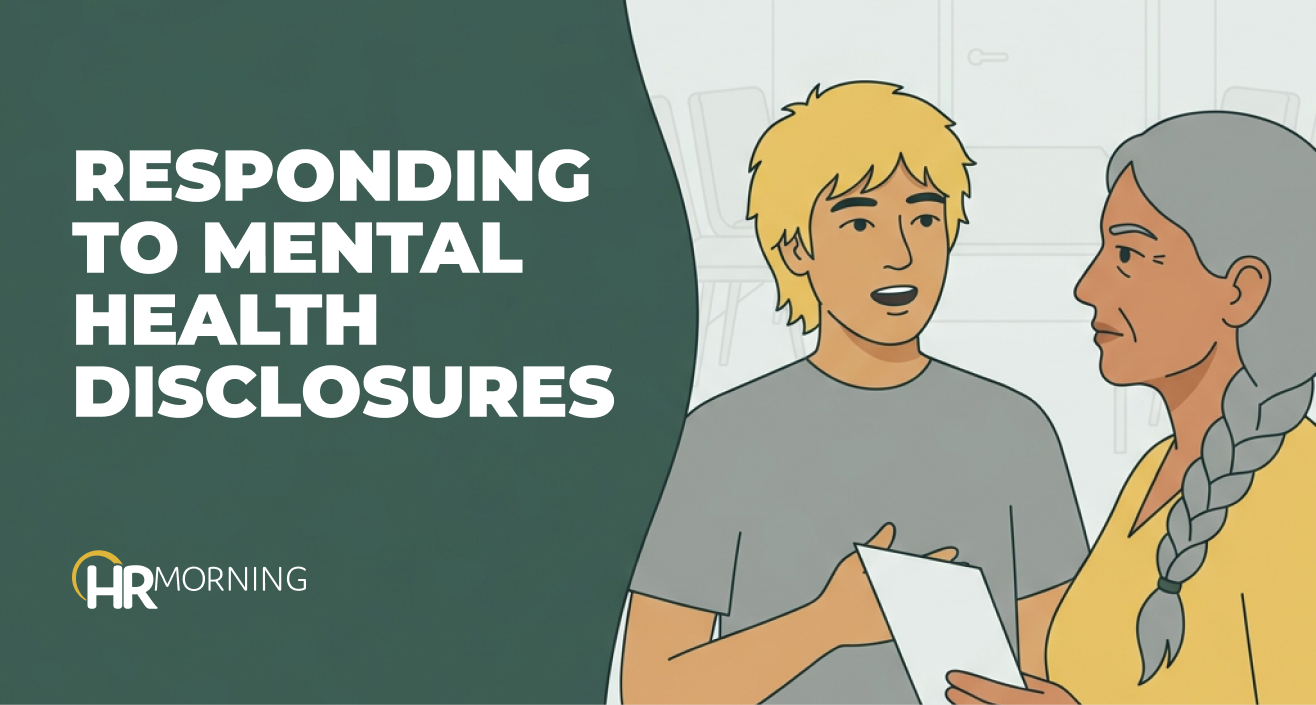
The right resources for mental well-being help everyone, including managers.
The National Alliance on Mental Illness (NAMI) 2026 Workplace Mental Health Poll found that 73% of managers without company-provided mental health resources feel burned out, compared to 45% of managers with them.
Responding to Mental Health Disclosures
How a manager responds to formal mental health disclosures or an informal comment about mental health or self-care dramatically impacts whether and how employees talk about mental health at work.
Ahead of World Mental Health Day on Oct. 10, here are four ways HR leaders can prepare managers to support their employees.
1. What to Say When an Employee Discloses a Mental Health Condition
There’s no script for responding to a mental health disclosure from someone you work with. What matters most is that managers listen, hold off on coming to conclusions, and don’t make assumptions about what the employee is going through. Those first few minutes shape whether the employee ever brings up their mental health at work again.
The responses that work best tend to be short and simple:
- “I’m glad you felt comfortable sharing this with me.”
- “What support do you need from me to do your job well?”
- “Let me look into what resources we have, and I’ll follow up with you later this week.”
Many managers instinctively jump in with advice, but unless the employee explicitly asks for it, or the issue is getting in the way of them completing their work, giving advice isn’t the manager’s job. A manager’s role is to make sure the employee has the tools, resources and support they need to do their work—and to connect them to those resources.
Two responses backfire here. The first is minimizing. Minimizing can sound like what my manager told me as an intern: that it wasn’t appropriate to share my anxiety in the workplace. It can also sound like downplaying the employee’s condition, such as saying, “You seem fine to me.” Employees are human, and they can’t simply check their emotions at the door. When a manager expects them to, the employee learns to stay silent, just like I did.
The second is asking for a diagnosis. Questions like “What’s your diagnosis?” or “Are you on medication for that?” put the employee on the spot, and the answers don’t help the manager support them.
2. How to Keep Supporting Employees After a Disclosure
Mental health needs are vast, so the answer to “What support do you need from me to do your job well?” varies from employee to employee.
The support doesn’t stop after that first ask, though. Managers also need to check in regularly, keeping the focus on the employee’s current projects, blockers, career goals and development. Yes, managers can ask how the employee is doing, but the goal is to help them do their work to the best of their abilities, not to solve their personal problems.
Many employee requests related to mental health are small enough for a manager to approve on the spot, like coming in late or leaving early for an appointment, using AI to transcribe meetings or keeping the camera off. Larger or ongoing changes may become formal accommodations, which is when the manager needs to bring HR in to walk through the process and involve legal counsel when needed.
3. When to Bring In HR, Accommodations or EAP?
When a company hasn’t set clear expectations for one-on-ones and manager-employee relationships, it’s easy for a manager to slide into the role of therapist. Managers are not trained, licensed mental health professionals, and they shouldn’t try to be.
This came up in a session with a group of HR leaders I coach. One HR leader shared a challenge a manager had brought up: An employee kept turning their one-on-ones into what felt like therapy sessions. The manager wanted to be empathetic, yet the conversations kept veering into personal issues.
The group helped that HR leader clarify the manager’s role, coach the manager to be both kind and direct, and make sure the employee was pointed to resources like the employee assistance program (EAP) and leave under the Family and Medical Leave Act. The manager’s next conversation went well, and their one-on-ones got back on track.
We also walked through three distinct roles: employees ask for what they want and own their performance, managers listen and drive performance, and HR supports managers, offers training, and serves as the liaison to the EAP.
Managers should bring in HR when:
- An employee’s performance is slipping
- There’s a safety concern for the employee or anyone else
- An employee asks for a formal accommodation or leave
- An employee raises harassment, discrimination, or similar legally sensitive situations, and/or
- The manager isn’t sure what to do next.
When a manager brings in HR, the handoff matters. Managers should get the employee’s permission, or at least give them a heads-up, so they aren’t blindsided. A warm handoff goes beyond sharing a link to the EAP, though, such as introducing the employee to their HR partner by email—with their OK, of course.
4. Why Employees Skip Mental Health Benefits
According to Mental Health America (MHA), 98% of mid-to-large U.S. companies offer an EAP, yet only about 4% of employees use it each year. MHA says one reason for this is that employees worry their employer is tracking who uses these resources.
Even executives share that same fear. Many of the executives I coach tell me they don’t use their EAP because they don’t want it reported back to their organization, even when the vendor says it doesn’t share individual names. One CHRO client I know paid out of pocket for therapy so none of it would be tied to their company.
When executives never talk about using the EAP or any other mental health support, employees may assume it isn’t safe for them to, either. NAMI’s poll found that only 30% of employees feel comfortable talking about their mental health with senior or C-suite leaders.
A Mental Health Disclosure Checklist for Managers
According to NAMI, fewer than three in ten managers have received training on how to talk about mental health with their teams. HR leaders can share or adapt this checklist:
- Listen first. Skip assumptions and unrequested advice, avoid minimizing, and don’t probe for a diagnosis.
- Ask: “What support do you need from me to do your job well?”
- Keep one-on-ones focused on projects, blockers, career goals, and development, so they don’t turn into quasi-therapy sessions.
- Bring in HR for performance, safety, accommodation, or leave concerns, or when you’re unsure.
- Tell the employee before looping HR in, and make the handoff a warm one.
- Talk about the mental health support you use, if you’re comfortable. Your team takes cues from you on how much they can disclose.
When HR prepares managers for these conversations, employees are more likely to speak up and get the support they need.
A Personal Story that Proves the Importance of Support
Early in my career, I interned at a Bay Area mental health organization. I disclosed to my manager that I lived with anxiety, which made the organization’s mission very personal to me. He told me that my challenge wasn’t appropriate to share in the workplace.
I didn’t feel like I had shared too much, especially since it was a mental health organization, and his response stung. Moving forward, I felt like I was walking on eggshells around him, and I stopped talking about mental health at work for several years.
Later, I worked at a mental health nonprofit. My boss was transparent about her own mental health condition, and I finally felt comfortable disclosing again because she met me with understanding and compassion.
More than a decade later, those two responses still shape how comfortable I feel about sharing my story. Today, I train leaders and HR teams on how to support employee mental health.
In a January HRMorning article, LifeSpeak’s Anna Mittag said of front-line managers, “They’re not counselors, therapists, or psychiatrists, yet they’re called to be these.” Today, I open every manager training by making that same point.
- Share on


Free Training & Resources
White Papers
Provided by Marsh


