• Skip to primary navigation
  • Skip to main content

HRMorning

  • FREE RESOURCES
  • PREMIUM CONTENT
  • HR DEEP DIVES
  • PODCASTS
    • VOICES OF HR
    • WOMEN’S LEADERSHIP TODAY
  • LOGIN
  • SIGN UP FREE
  • Employment Law
  • Benefits
  • Recruiting
  • HR Technology
  • Payroll
  • Management
  • Women’s Leadership
  • More
    • Talent Management
    • Performance Management
    • Leadership & Strategy
    • Compensation
    • Policy & Procedures
    • Wellness
    • Staff Departure
    • HR Career & Self-Care
    • Health Care
    • Retirement Plans
RM Logo
  • Talent Management

8 Ways to Motivate a Team of Misfits to Success

Michele McGovern
By: Michele McGovern
  • Share on

About the Author

Michele McGovern writes. A lot. These days, she covers HR, digging deep into company culture, DEI, leadership, management and the everchanging world of work. In the years between getting a BA in journalism from a state school and writing about HR, she wrote about big-city crime for a wire service and small-town life for local newspapers. She’s a mediocre mom, decent wife, wannabe athlete and consummate pursuer of fun - on land, snow and water. Find her on LinkedIn @michele-mcgovern-writer.

Show Less
Last Updated: March 29, 2026
4 minute engagement

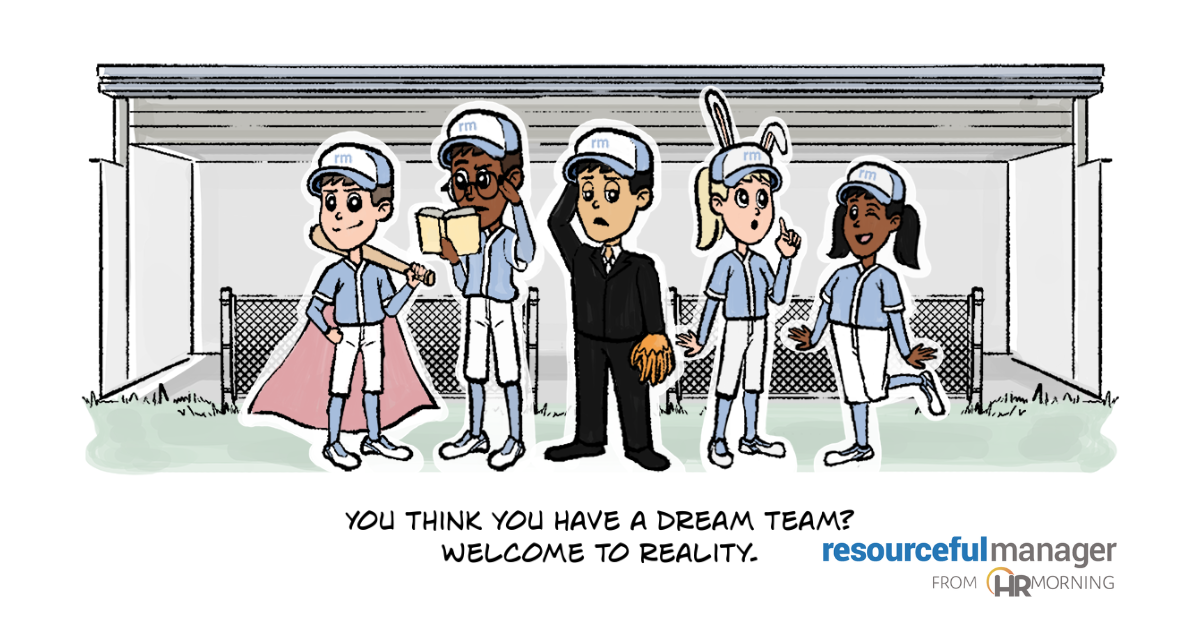
Managers often think they have a pennant-winning Yankees lineup in place, when in reality, they’re looking at a bench full of Bad News Bears.

So they have to face the question: How can I help a team of misfits succeed?

Well, here’s the good news: The right manager motivated the Bad News Bears — and so can you. (Not to mention, more than one Yankees team has imploded!)

From Misfits to Megastars

First off, we aren’t saying your team is a group of outright misfits — a group of odd individuals who wouldn’t bother with each other if it weren’t for the shared goal. More likely, what makes them “misfits” is that they’re all individuals motivated by different things.

And that’s why it feels like misfits: How can you possibly make them all happy? Keep them all engaged? Motivate them to reach the goal together at the same time?

“The manager’s function is not to make people work, it is to make it possible for people to work.” That’s according to Tom DeMarco and Timothy Lister, authors of Peopleware: Productive Projects and Teams (which has proven to be an effective guide, considering it’s been published three times!)

So when you lead a misfit team, it’s critical to find the right motivation for everyone.

Here’s help to do that:

1. Lead by Example

First step: Be positive and motivated yourself.

“Be the change you want to see,” says Andres Lares, Managing Partner at Shapiro Negotiations Institute and co-author of Persuade. “Being appreciative of what you have, seeing the positive in situations, rather than the negative, is a very challenging but technically easy thing to change and makes a dramatic difference in satisfaction, motivation, etc.”

2. Set SMART Goals

As a leader, you want to help individuals and the team set SMART goals (Specific, Measurable, Achievable, Relevant and Time-Bound). When everyone is headed toward the same achievable goal — and a tangible reward — they’ll be motivated to work together.

“Most people know this, but it’s about compelling yourself to actually do it. Write down your goals, check in on your goals and share them with others,” says Lares.

3. Encourage Strengths

In the Bad News Bears, one player, Ahmad, wants to give up after a string of failures. Coach Buttermaker asks him what he did well. “I am pretty fast, aren’t I?” the boy asks.

And the motivation magic comes from Buttermaker: “You’re very fast.“

In three words, the coach elevated a defeated player from “I suck” to “I’m good” to “I’m very good!”

That’s why you want to encourage your team members’ strengths as often as possible.

4. Revel in the Accomplishments

The Bad News Bears didn’t win the championship (sorry if that was a spoiler). But they celebrated wins like nobody’s business — trash talking, beer drinking and full-on camaraderie. That’s all they needed to motivate them to take on the next challenge.

Celebrate milestones to build momentum to the final victory.

5. Keep Them Team-Focused

Team members will always have their own best interests in mind. So to achieve team success, you’ll need to keep “team” top of mind too.

As Coach Buttermaker said, “All I know is when we win a game, it’s a team win. When we lose a game, it’s a team loss.”

Words like that help team members recognize their accountability. Even better, reward the team for wins achieved through teamwork.

6. Get Hot Dogs and Cokes

I know: Pizza parties and bagel Fridays are cliché and don’t really work to motivate teams. That’s still true — free food isn’t the primary way to motivate teams. But food brings people together.

So plan food and drinks together. Buttermaker: “That’s the spirit! Come on, guys. Cokes and hot dogs on me.”

Then use the time together eating and drinking to get focused on the goal and how you’ll achieve it.

7. Balance the Dogs and Soda

A healthy team is a motivated team, too. Do all you can to help team members stay physically and mentally healthy. At a minimum, direct them toward the wellness benefits your company offers.

“Promote wellness initiatives such as mindfulness sessions, health challenges and team-building activities, or doing something that will get your employees in a good mood,” says Lares. “A healthy and happy team is a motivated, confident and high-performing team. Doing things you enjoy will get you in a good mood!”

8. Let Them Grow

DeMarco and Lister — the Peopleware authors — use a perfect agricultural metaphor to explain motivation: You prepare the soil, plant the seeds, occasionally water and remove weeds, but otherwise you step out of the way and let it grow. There is nothing else you can do. With luck, you get a good harvest, but you will have to sweat again next year!

Filed under
RM Logo
  • Talent Management
  • Share on

Get the HRMorning Newsletter

With HRMorning arriving in your inbox, you will never miss critical stories on labor laws, benefits, retention and onboarding strategies.

  • This field is for validation purposes and should be left unchanged.
  • This field is hidden when viewing the form
  • This field is hidden when viewing the form
  • This field is hidden when viewing the form
  • This field is hidden when viewing the form
  • This field is hidden when viewing the form
  • This field is hidden when viewing the form
  • This field is hidden when viewing the form
  • This field is hidden when viewing the form
  • This field is hidden when viewing the form
  • This field is hidden when viewing the form
  • This field is hidden when viewing the form
  • This field is hidden when viewing the form
  • This field is hidden when viewing the form
  • This field is hidden when viewing the form
  • This field is hidden when viewing the form
  • This field is hidden when viewing the form
  • This field is hidden when viewing the form
  • This field is hidden when viewing the form
  • This field is hidden when viewing the form
  • This field is hidden when viewing the form
  • This field is hidden when viewing the form
  • This field is hidden when viewing the form
  • This field is hidden when viewing the form
  • This field is hidden when viewing the form
  • This field is hidden when viewing the form
  • This field is hidden when viewing the form
  • This field is hidden when viewing the form
  • This field is hidden when viewing the form
  • This field is hidden when viewing the form
  • This field is hidden when viewing the form
  • This field is hidden when viewing the form
  • This field is hidden when viewing the form
  • This field is hidden when viewing the form
  • This field is hidden when viewing the form
  • This field is hidden when viewing the form
  • This field is hidden when viewing the form
  • This field is hidden when viewing the form
  • This field is hidden when viewing the form
  • This field is hidden when viewing the form
  • This field is hidden when viewing the form
  • This field is hidden when viewing the form
  • This field is hidden when viewing the form
  • This field is hidden when viewing the form
  • This field is hidden when viewing the form
  • This field is hidden when viewing the form
  • This field is hidden when viewing the form
  • This field is hidden when viewing the form
  • This field is hidden when viewing the form
  • This field is hidden when viewing the form
  • This field is hidden when viewing the form
  • This field is hidden when viewing the form
  • This field is hidden when viewing the form
  • This field is hidden when viewing the form
  • This field is hidden when viewing the form
  • This field is hidden when viewing the form
  • This field is hidden when viewing the form

Free Training & Resources

White Papers

Maven’s State of Women’s and Family Health Benefits — 2025 Report

Provided by Maven Clinic

White Papers

Employee Recognition Playbook

Provided by Inspirus

Webinars

Serena Williams and Paycom: A Conversation About Purpose, Success and Work Ethic

Provided by Paycom

Webinars

Trends Reshaping Corporate Philanthropy: Employee Giving and Volunteerism

SPONSORED CONTENT

HR Technology

sponsored content
The Best AI Software for HR Automation

Courtesy of G-P

Talent Management

sponsored content
Powerful Employee Retention Strategies for 2025: How to Keep Your Best People

Courtesy of PEOPLEGURU

Benefits

Health Care

Wellness

sponsored content
Proven Results: 5 Ways Teladoc Health Chronic Condition Management Transforms HR Outcomes

Courtesy of TELADOC HEALTH

Further Reading

  • Talent Management
3 Ways Taylor Swift Will Affect Your Office Productivity

Taylor Swift will probably affect employee productivity. From days off to office distractions, the newly engaged pop star is making her ...

  • Talent Management
Bored at Work: 6 Ways to Dump the Slump

I’m bored at work. My daughter is bored at work. For very different reasons, we’re bored. And it’s the perfect exam...

  • Talent Management
Job Sharing: 6 Ways This Old Trend with a New Twist Can Fix Hiring & Retention Woes

Let’s go retro to fix hiring and retention woes: Job sharing could be this year’s solution. Job sharing — when two, or...

  • Talent Management
Biggest Office Holiday Party Mistakes – and How To Avoid Them

With the number of holiday party mistakes that could happen, it’s a wonder companies host events. At the same time, many of us lov...

  • Talent Management
Hybrid work caused this company to collapse: Here’s how to avoid 6 hybrid failures

For many, hybrid work is a godsend. For others, hybrid work can hurt culture, connection and collaboration. For one company in particul...

  • Talent Management
What is Talent Management? Learn Why It’s Important with HRMorning’s Guide

Managing talent could be the most important part of human resources professionals’ jobs. But what is talent management to HR? It&...

Get the latest from HRMorning in your inbox PLUS immediately access 10 FREE HR guides.

I WANT MY FREE GUIDES
HR Morning Logo
  • Facebook
  • Linked In
  • ABOUT HRMORNING
  • ADVERTISE WITH US
  • WRITE FOR US
  • CONTACT
  • Employment Law
  • Benefits
  • Recruiting
  • Talent Management
  • Performance Management
  • HR Technology
  • Leadership & Strategy
  • Compensation
  • Policy & Procedures
  • Wellness
  • Staff Departure
  • HR Career & Self-Care
  • Health Care
  • Retirement Plans
  • DEI

HRMorning, part of the Rover Insights Network, provides the latest HR and employment law news for HR professionals in the trenches of small-to-medium-sized businesses. Rather than simply regurgitating the day's headlines, HRMorning delivers actionable insights, helping HR execs understand what HR trends mean to their business.

Powered By Rover Insights
Privacy Policy | Terms of Service
Copyright© 2026 Rover Insights
HRMorning Logo

WELCOME BACK!

Enter your username and password below to log in

Forget Your Username or Password?

Reset Password

Lost your password? Please enter your username or email address. You will receive a link to create a new password via email.

Log In

Why do we need your credit card for a free trial?

We ask for your credit card to allow your subscription to continue should you decide to keep your membership beyond the free trial period.  This prevents any interruption of content access.

Your card will not be charged at any point during your 21 day free trial
and you may cancel at any time during your free trial.

During your free trial, you can cancel at any time with a single click on your “Account” page.  It’s that easy.