Rebuild the Human Connection in the Age of AI | 2-Minute Video

AI is helpful, increasing productivity, aiding creativity and eliminating repetitive tasks.
But it has a dark side, too: A steep learning curve, workslop and the elimination of some human connection in the workplace.
Without that, company culture suffers, too.
What’s Up in This Episode: Rebuilding Human Connections
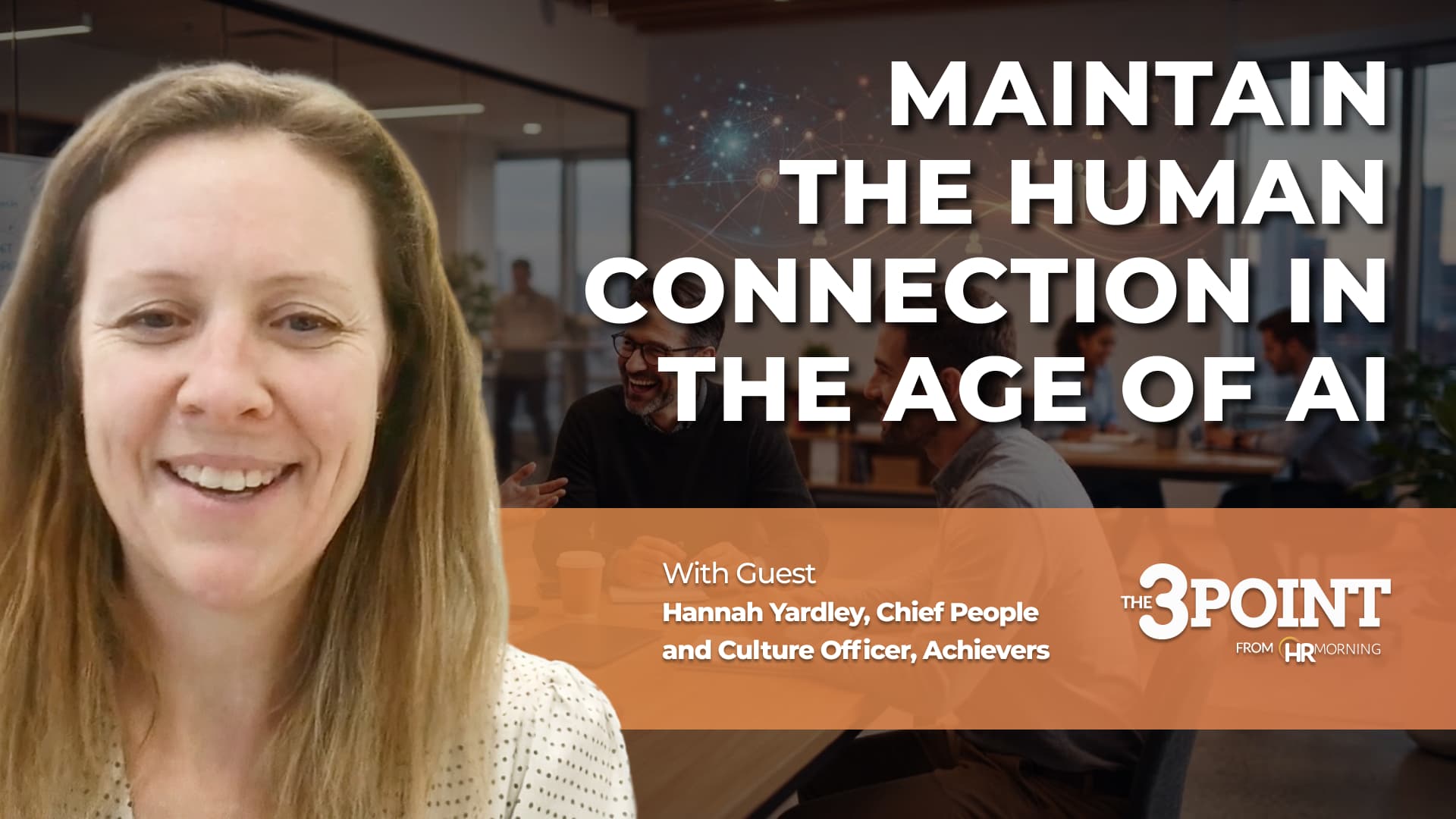
That’s why in this episode of HRMorning’s 3-Point, we explore the toll AI has taken on human connection. Our expert, Hannah Yardley, Chief People and Culture Officer at Achievers, shares some research on who’s suffering and who can best help rebuild workplace connections.
Click, watch and listen for more details on rebuilding relationships, connections and culture.
Transcript (edited for clarity):
AI at work is inevitable. While it’s helpful, all that interaction with technology has had some negative effects. Workslop, for one. Disconnect is another. So in this episode of the 3-Point, we’re going to cover what helps eliminate both. Our expert dives directly into the problem and solution.
Hannah Yardley, Chief People and Culture Officer, Achievers: “If employees are doing more, taking on more tasks, how do you really focus them on doing the things that are important? Not just that you get workslop, but how do you actually direct people to know that the things that they’re working on are those that are most meaningful? And that’s where stuff like good middle management or reinforcing of that through effective feedback and recognition are all mechanisms that help.”
So front-line managers are key to keeping work meaningful in the age of AI. After all, we’re all still learning, and that alone can be overwhelming and sloppy. Now, how can they do it?
Yardley: “There’s absolute data around that things like frequent one-on-ones and connections and recognition are making employees feel much, much more — like three times more — connected to their organizations. And that’s really important. But it only works if it’s a meaningful, frequent connection. And the meaningful also needs to be unpacked: It’s not that you’re doing things like, ‘You did a great job.’ You can actually do more than ‘You’ve done a great job,’ because then it becomes meaningless. But if you connect it back to the important things that people are working on, the things that they feel valued for, and what the manager’s actually connecting back to having a bigger or broader impact.”
We know feedback and connecting one-on-one is important, but how frequently?
Yardley: “It’s so dependent on the job. So if you have multiple people doing multiple types of jobs, then you need a context switch all the time, and you can probably manage less people. But if you have people doing a similar function, such as an SDR function, you’re much more likely to be able to manage more people because you can do a lot more group coaching.”
So to help employees feel more connected when they’re working harder and overwhelmed:
- Circle back to meaning. Managers want to regularly talk about why their work matters and how their tasks affect the bigger picture.
- Be intentional. These “meaningful” conversations need to be intentional. Try one-on-ones and feedback conversations.
- Be consistent. The number of meetings may vary, but the importance of consistency is the same.
Now, for more tips on AI use and keeping employees connected, check out the 3-Point library for plenty more from experts in both fields. As always, thanks for joining me.
- Share on


Free Training & Resources
EBOOK, White Papers
Provided by Personify Health