• Skip to primary navigation
  • Skip to main content

HRMorning

  • FREE RESOURCES
  • PREMIUM CONTENT
  • HR DEEP DIVES
  • PODCASTS
    • VOICES OF HR
    • WOMEN’S LEADERSHIP TODAY
  • LOGIN
  • SIGN UP FREE
  • Employment Law
  • Benefits
  • Recruiting
  • HR Technology
  • Payroll
  • Management
  • Women’s Leadership
  • More
    • Talent Management
    • Performance Management
    • Leadership & Strategy
    • Compensation
    • Policy & Procedures
    • Wellness
    • Staff Departure
    • HR Career & Self-Care
    • Health Care
    • Retirement Plans
WLT Logo
  • Business Skills

Took a Leave of Absence? 3 Keys to Navigating a Successful Transition Back to Work

Michelle Myers
By: Michelle Myers
  • Share on

About the Author

Michelle Myers is a dedicated Creative Content Production Manager overseeing the content strategy and execution for Women's Leadership, HRMorning, and Resourceful Finance Pro. With a keen eye for detail and a passion for creating engaging and informative content, Michelle plays a vital role in delivering high-quality resources to professionals in HR, finance, and women's leadership. Her expertise spans across various content formats, ensuring that each platform provides valuable insights and fosters professional growth. Michelle's commitment to excellence and her ability to manage complex production workflows make her an invaluable asset to her team.

Show Less
Last Updated: May 4, 2026
3 minute engagement
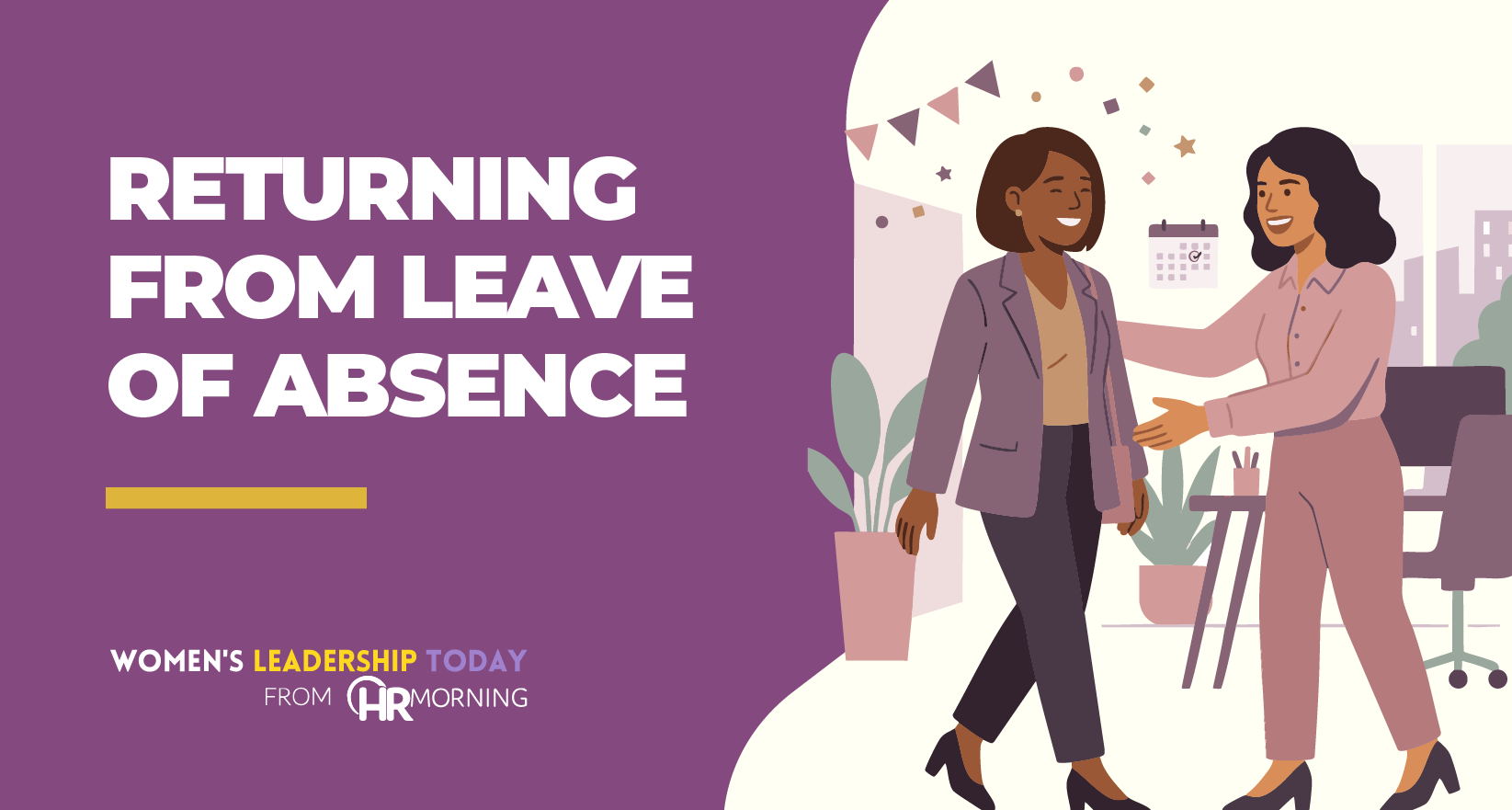
A Corporate Memphis style illustration for an HRMorning and Women's Leadership Today blog titled "RETURNING FROM LEAVE OF ABSENCE." The scene depicts a warm welcome for a returning professional, featuring festive decorations like bunting and stars. This visually represents the importance of a structured and empathetic reintegration strategy to help employees feel valued and supported after a period away from work.

So, you took a leave of absence from work.

Perhaps you stepped away to focus on your health or education, to care for a loved one, or to spend time with your family.

Whatever the reason, returning to work after a leave of absence can be challenging, regardless of the length of your absence or the position you are returning to.

Getting Back to Work after Leave of Absence

To successfully transition back, it is essential to monitor your physical, mental, emotional, and professional well-being.

This will help you avoid feeling overwhelmed during the first few weeks. Here’s help.

1. Prepare for Change

You may be returning to the role you had before your leave, or you may be shifting gears and taking on a new role or an augmented role depending on your company’s needs. While adjusting to a new role will be more challenging, even returning to a familiar role can be difficult after stepping away for a while. Ease into it and allow yourself time to get used to being back at work.

Also, keep in mind that you will be dealing with a sudden shift in your daily schedule. On top of that, your workplace has likely changed while you were away. You may find you have new responsibilities. Or maybe the composition or goals of your team have shifted. There may even be new faces in leadership. Even if you are going back to the same series of processes you used to handle every day, it is perfectly normal to feel a little out of your element at first. It can be overwhelming!

That is why it is essential to manage your expectations. Before stepping back into the office for the first time in perhaps months, you may have assumed that you would be good to go by the end of the first week. Yet you found that the challenge is more difficult than you thought it would be. That is not due to any failure on your part, however. Believing that you would adjust faster than you have is a sign that you are confident in your skill sets. Cut yourself some slack and take your return to work one day at a time.

2. Recognize Boundaries

Try to keep your routine as easygoing as possible until you start to feel a little more comfortable handling the full load of your responsibilities. You may even consider starting back at reduced hours or asking to temporarily delegate some responsibilities.

Also, be honest with yourself about new boundaries you may need to set. Be open with your boss and colleagues so that they know what to expect during the initial weeks of your return. Inform those you work with of any schedule demands you need to adhere to, ask about new processes you did not cover before, and make a note of whom you can reach out to for support and guidance.

3. Define Professional Goals

Finally, this is an ideal time to speak with your leadership team about your professional goals. Your reason for taking leave may have changed your perspective, timeline or priorities, and it is important to communicate so you can work together on a development plan moving forward.

Even if nothing has changed regarding your objectives, sitting down with leadership to remind them of what you are aiming for can be vital for your career progress and ensure you will not get overlooked for opportunities that may arise shortly after your return.

Remember that change is normal – healthy even! Embrace the new elements of your life. By taking things one step at a time and being open to new experiences, you will successfully transition back to work in no time.

Filed under
WLT Logo
  • Business Skills
  • Share on

Get the HRMorning Newsletter

With HRMorning arriving in your inbox, you will never miss critical stories on labor laws, benefits, retention and onboarding strategies.

  • This field is for validation purposes and should be left unchanged.
  • This field is hidden when viewing the form
  • This field is hidden when viewing the form
  • This field is hidden when viewing the form
  • This field is hidden when viewing the form
  • This field is hidden when viewing the form
  • This field is hidden when viewing the form
  • This field is hidden when viewing the form
  • This field is hidden when viewing the form
  • This field is hidden when viewing the form
  • This field is hidden when viewing the form
  • This field is hidden when viewing the form
  • This field is hidden when viewing the form
  • This field is hidden when viewing the form
  • This field is hidden when viewing the form
  • This field is hidden when viewing the form
  • This field is hidden when viewing the form
  • This field is hidden when viewing the form
  • This field is hidden when viewing the form
  • This field is hidden when viewing the form
  • This field is hidden when viewing the form
  • This field is hidden when viewing the form
  • This field is hidden when viewing the form
  • This field is hidden when viewing the form
  • This field is hidden when viewing the form
  • This field is hidden when viewing the form
  • This field is hidden when viewing the form
  • This field is hidden when viewing the form
  • This field is hidden when viewing the form
  • This field is hidden when viewing the form
  • This field is hidden when viewing the form
  • This field is hidden when viewing the form
  • This field is hidden when viewing the form
  • This field is hidden when viewing the form
  • This field is hidden when viewing the form
  • This field is hidden when viewing the form
  • This field is hidden when viewing the form
  • This field is hidden when viewing the form
  • This field is hidden when viewing the form
  • This field is hidden when viewing the form
  • This field is hidden when viewing the form
  • This field is hidden when viewing the form
  • This field is hidden when viewing the form
  • This field is hidden when viewing the form
  • This field is hidden when viewing the form
  • This field is hidden when viewing the form
  • This field is hidden when viewing the form
  • This field is hidden when viewing the form
  • This field is hidden when viewing the form
  • This field is hidden when viewing the form
  • This field is hidden when viewing the form
  • This field is hidden when viewing the form
  • This field is hidden when viewing the form
  • This field is hidden when viewing the form
  • This field is hidden when viewing the form
  • This field is hidden when viewing the form
  • This field is hidden when viewing the form

Free Training & Resources

Webinars

DEI For a More Equitable Hiring Process

White Papers

The True Cost of a Delayed Diagnosis

White Papers

Ultimate Guide To Aligning Employee Experience Program

Provided by ITA Group

White Papers

MODERNIZING LEGACY APPLICATIONS: WHEN, WHY, AND HOW

Provided by CHAMPS

SPONSORED CONTENT

HR Technology

sponsored content
The Best AI Software for HR Automation

Courtesy of G-P

Talent Management

sponsored content
Powerful Employee Retention Strategies for 2025: How to Keep Your Best People

Courtesy of PEOPLEGURU

Benefits

Health Care

Wellness

sponsored content
Proven Results: 5 Ways Teladoc Health Chronic Condition Management Transforms HR Outcomes

Courtesy of TELADOC HEALTH

Further Reading

  • Business Skills
Presenting with Purpose: Strategies for Translating Knowledge into Action

What sets executive presentations apart from standard presentations? The answer is executive presence. Executive presence is a delivery sty...

  • Business Skills
7 Critical Points to Inclusive Language at Work (Plus an Infographic to Share)

Inclusive language is a way of speaking that aims to keep conversations more general and welcoming to a wider audience. Using gender-ne...

  • Business Skills
The Smartest Investment is Self-Investment: 4 Critical Areas to Focus

Working towards a goal is always a good decision for women in leadership. But it’s equally important to ensure you’re taking time o...

  • Business Skills
5 Critical Keys to Coaching For Everyone, By Everyone

The concept of coaching has evolved from a luxury reserved for senior executives to a vital tool for development at all levels of an organi...

  • Business Skills
Own Your Voice in the Boardroom: 6 Tips to Handle Interruptions

Have you ever spoken up in a meeting, only to be interrupted or dismissed? If so, you’re far from alone. Research confirms women ...

  • Business Skills
Integrating Personal & Professional Growth to Maximize Your Potential

Balanced growth refers to personal and professional development happening simultaneously. For instance, a person may aspire to advance profe...

Get the latest from HRMorning in your inbox PLUS immediately access 10 FREE HR guides.

I WANT MY FREE GUIDES
HR Morning Logo
  • Facebook
  • Linked In
  • ABOUT HRMORNING
  • ADVERTISE WITH US
  • WRITE FOR US
  • CONTACT
  • Employment Law
  • Benefits
  • Recruiting
  • Talent Management
  • Performance Management
  • HR Technology
  • Leadership & Strategy
  • Compensation
  • Policy & Procedures
  • Wellness
  • Staff Departure
  • HR Career & Self-Care
  • Health Care
  • Retirement Plans
  • DEI

HRMorning, part of the Rover Insights Network, provides the latest HR and employment law news for HR professionals in the trenches of small-to-medium-sized businesses. Rather than simply regurgitating the day's headlines, HRMorning delivers actionable insights, helping HR execs understand what HR trends mean to their business.

Powered By Rover Insights
Privacy Policy | Terms of Service
Copyright© 2026 Rover Insights
HRMorning Logo

WELCOME BACK!

Enter your username and password below to log in

Forget Your Username or Password?

Reset Password

Lost your password? Please enter your username or email address. You will receive a link to create a new password via email.

Log In

Why do we need your credit card for a free trial?

We ask for your credit card to allow your subscription to continue should you decide to keep your membership beyond the free trial period.  This prevents any interruption of content access.

Your card will not be charged at any point during your 21 day free trial
and you may cancel at any time during your free trial.

During your free trial, you can cancel at any time with a single click on your “Account” page.  It’s that easy.
