• Skip to primary navigation
  • Skip to main content

HRMorning

  • FREE RESOURCES
  • PREMIUM CONTENT
  • HR DEEP DIVES
  • PODCASTS
    • VOICES OF HR
    • WOMEN’S LEADERSHIP TODAY
  • LOGIN
  • SIGN UP FREE
  • Employment Law
  • Benefits
  • Recruiting
  • HR Technology
  • Payroll
  • Management
  • Women’s Leadership
  • More
    • Talent Management
    • Performance Management
    • Leadership & Strategy
    • Compensation
    • Policy & Procedures
    • Wellness
    • Staff Departure
    • HR Career & Self-Care
    • Health Care
    • Retirement Plans
RM Logo
  • Performance Management

5 Tips to Talk About The Weird Things at Work

Michele McGovern
By: Michele McGovern
  • Share on

About the Author

Michele McGovern writes. A lot. These days, she covers HR, digging deep into company culture, DEI, leadership, management and the everchanging world of work. In the years between getting a BA in journalism from a state school and writing about HR, she wrote about big-city crime for a wire service and small-town life for local newspapers. She’s a mediocre mom, decent wife, wannabe athlete and consummate pursuer of fun - on land, snow and water. Find her on LinkedIn @michele-mcgovern-writer.

Show Less
Last Updated: December 8, 2025
5 minute engagement

Age. Health. Politics. Money.

We don’t talk about them in the workplace — or at least, we aren’t supposed to talk about them in the workplace.

But what if we hit them straight on? What if we talk about the weird things we think we shouldn’t talk about — like how much money we make, how old we are, a political move and when we want to have babies?

It might actually be better. That’s what one Harvard Business School researcher and lecturer suggests — and she gives us tips to talk about them.

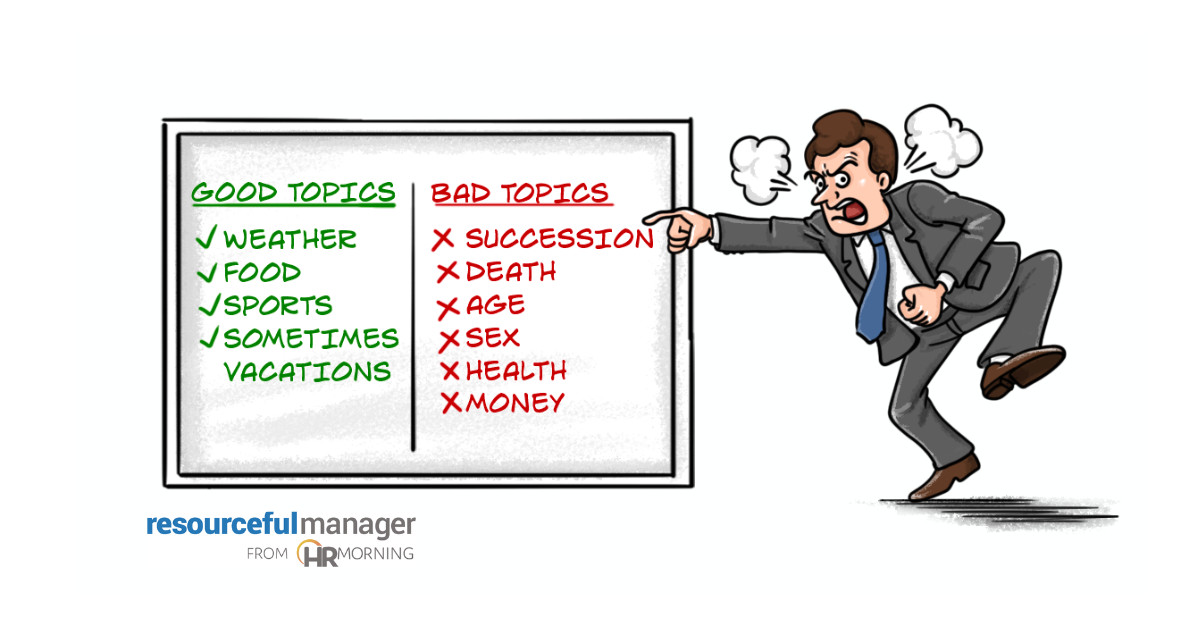
“What do you speak about with colleagues?” asks Christina Wing, Senior Lecturer of Business Administration at Harvard. “Weather, food, sports, and sometimes vacations. What we don’t talk about is succession, death, age, sex, health, money — so many things that affect our ability to do our jobs. Yet we want our leaders to be authentic, empathetic people we want to follow. If we don’t talk about anything that’s real, how can they do their jobs, and why would we follow them?”

Tips to Talk About the Weird Things

Her point: We need to talk about the things we usually think are taboo within the confines of work. Fortunately, Wing has strategies to talk about anything with tact and professionalism.

And that’s important because, she says, “We’ve spent so much time talking about what we shouldn’t talk about that we never spend time talking about what we should talk about.”

So go ahead and tackle money, politics, age and beyond with these tips. And that’s the important part: Use these tips to talk with tact, dignity and respect with your colleagues.

Address It Head-on

You don’t want to let seemingly sensitive topics fester — for instance, a pay raise, a family planning issue or a political concern. They only get worse the longer you stew.

Getting it out in the open and potentially resolved early can help make the conversation more comfortable and efficient.

For instance, Wing says, it’s better for a 50-year-old manager who reports to a 64-year-old boss to address career succession and the boss’s retirement than stew over fear of not advancing.

Call for a Meeting

When you want to talk about a subject that’s potentially weird, give the other person or people at least 24 hours’ notice. And lay out what you want to address. Let them know you want to have a professional conversation about an important topic — not an argument about an injustice.

This gives them time to prepare and shows you’re interested in a productive, non-confrontational conversation.

For example, if you want to talk about how much money you make — and a desire for more — you might say, “Boss, I’d like to meet tomorrow afternoon to discuss my current salary and why I believe I deserve better compensation. Can you be prepared to listen to my thoughts and discuss this important topic?”

After all, most leaders would prefer to have this conversation and respond to it than lose people to better-paying jobs.

Get Together in a Neutral Spot

You definitely want to have these conversations in person. Email, text and communication apps leave a lot of room for miscommunication.

In-person meetings are also more professional. And remember: Just because it’s an awkward topic (at first), doesn’t mean it’s controversial. You should have open conversations on topics that affect the company and its employees.

So, if you want to address some political issues you think might affect your organization or employees, ask to meet in a conference room. You still want to skip voting records and political party affiliations, but “you shouldn’t completely self-censor when it comes to discussing geopolitical issues that might impact the business,” says Wing.

Stay Focused on the Goal

Know what you want to accomplish and keep that single goal in mind during the conversation. In some cases, you may just want to be heard because you’re concerned about or interested in what’s next. In most situations, you’ll likely want to accomplish something.

Say, for instance, a woman is concerned her plans to have children will affect her promotion hopes (yes, this is one of those conversations that seem like we shouldn’t have, but it’s important to have). She’ll want to focus on the desired outcome that she shares with her boss — the same opportunities at promotions while she takes maternity leave. She might say, “My husband and I plan to have children in the coming years. So while I might have to step away a few times over the coming years for maternity leave, I’m focused on growing my career. I’d like to talk about opportunities to keep progressing.”

Outline the Next Steps

Most of these conversations should lead to next steps — the exception being when someone just needs to get something off their chest.

So, assuming you set an agenda and stayed focused on the goal, you’ll want to leave the conversation with a clear plan to move ahead.

For instance, if it’s a geopolitical conversation, you might set a plan to gather more details and implications to present to a larger group of leaders. If it’s a chat about family planning, you might decide to create a career path that includes time for leave. Or if it’s a compensation conversation, you may need to spend time creating new, higher goals and a plan to achieve them before a salary review.

Filed under
RM Logo
  • Performance Management
  • Share on

Get the HRMorning Newsletter

With HRMorning arriving in your inbox, you will never miss critical stories on labor laws, benefits, retention and onboarding strategies.

  • This field is for validation purposes and should be left unchanged.
  • This field is hidden when viewing the form
  • This field is hidden when viewing the form
  • This field is hidden when viewing the form
  • This field is hidden when viewing the form
  • This field is hidden when viewing the form
  • This field is hidden when viewing the form
  • This field is hidden when viewing the form
  • This field is hidden when viewing the form
  • This field is hidden when viewing the form
  • This field is hidden when viewing the form
  • This field is hidden when viewing the form
  • This field is hidden when viewing the form
  • This field is hidden when viewing the form
  • This field is hidden when viewing the form
  • This field is hidden when viewing the form
  • This field is hidden when viewing the form
  • This field is hidden when viewing the form
  • This field is hidden when viewing the form
  • This field is hidden when viewing the form
  • This field is hidden when viewing the form
  • This field is hidden when viewing the form
  • This field is hidden when viewing the form
  • This field is hidden when viewing the form
  • This field is hidden when viewing the form
  • This field is hidden when viewing the form
  • This field is hidden when viewing the form
  • This field is hidden when viewing the form
  • This field is hidden when viewing the form
  • This field is hidden when viewing the form
  • This field is hidden when viewing the form
  • This field is hidden when viewing the form
  • This field is hidden when viewing the form
  • This field is hidden when viewing the form
  • This field is hidden when viewing the form
  • This field is hidden when viewing the form
  • This field is hidden when viewing the form
  • This field is hidden when viewing the form
  • This field is hidden when viewing the form
  • This field is hidden when viewing the form
  • This field is hidden when viewing the form
  • This field is hidden when viewing the form
  • This field is hidden when viewing the form
  • This field is hidden when viewing the form
  • This field is hidden when viewing the form
  • This field is hidden when viewing the form
  • This field is hidden when viewing the form
  • This field is hidden when viewing the form
  • This field is hidden when viewing the form
  • This field is hidden when viewing the form
  • This field is hidden when viewing the form
  • This field is hidden when viewing the form
  • This field is hidden when viewing the form
  • This field is hidden when viewing the form
  • This field is hidden when viewing the form
  • This field is hidden when viewing the form
  • This field is hidden when viewing the form

Free Training & Resources

EBOOK, White Papers

The Prevention Mandate: An Employer’s Framework for a Healthier Workforce

Provided by Personify Health

White Papers

Managing Your Salary Structure and Pay Ranges with Confidence

Provided by Marsh

White Papers

Is Your Reporting Volume a Good Sign or a Warning Sign?

Provided by Navex

Webinars

Upskill, Reskill and Retain: How to Future-Proof Your Workforce

Provided by PAYCOM

SPONSORED CONTENT

Employment Law

Policy & Procedures

sponsored content
Policy Rollout: 4 Checkpoints That Show Employees Got the Message

Courtesy of NAVEX

Benefits

Staff Administration

sponsored content
PEO ROI: 3 Numbers to Know Before You Leave Patchwork HR

Courtesy of TRINET

Talent Management

sponsored content
Employee Retention Strategies: 5 That Work When You Can’t Pay More

Courtesy of INSPIRUS

Further Reading

  • Performance Management
4 Ways to Avoid Difficult Conversation Traps

Some conversations are difficult before they start. They become even more of a nightmare when they take a turn for the worse — and yo...

  • Performance Management
Cure to Employee Discontent? It’s Purposeful Work and Here Are 4 Solutions

Turns out, employees are still relatively miserable at work, regardless of where they work. Employee discontent spreads across location...

  • Performance Management
Beyond promotions: Why promoted workers are leaving and how to stop it

Any seasoned HR pro knows that a key part of the employee experience is rewards and recognition.  In an uncertain economy, compensa...

  • Performance Management
7 Keys to Help Employees Navigate Change in Uncertain Times

Change is about the only certain thing in the workplace today. So HR pros need to help employees navigate change year-round.  In fa...

  • Performance Management
Effective Upskilling: 4 Ways to Cure the ‘Silent Standoff’

Technology is moving faster than ever before. As innovations and applications emerge, it’s more critical than ever to build resilient tec...

  • Performance Management
To improve workplace productivity, own your work friction: 3 ways to identify, eliminate it

From front-line workers to C-suite executives, employees throughout organizations share an all-too-common experience. Routine work is incre...

Get the latest from HRMorning in your inbox PLUS immediately access 10 FREE HR guides.

I WANT MY FREE GUIDES
HR Morning Logo
  • Facebook
  • Linked In
  • ABOUT HRMORNING
  • ADVERTISE WITH US
  • WRITE FOR US
  • CONTACT
  • Employment Law
  • Benefits
  • Recruiting
  • Talent Management
  • Performance Management
  • HR Technology
  • Leadership & Strategy
  • Compensation
  • Policy & Procedures
  • Wellness
  • Staff Departure
  • HR Career & Self-Care
  • Health Care
  • Retirement Plans
  • DEI

HRMorning, part of the Rover Insights Network, provides the latest HR and employment law news for HR professionals in the trenches of small-to-medium-sized businesses. Rather than simply regurgitating the day's headlines, HRMorning delivers actionable insights, helping HR execs understand what HR trends mean to their business.

Powered By Rover Insights
Privacy Policy | Terms of Service
Copyright© 2026 Rover Insights
HRMorning Logo

WELCOME BACK!

Enter your username and password below to log in

Forget Your Username or Password?

Reset Password

Lost your password? Please enter your username or email address. You will receive a link to create a new password via email.

Log In

Why do we need your credit card for a free trial?

We ask for your credit card to allow your subscription to continue should you decide to keep your membership beyond the free trial period.  This prevents any interruption of content access.

Your card will not be charged at any point during your 21 day free trial
and you may cancel at any time during your free trial.

During your free trial, you can cancel at any time with a single click on your “Account” page.  It’s that easy.

