• Skip to primary navigation
  • Skip to main content

HRMorning

  • FREE RESOURCES
  • PREMIUM CONTENT
  • HR DEEP DIVES
  • PODCASTS
    • VOICES OF HR
    • WOMEN’S LEADERSHIP TODAY
  • LOGIN
  • SIGN UP FREE
  • Employment Law
  • Benefits
  • Recruiting
  • HR Technology
  • Payroll
  • Management
  • Women’s Leadership
  • More
    • Talent Management
    • Performance Management
    • Leadership & Strategy
    • Compensation
    • Policy & Procedures
    • Wellness
    • Staff Departure
    • HR Career & Self-Care
    • Health Care
    • Retirement Plans
WLT Logo
  • Business Skills

7 Critical Points to Inclusive Language at Work (Plus an Infographic to Share)

Michelle Myers
By: Michelle Myers
  • Share on

About the Author

Michelle Myers is a dedicated Creative Content Production Manager overseeing the content strategy and execution for Women's Leadership, HRMorning, and Resourceful Finance Pro. With a keen eye for detail and a passion for creating engaging and informative content, Michelle plays a vital role in delivering high-quality resources to professionals in HR, finance, and women's leadership. Her expertise spans across various content formats, ensuring that each platform provides valuable insights and fosters professional growth. Michelle's commitment to excellence and her ability to manage complex production workflows make her an invaluable asset to her team.

Show Less
Last Updated: July 28, 2026
3 minute engagement
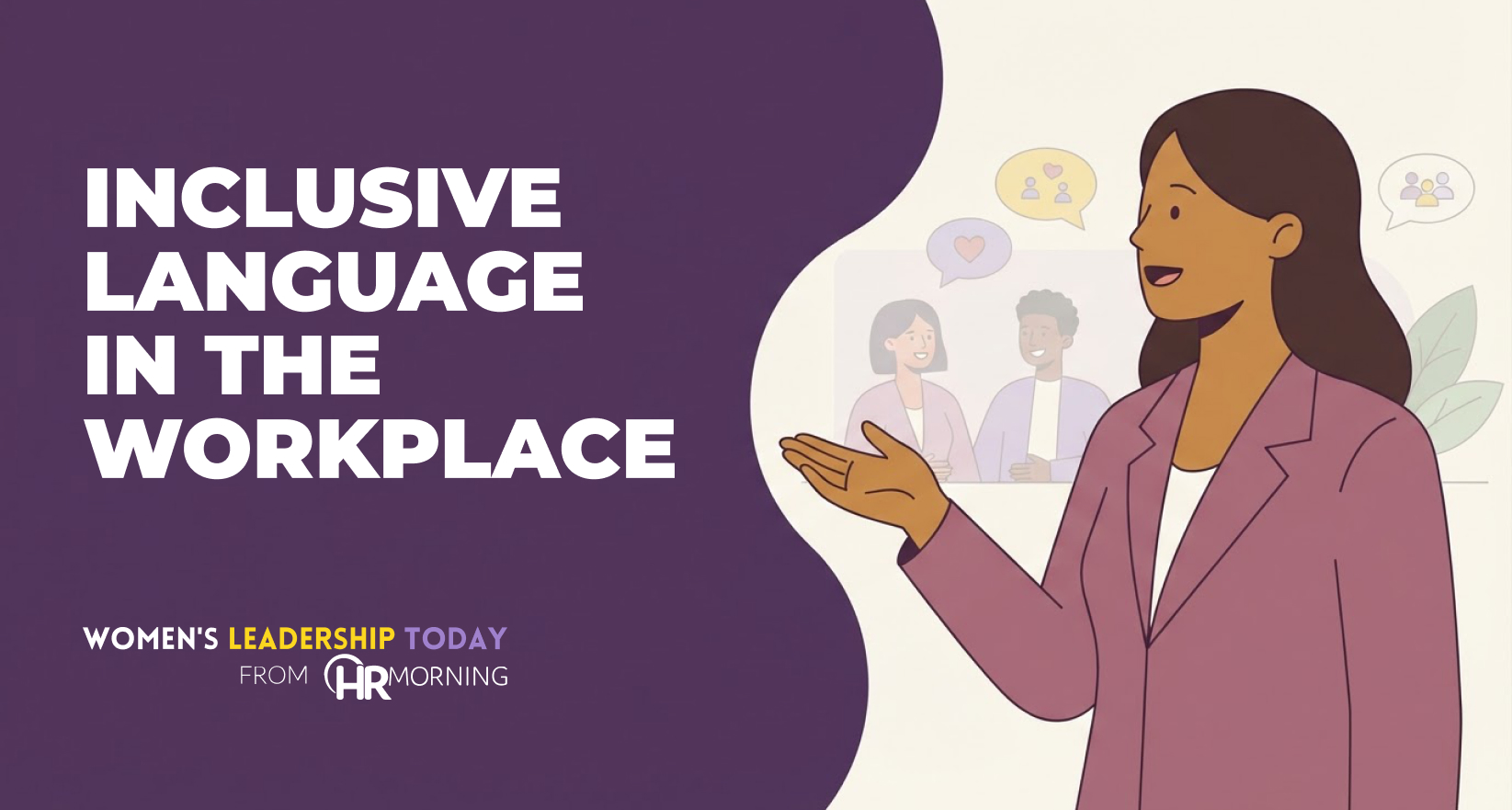
Flat illustration of a woman leader speaking warmly to diverse coworkers, symbolizing inclusive language in the workplace.

Inclusive language is a way of speaking that aims to keep conversations more general and welcoming to a wider audience.

Using gender-neutral, gender-confirming or anti-ableist language enables speakers and audiences alike to expand their perspectives and include each other in workplace processes.

The point of inclusive language is to be mindful of how we speak to and about other people to create a supportive environment among our colleagues.

At times, the language used in professional settings can be limiting, even when the speaker doesn’t intend to exclude others. Using inclusive language stands to minimize instances in which potentially offensive phrases are used (with or without intent).

Why Is Inclusive Language Important?

The professional landscape is incredibly diverse, and because of this, leaders and employees need to be willing and able to ensure that every member of their team feels they’re an equal part of the workforce. This way, organizations can harness all the strengths and benefits of having a diverse working environment. Making efforts to include everyone encourages employees to share different ideas and perspectives that promote productivity and progress.

Examples of Exclusive Language

Let’s say a woman in Department A is married to another woman. Even if her colleagues don’t know that detail of her life, being asked questions about her husband might become off-putting. Instead, if her colleagues asked her about her spouse, she’d probably feel more welcome to talk about her wife.

In another situation, a person working in Department B is managing the symptoms of obsessive-compulsive disorder. One of his colleagues is very neat, punctual and organized, and he overhears another team member stating that this colleague is “so OCD, and it’s annoying.” Even if the neat employee doesn’t have any sort of health condition, the statement made portrays OCD in a negative light. The team member could have just mentioned that the colleague maintained a strict routine, and it would have illustrated the same point without being offensive.

Promoting Inclusive Language

Maintaining the use of inclusive language in an office setting may take some work, but it’s an achievable goal. While there will be times when an individual makes a mistake, continuous practice will eventually make inclusive language come naturally.

To work towards inclusive language in your own workplace environment, follow these guidelines:

  • Use people-first language, unless an individual in question has provided you with preferred terms. For example, say “people with disabilities” rather than “disabled people.”
  • Do not make assumptions about a colleague’s personal life, identity or background. For example, asking about an individual’s spouse or partner is a better option than asking about their husband or wife until you know more about the person.
  • Avoid words and phrases with negative connotations and origins. For example, the word “crazy” implies a negative connotation about people managing mental disorders. Many phrases and idioms have negative origins and are rooted in stereotypes as well. For example, the common phrase “grandfathered in” originates from racially biased policies.
  • Avoid “victim” language. Language such as “she suffers from” or “confined to a wheelchair” implies that a person is a victim of their circumstance and can come off as condescending.
  • Be aware of microaggressions. Consider whether what you want to say is something you would say to anyone, regardless of race, gender, ability or orientation. For example, questions like “Where are you from?” are typically only directed at non-white peers and therefore are discriminatory.
  • Speak broadly when you can. When you’re addressing a group, use words like “all” or “everyone” to call their attention, rather than gendered terms like “guys” or “ladies”.
  • Listen to feedback. If a colleague or manager points out that you’ve said something offensive, listen. Even if you didn’t mean it the way it sounded, listen to the individual’s point of view instead of becoming defensive. Apologize and learn from the interaction. It’s the best step you can take toward self-improvement.

It’s a learning process, but if you make an effort to use more inclusive language at work, you will help create a more collaborative, culturally sensitive environment.
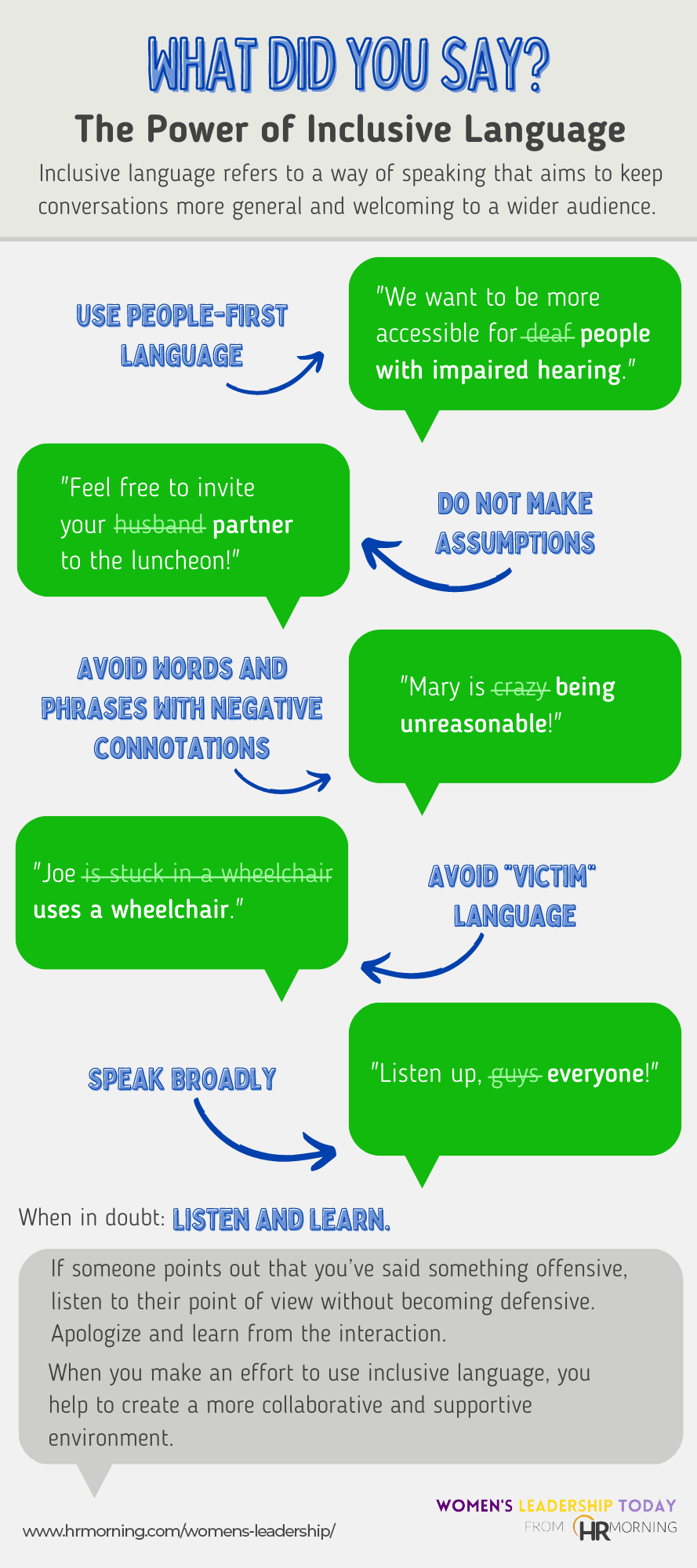

Infographic of "What did you say" Listen and Learn.
Filed under
WLT Logo
  • Business Skills
  • Share on

Get the HRMorning Newsletter

With HRMorning arriving in your inbox, you will never miss critical stories on labor laws, benefits, retention and onboarding strategies.

  • This field is for validation purposes and should be left unchanged.
  • This field is hidden when viewing the form
  • This field is hidden when viewing the form
  • This field is hidden when viewing the form
  • This field is hidden when viewing the form
  • This field is hidden when viewing the form
  • This field is hidden when viewing the form
  • This field is hidden when viewing the form
  • This field is hidden when viewing the form
  • This field is hidden when viewing the form
  • This field is hidden when viewing the form
  • This field is hidden when viewing the form
  • This field is hidden when viewing the form
  • This field is hidden when viewing the form
  • This field is hidden when viewing the form
  • This field is hidden when viewing the form
  • This field is hidden when viewing the form
  • This field is hidden when viewing the form
  • This field is hidden when viewing the form
  • This field is hidden when viewing the form
  • This field is hidden when viewing the form
  • This field is hidden when viewing the form
  • This field is hidden when viewing the form
  • This field is hidden when viewing the form
  • This field is hidden when viewing the form
  • This field is hidden when viewing the form
  • This field is hidden when viewing the form
  • This field is hidden when viewing the form
  • This field is hidden when viewing the form
  • This field is hidden when viewing the form
  • This field is hidden when viewing the form
  • This field is hidden when viewing the form
  • This field is hidden when viewing the form
  • This field is hidden when viewing the form
  • This field is hidden when viewing the form
  • This field is hidden when viewing the form
  • This field is hidden when viewing the form
  • This field is hidden when viewing the form
  • This field is hidden when viewing the form
  • This field is hidden when viewing the form
  • This field is hidden when viewing the form
  • This field is hidden when viewing the form
  • This field is hidden when viewing the form
  • This field is hidden when viewing the form
  • This field is hidden when viewing the form
  • This field is hidden when viewing the form
  • This field is hidden when viewing the form
  • This field is hidden when viewing the form
  • This field is hidden when viewing the form
  • This field is hidden when viewing the form
  • This field is hidden when viewing the form
  • This field is hidden when viewing the form
  • This field is hidden when viewing the form
  • This field is hidden when viewing the form
  • This field is hidden when viewing the form
  • This field is hidden when viewing the form
  • This field is hidden when viewing the form

Free Training & Resources

White Papers

Demystifying HSAs: A new study reveals the myths around HSAs

Provided by Incomm

Webinars

Data-Driven Culture Transformation – Go Beyond Vanity Metrics

Webinars

Prevention in Practice: Rethinking Health Cost Control

Provided by Personify Health

Webinars

AON – Talent Assessment 2020: Impactful Business Responses in the Context of Current Events

SPONSORED CONTENT

HR Technology

sponsored content
The Best AI Software for HR Automation

Courtesy of G-P

Talent Management

sponsored content
Powerful Employee Retention Strategies for 2025: How to Keep Your Best People

Courtesy of PEOPLEGURU

Benefits

Health Care

Wellness

sponsored content
Proven Results: 5 Ways Teladoc Health Chronic Condition Management Transforms HR Outcomes

Courtesy of TELADOC HEALTH

Further Reading

  • Business Skills
When You Need to Intervene: Coaching Your Employees to Greatness

Being a team leader involves a great deal of work; leaders need to be aware of the how, when, and why they are directing their efforts towar...

  • Business Skills
6 Big Ways Good Communication Will Support Organizational Resilience

Management teams and individuals in leadership roles are constantly searching for new and effective ways to reinforce the strength and func...

  • Business Skills
Own Your Voice in the Boardroom: 6 Tips to Handle Interruptions

Have you ever spoken up in a meeting, only to be interrupted or dismissed? If so, you’re far from alone. Research confirms women ...

  • Business Skills
Understanding Workplace Stress – and What to Do About It

Stress is a response to pressure, which can be either negative or positive. Stress is often relatively short-term and is caused by a feeling...

  • Business Skills
The Wisdom of Grace: Redefining Success

When I heard the theme for this month was grace, I immediately smiled. Not because I thought it was an easy subject to write about, but beca...

  • Business Skills
What’s Your Conflict Style? Take the Quiz!

Not everybody handles conflict the same way. While some are confident and assertive, others might want to avoid conflict like it’s co...

Get the latest from HRMorning in your inbox PLUS immediately access 10 FREE HR guides.

I WANT MY FREE GUIDES
HR Morning Logo
  • Facebook
  • Linked In
  • ABOUT HRMORNING
  • ADVERTISE WITH US
  • WRITE FOR US
  • CONTACT
  • Employment Law
  • Benefits
  • Recruiting
  • Talent Management
  • Performance Management
  • HR Technology
  • Leadership & Strategy
  • Compensation
  • Policy & Procedures
  • Wellness
  • Staff Departure
  • HR Career & Self-Care
  • Health Care
  • Retirement Plans
  • DEI

HRMorning, part of the Rover Insights Network, provides the latest HR and employment law news for HR professionals in the trenches of small-to-medium-sized businesses. Rather than simply regurgitating the day's headlines, HRMorning delivers actionable insights, helping HR execs understand what HR trends mean to their business.

Powered By Rover Insights
Privacy Policy | Terms of Service
Copyright© 2026 Rover Insights
HRMorning Logo

WELCOME BACK!

Enter your username and password below to log in

Forget Your Username or Password?

Reset Password

Lost your password? Please enter your username or email address. You will receive a link to create a new password via email.

Log In

Why do we need your credit card for a free trial?

We ask for your credit card to allow your subscription to continue should you decide to keep your membership beyond the free trial period.  This prevents any interruption of content access.

Your card will not be charged at any point during your 21 day free trial
and you may cancel at any time during your free trial.

During your free trial, you can cancel at any time with a single click on your “Account” page.  It’s that easy.
