‘Holy $#!+’ Where Did These 5 Workplace Manners Go?

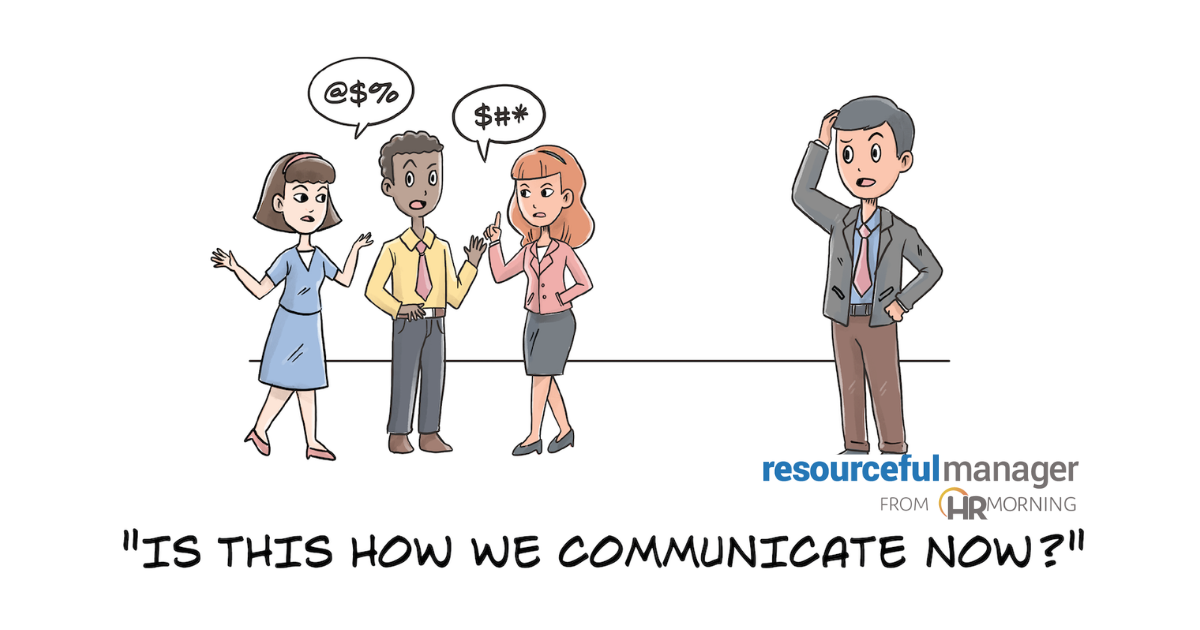
Cursed at lately? Talked over frequently? Ignored often? You aren’t imagining it.
Workplace manners and office etiquette are getting worse. Seventy-two percent of employees believe etiquette has deteriorated in the past three years, according to data from instantprint.
What’s worse, office etiquette affects how well people work. More than 60% of employees say their colleagues’ poor behavior directly affects their motivation. Nearly 45% say it changes how they perceive their colleagues’ professionalism. And 53% say small irritations build resentment over time.
“On paper, office habits are minor irritations,” the researchers noted. “In reality, they are emotional accumulators.”
After years of remote or hybrid work, employees are spending more time together. And it’s getting on their nerves.
Where Workplace Manners Have Gone Awry
What’s gone awry:
- Noise. Nearly 60% of employees in the instantprint survey say they’re frustrated with their colleagues who talk loudly, without regard to others around them, during phone and video calls.
- Language: In another office etiquette study, researchers found the number of expletives in conversations jumped excessively over five years. That means the F-bombs are dropping and the $#!+ is rising in most workplaces.
- Courtesy: Some employees have forgotten to use “please” and “thank you” with colleagues. “Thank you” for a specific act has been replaced by a vague “I appreciate you.” And “You’re welcome” has been replaced by “No problem,” which makes it sound like there’s a possibility it could’ve been a problem.
- Kindness: Employees complain that colleagues interrupt in meetings, ignore colleagues or belittle co-workers.
- Attire: You might know a person or two who don’t realize sweatpants and T-shirts are OK at the home office, but not in the office. Or those who don’t understand a summer dress code.
- Communication: Now, more than ever, it’s either workslop or riddled with grammar and spelling errors and peppered with emojis.
Is this really how we’re supposed to work now?
“You’re probably not picking up on ‘forgetting their manners’ … but that the scope of what’s considered acceptable at work has changed,” says Tessa West, author of Job Therapy: Finding Work that Works for You. “The main challenge is to make sure norms are super explicit to begin with — to not assume that people know what manners and etiquette are here. And those things are surprisingly variable from workplace to workplace.”
So, how can we regain workplace manners where it matters? Here are the five biggest issues and strategies to address them:
Cursing
Cursing at work is nothing new and it’s not exactly terrible.
“Beliefs around who swears and when it’s acceptable to swear are changing. In fact, there’s some scientific research indicating that people who swear have good ‘verbal fluency’ overall – they aren’t swearing out of a lack of manners or because they can’t find other, more appropriate words to use. They’re actually pretty smart!” says West.
Of course, there are still caveats: Not all curse words are created equal. And not all employees feel the same about profanity. If you must, draw a line in the sand. Prohibit profanity completely. Otherwise, remind employees that everyone is expected to speak with respect for each other and the workplace.
“This is very culturally determined. I consult for a UK-based company, and if I said “crap” in a meeting, that would be considered very inappropriate,” says West. “So if you’re going to drop some F bombs at work, make sure everyone is on board before you do. This isn’t a norm you want to violate first and then change your behavior later.”
Also, note that business coaches and career experts agree that everyone needs to avoid using curse words in email, text and chat, and when youre talking to a large audience. Those are the times when an errant $#!% can spread quickly and out of context.
Communication
The biggest problem with communication etiquette lies in expectations. One manager expects an immediate Slack response. An employee prefers to respond to email at just three points throughout the day. A hiring manager wants to hear back from candidates within a day. Candidates think anything under a week makes them look eager. Some people love emojis. Others despise them.
Yet, communicating well is still a matter of manners. It’s about treating people the way they want to be treated.
Best bet: Set baseline communication expectations on your team. For instance, Slack messages answered within an hour. Email within a day. Phone calls — immediately.
From there, encourage employees and colleagues to get more specific about their personal communication expectations.
Noise
Since this was the top complaint from employees, companies want to address it.
Introduce simple guidance on how employees should attend video conference meetings or take business calls when colleagues are around. That might be using headphones and not using a speaker. Or you might open individual spaces for people to tend to those events in a quiet spot.
Attire
We won’t likely ever go back to the days when the ubiquitous IBM uniform – dark suits, white button-down shirts, conservative ties and wing-tipped shoes – ruled the workplace. And most workplaces won’t likely adopt the full athleisure look, either.
So what’s OK in the office? One of the best – and most basic- analyses we saw on is this: If you’d wear it to the gym or to participate in a sport, it’s not OK for work.
How we do business has changed, and wardrobes can reflect that. Make sure your organization has a descriptive work attire policy so no one wonders (or violates an unwritten rule).
Courtesy and Kindness
As is often said, people follow their leaders. Courtesy – using the “please,” “thank you,” “pardon me” – comes natural to others when they’re treated with it.
Kindness, too. The best way to increase it in the workplace is to reward it. Encourage employees to give shout-outs to colleagues who go out of their way to help and be kind. Celebrate those acts and give rewards – gift cards to local businesses, time off, public recognition, etc.

- Share on


Free Training & Resources
White Papers
Provided by TriNet
White Papers
Provided by Maven Clinic