• Skip to primary navigation
  • Skip to main content

HRMorning

  • FREE RESOURCES
  • PREMIUM CONTENT
  • HR DEEP DIVES
  • PODCASTS
    • VOICES OF HR
    • WOMEN’S LEADERSHIP TODAY
  • LOGIN
  • SIGN UP FREE
  • Employment Law
  • Benefits
  • Recruiting
  • HR Technology
  • Payroll
  • Management
  • Women’s Leadership
  • More
    • Talent Management
    • Performance Management
    • Leadership & Strategy
    • Compensation
    • Policy & Procedures
    • Wellness
    • Staff Departure
    • HR Career & Self-Care
    • Health Care
    • Retirement Plans
WLT Logo
  • Leadership & Strategy

The ‘Broken Rung’ Impact on Today’s Gender Gap: 3 Training Tips to Repair It

Michelle Myers
By: Michelle Myers
  • Share on

About the Author

Michelle Myers is a dedicated Creative Content Production Manager overseeing the content strategy and execution for Women's Leadership, HRMorning, and Resourceful Finance Pro. With a keen eye for detail and a passion for creating engaging and informative content, Michelle plays a vital role in delivering high-quality resources to professionals in HR, finance, and women's leadership. Her expertise spans across various content formats, ensuring that each platform provides valuable insights and fosters professional growth. Michelle's commitment to excellence and her ability to manage complex production workflows make her an invaluable asset to her team.

Show Less
Last Updated: July 22, 2026
4 minute engagement
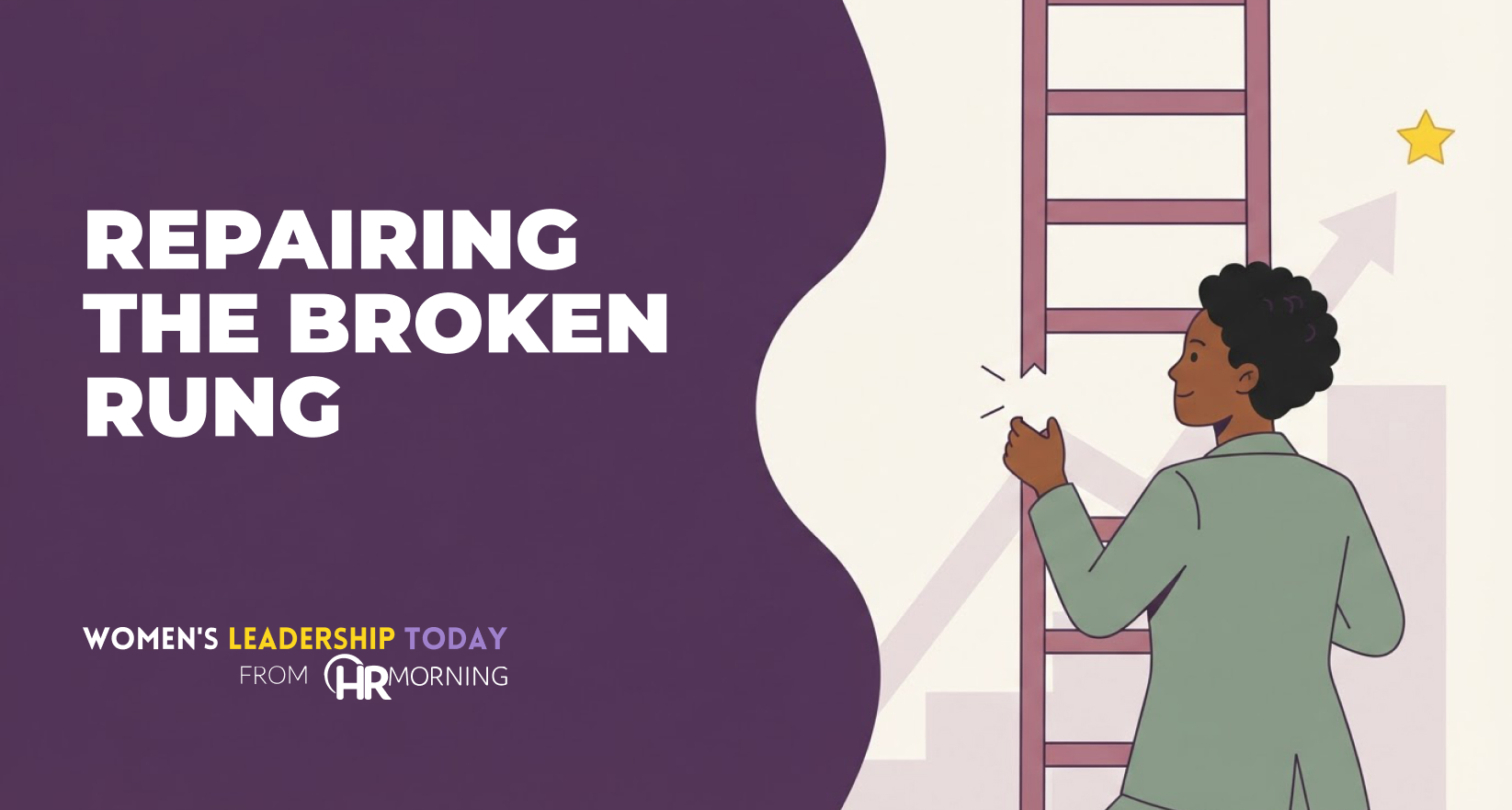
Flat illustration of a woman repairing a broken rung on a corporate ladder, symbolizing closing the workplace gender gap.

The business world is not a fair playing field for everyone, despite all the progress made surrounding work relations in the past century. If you’ve overheard discussions about disadvantages professional women deal with at work, or you’ve experienced these issues yourself, you probably want to know why.

What is the Broken Rung?

You may have heard the term “glass ceiling,” referring to an invisible barrier that prevents many women from being promoted to high corporate positions.

The “broken rung” is a more updated version of this phenomenon. It replaces the old glass ceiling and more accurately describes the experiences women have in the professional world.

The barrier starts influencing opportunities to excel far earlier than the last jump to a corporate-level position. The idea of a broken rung applies to the “corporate ladder” in general, and a broken rung creates an incredible (and dangerous) climbing challenge.

Rather than the barrier existing high up in the glass ceiling, obstacles start getting in the way right from the beginning.

The Broken Rung Disproportionately Affects Women

The existence of the broken rung metaphor affects women as a result of management biases. Individuals who oversee evaluating employees and offering promotions tend to prioritize men in the workplace over women, even when both promotion candidates are equally qualified. In some cases, even if the female candidate has more qualifications, the male candidate will still be chosen by management.

In fact, women only account for 31% of leadership positions in the workplace, according to LinkedIn’s State of Women in Leadership Global Employment Trends.

The biases women deal with in the workplace are not always apparent, as management teams may not even be aware of the unfair behaviors taking place. Many of us don’t recognize our own implicit biases – this is known as unconscious bias – and it’s actively oppressing women’s leadership efforts today.

And when no measures exist to question motives and address these biases, they continue to affect the way people think and behave unchecked.

The Gender Gap

With men holding 69% of leadership positions, they are more often in a position to offer promotions and secure new hires. This is where unconscious bias becomes an issue. According to one study, male managers are five times more likely to choose another man for a promotion than they are to choose a woman.

On top of that, men who are seeking promotions or higher-level positions tend to favor the idea of being promoted or hired by a male manager. This is known as cognitive evaluation – people are naturally more inclined towards people who look and act like them because they are more comfortable, assuming they already understand the person who is like them as opposed to someone who seems different at initial evaluation.

You can see how this creates a barrier for women trying to move up – the odds created by bias, conscious or unconscious, are stacked against them. And without support to overcome this missing link from entry level into management, it becomes exceedingly difficult to rise through the rest of the ranks.

What Can You Do?

For leaders who want to play an active role in repairing the broken rung, bias training is a must. Training procedures need to effectively show participants how to identify and correct discriminatory beliefs and processes.

Furthermore, once participants adopt new thought processes and procedural techniques, management teams need to be willing to address and correct behaviors pointed out to them.

To be effective, bias training needs to use facts and data to:

  • Highlight workplace inequalities
  • Explain the concept of unconscious bias
  • Discuss ways these preconceptions influence decision-making, and
  • Provide advice for monitoring and evaluating current and future systems at work.

Make it clear that the point of bias training is not to blame management for their biases but to teach them how to recognize them and take steps to change gears. And the training needs to be an open and inclusive group effort – it cannot be set up as an us vs. them scenario.

In simple terms, it aims to:

  • Identify an issue: “This problem exists, and we didn’t know about it before.”
  • Address the causes/effects: “It has led to X, Y, and Z problems, and it needs to change.”
  • Pursue solutions: “How are we going to avoid making the same mistakes again?”

Laying out the goal in this way and focusing on setting new actionable intentions doesn’t place blame on anyone. Instead, it presents an opportunity for everyone to improve.

Approaching a challenge with maturity and an open mind is the best way to overcome the hardships brought on by biases existing in the workplace. Only taking steps toward change will lead to progress.

Filed under
WLT Logo
  • Leadership & Strategy
  • Share on

Get the HRMorning Newsletter

With HRMorning arriving in your inbox, you will never miss critical stories on labor laws, benefits, retention and onboarding strategies.

  • This field is for validation purposes and should be left unchanged.
  • This field is hidden when viewing the form
  • This field is hidden when viewing the form
  • This field is hidden when viewing the form
  • This field is hidden when viewing the form
  • This field is hidden when viewing the form
  • This field is hidden when viewing the form
  • This field is hidden when viewing the form
  • This field is hidden when viewing the form
  • This field is hidden when viewing the form
  • This field is hidden when viewing the form
  • This field is hidden when viewing the form
  • This field is hidden when viewing the form
  • This field is hidden when viewing the form
  • This field is hidden when viewing the form
  • This field is hidden when viewing the form
  • This field is hidden when viewing the form
  • This field is hidden when viewing the form
  • This field is hidden when viewing the form
  • This field is hidden when viewing the form
  • This field is hidden when viewing the form
  • This field is hidden when viewing the form
  • This field is hidden when viewing the form
  • This field is hidden when viewing the form
  • This field is hidden when viewing the form
  • This field is hidden when viewing the form
  • This field is hidden when viewing the form
  • This field is hidden when viewing the form
  • This field is hidden when viewing the form
  • This field is hidden when viewing the form
  • This field is hidden when viewing the form
  • This field is hidden when viewing the form
  • This field is hidden when viewing the form
  • This field is hidden when viewing the form
  • This field is hidden when viewing the form
  • This field is hidden when viewing the form
  • This field is hidden when viewing the form
  • This field is hidden when viewing the form
  • This field is hidden when viewing the form
  • This field is hidden when viewing the form
  • This field is hidden when viewing the form
  • This field is hidden when viewing the form
  • This field is hidden when viewing the form
  • This field is hidden when viewing the form
  • This field is hidden when viewing the form
  • This field is hidden when viewing the form
  • This field is hidden when viewing the form
  • This field is hidden when viewing the form
  • This field is hidden when viewing the form
  • This field is hidden when viewing the form
  • This field is hidden when viewing the form
  • This field is hidden when viewing the form
  • This field is hidden when viewing the form
  • This field is hidden when viewing the form
  • This field is hidden when viewing the form
  • This field is hidden when viewing the form
  • This field is hidden when viewing the form

Free Training & Resources

White Papers

Employee Engagement Trends 2026

Provided by Inspirus

Webinars

Unconscious Bias in Recruitment

White Papers

Remarkable Workforce Management Made Surprisingly Easy

Provided by WorkEasy

Webinars

Employee Engagement, Motivation and Recognition in the Age of COVID-19

SPONSORED CONTENT

HR Technology

sponsored content
The Best AI Software for HR Automation

Courtesy of G-P

Talent Management

sponsored content
Powerful Employee Retention Strategies for 2025: How to Keep Your Best People

Courtesy of PEOPLEGURU

Benefits

Health Care

Wellness

sponsored content
Proven Results: 5 Ways Teladoc Health Chronic Condition Management Transforms HR Outcomes

Courtesy of TELADOC HEALTH

Further Reading

  • Leadership & Strategy
6 Practices of Highly Successful People in Today’s Workplace

Do you use your time strategically? Being busy and being efficient are not the same, and the most successful people know how to use their t...

  • Leadership & Strategy
5 Strategies to Help Women Thrive in Male-Dominated Industries

In many professional fields, women continue to be underrepresented, especially in industries traditionally dominated by men, such as techn...

  • Leadership & Strategy
4 Stages of an Emotional Hijack — and How to Regain Control When It Happens

We’ve all been there – that moment when emotions take over and we react without thinking. This experience — known as ...

  • Leadership & Strategy
Leadership 2.0: 9 New Ways to Harness the Power of AI

The world is becoming increasingly more technologically advanced, with widespread access to AI being one of the most recent advancements. ...

  • Leadership & Strategy
Are You a Helicopter Leader? (Take the Quiz Now)

We’ve all heard the saying, “If you want something done right, you better do it yourself.” But with this outlook, it’s difficult to...

  • Leadership & Strategy
Creativity in the Workplace: 8 Ways to Inspire Innovation in Your Team

Creativity isn’t just reserved for artists and visionaries: It’s a vital force in every workplace, driving innovation, solving complex ...

Get the latest from HRMorning in your inbox PLUS immediately access 10 FREE HR guides.

I WANT MY FREE GUIDES
HR Morning Logo
  • Facebook
  • Linked In
  • ABOUT HRMORNING
  • ADVERTISE WITH US
  • WRITE FOR US
  • CONTACT
  • Employment Law
  • Benefits
  • Recruiting
  • Talent Management
  • Performance Management
  • HR Technology
  • Leadership & Strategy
  • Compensation
  • Policy & Procedures
  • Wellness
  • Staff Departure
  • HR Career & Self-Care
  • Health Care
  • Retirement Plans
  • DEI

HRMorning, part of the Rover Insights Network, provides the latest HR and employment law news for HR professionals in the trenches of small-to-medium-sized businesses. Rather than simply regurgitating the day's headlines, HRMorning delivers actionable insights, helping HR execs understand what HR trends mean to their business.

Powered By Rover Insights
Privacy Policy | Terms of Service
Copyright© 2026 Rover Insights
HRMorning Logo

WELCOME BACK!

Enter your username and password below to log in

Forget Your Username or Password?

Reset Password

Lost your password? Please enter your username or email address. You will receive a link to create a new password via email.

Log In

Why do we need your credit card for a free trial?

We ask for your credit card to allow your subscription to continue should you decide to keep your membership beyond the free trial period.  This prevents any interruption of content access.

Your card will not be charged at any point during your 21 day free trial
and you may cancel at any time during your free trial.

During your free trial, you can cancel at any time with a single click on your “Account” page.  It’s that easy.
