• Skip to primary navigation
  • Skip to main content

HRMorning

  • FREE RESOURCES
  • PREMIUM CONTENT
  • HR DEEP DIVES
  • PODCASTS
    • VOICES OF HR
    • WOMEN’S LEADERSHIP TODAY
  • LOGIN
  • SIGN UP FREE
  • Employment Law
  • Benefits
  • Recruiting
  • HR Technology
  • Payroll
  • Management
  • Women’s Leadership
  • More
    • Talent Management
    • Performance Management
    • Leadership & Strategy
    • Compensation
    • Policy & Procedures
    • Wellness
    • Staff Departure
    • HR Career & Self-Care
    • Health Care
    • Retirement Plans
  • Benefits

HR’s Guide to Unlimited PTO: Pros, Cons and Best Practices

Alison Roller
By: Alison Roller
  • Share on

About the Author

Alison Roller is passionate about engaging and informative storytelling through writing and social media. She has been writing since 2018 on a range of topics: politics, higher education, leadership, workplace culture, and diversity, equity, & inclusion. She holds a Master's of Communication with a focus on journalism from Syracuse University's Newhouse School. When she’s not working, you can find her hanging out with her cat, knitting, and scrolling TikTok.

Show Less
Last Updated: June 28, 2024
4 minute engagement
Best practices to create an unlimited PTO policy

In the past, it was commonplace for employers to give workers a set amount of vacation days that typically increased with tenure. However, the past few years have seen a lot of changes in the workplace, from remote work to flexible scheduling, and paid time off (PTO) is not exempt from the changes. 

Now, some employers are offering unlimited PTO, which gives employees an unlimited amount of PTO throughout the year rather than a set number, giving employees the freedom to take time off when they need it.

Here’s everything you need to know about unlimited time off to determine whether it’s right for your company.

How unlimited PTO works

Unlimited PTO doesn’t mean that employees can take off work with no notice. The process works largely like any other PTO policy, and employees must still submit a PTO request ahead of time to ensure it doesn’t interfere with important duties.

The main difference with unlimited time off is that there is no cap on the number of PTO days an employee can take. There are, however, some unspoken guidelines, such as the amount of time taken off is reasonable and does not affect their work. Many companies also require the leave to be signed off by a manager or for leave to be staggered between colleagues. 

Companies may implement an unlimited PTO policy for a variety of reasons. Still, most reasons have to do with improving employee wellness or attracting and retaining top talent. Many companies have already implemented unlimited PTO:

  • Zoom offers unlimited vacation days with a “My Time Off” policy
  • Netflix has offered unlimited PTO since 2003, and
  • Evernote gives employees an annual vacation stipend in addition to unlimited PTO.

Pros and cons for employees

Although unlimited time off sounds like a dream, it doesn’t come without pitfalls. There are some pros and cons for employees.
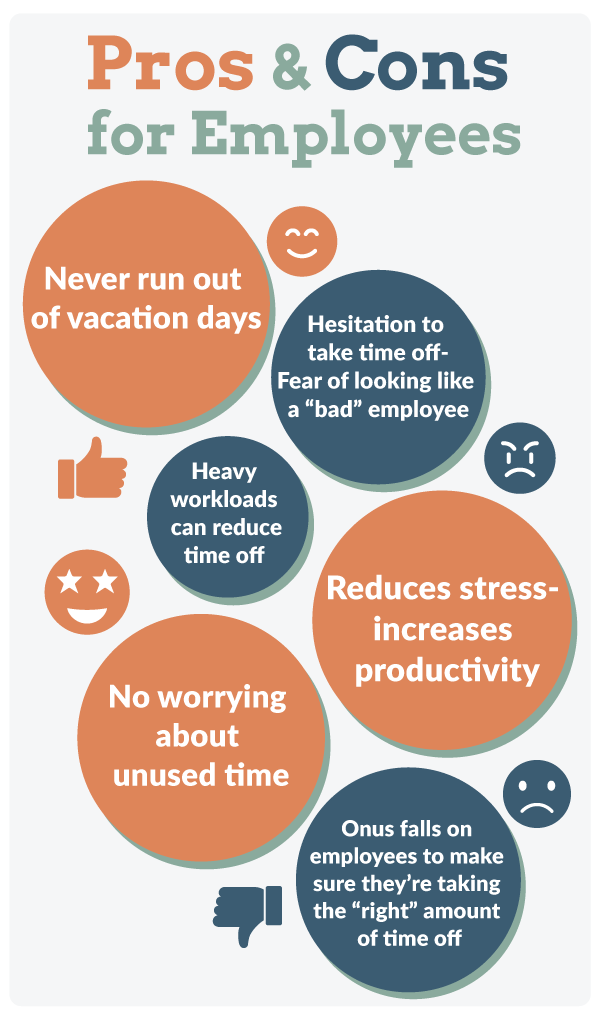
Pros & Cons for Employees: Pros for employees:  • Never run out of vacation days • Reduces stress - increases productivity • No worrying about unused time Cons for employees: • Hesitate to take time off - Fear of looking like a “bad” employee • Heavy workloads can reduce time off • Onus falls on employees to make sure they’re taking the “right” amount of time off

Pros and cons for employers

Unlimited PTO can have serious benefits for employers, as well as risks. 

Pro: Attracts and retains talent. Unlimited PTO is a sought-after benefit, and amid a tight labor market and economic uncertainty, top-notch benefits can attract talent and boost retention.

Con: Risk of policy abuse. “Employees may take off more time and, in some cases, may take off excessive time. Also in this vein, it [can] be hard to discipline employees for taking off too much time if their time off is ‘unlimited,’” says John Viola, employment law attorney at Thompson Coburn.

Pro: Boosts employee morale. “Unlimited PTO may help boost morale and promote a trusting workplace environment,” says Viola. Employees who have the freedom to take time off when they need it to reset and recharge often come back ready to hit the ground running, do better work and have increased productivity.

Con: Causes conflict among employees. Unlimited time off can cause tension between colleagues if one employee is taking a much larger amount of leave than colleagues, and lead to resentment and conflict.

Pro: Saves HR time and effort. Getting rid of a limited PTO policy can help to eliminate administrative tasks for the HR department such as tracking PTO days and accruals. 

Con: Potential for legal concerns. Unlimited PTO can clash with other types of leave, according to Viola. “If an employee takes a six-month military leave of absence, [they] may claim [they are] entitled to receive pay during that entire period. Employers must handle such absences consistently and in a nondiscriminatory way,” advises Viola.

How to tell if unlimited PTO will work for your business

Unlimited PTO isn’t one-size-fits-all, and there’s a chance it may not work at all for your business. Before deciding if an unlimited time off policy is a feasible benefit for your company, consider:

  • Business type: It’s important to take the type of business you’re in into consideration. Can it sustain an unlimited PTO policy without sacrificing business needs? What guidelines would you need to set in place to maximize efficiency?
  • Employee needs: Even though it sounds good on paper, unlimited PTO isn’t always the best option for your employees. It’s important to consider the demographics and needs of your workers to see if they’d benefit from unlimited time off or some other PTO policy.
  • Company culture: Unlimited PTO relies on trust between employees and employers. A culture of employees not trusting their managers, or vice versa, can mean that unlimited PTO can be misused, abused or not used at all. Before you implement a new policy, assess your current company culture to make sure it’s a suitable fit.

Transitioning to an unlimited PTO policy: 3 best practices

If you think your company could benefit from an unlimited PTO policy, you may be ready to start implementing a trial run to see how it works. Here are a few best practices to create a smooth transition to a new PTO policy:

  • Specify what is and isn’t allowed within the policy and update the handbook with clear guidelines
  • Provide education to employees that answers frequently asked questions and guides employees through the new policy, and
  • Use a master calendar to help teams stay on track and coordinate leave to ensure work needs are fulfilled.
Filed under
  • Benefits
  • Share on

Get the HRMorning Newsletter

With HRMorning arriving in your inbox, you will never miss critical stories on labor laws, benefits, retention and onboarding strategies.

  • This field is for validation purposes and should be left unchanged.
  • This field is hidden when viewing the form
  • This field is hidden when viewing the form
  • This field is hidden when viewing the form
  • This field is hidden when viewing the form
  • This field is hidden when viewing the form
  • This field is hidden when viewing the form
  • This field is hidden when viewing the form
  • This field is hidden when viewing the form
  • This field is hidden when viewing the form
  • This field is hidden when viewing the form
  • This field is hidden when viewing the form
  • This field is hidden when viewing the form
  • This field is hidden when viewing the form
  • This field is hidden when viewing the form
  • This field is hidden when viewing the form
  • This field is hidden when viewing the form
  • This field is hidden when viewing the form
  • This field is hidden when viewing the form
  • This field is hidden when viewing the form
  • This field is hidden when viewing the form
  • This field is hidden when viewing the form
  • This field is hidden when viewing the form
  • This field is hidden when viewing the form
  • This field is hidden when viewing the form
  • This field is hidden when viewing the form
  • This field is hidden when viewing the form
  • This field is hidden when viewing the form
  • This field is hidden when viewing the form
  • This field is hidden when viewing the form
  • This field is hidden when viewing the form
  • This field is hidden when viewing the form
  • This field is hidden when viewing the form
  • This field is hidden when viewing the form
  • This field is hidden when viewing the form
  • This field is hidden when viewing the form
  • This field is hidden when viewing the form
  • This field is hidden when viewing the form
  • This field is hidden when viewing the form
  • This field is hidden when viewing the form
  • This field is hidden when viewing the form
  • This field is hidden when viewing the form
  • This field is hidden when viewing the form
  • This field is hidden when viewing the form
  • This field is hidden when viewing the form
  • This field is hidden when viewing the form
  • This field is hidden when viewing the form
  • This field is hidden when viewing the form
  • This field is hidden when viewing the form
  • This field is hidden when viewing the form
  • This field is hidden when viewing the form
  • This field is hidden when viewing the form
  • This field is hidden when viewing the form
  • This field is hidden when viewing the form
  • This field is hidden when viewing the form
  • This field is hidden when viewing the form
  • This field is hidden when viewing the form

Free Training & Resources

Webinars

[Employment Law] Red Flags Every HR Pro Should Know

White Papers

The Employer’s Guide to Lowering Healthcare Spend Without Losing Coverage

Provided by Personify Health

Webinars

The Future of HR: It’s Employees Doing Their Own Payroll

Webinars

Destigmatizing and Treating Addiction in the Workplace – DM

SPONSORED CONTENT

HR Technology

sponsored content
The Best AI Software for HR Automation

Courtesy of G-P

Talent Management

sponsored content
Powerful Employee Retention Strategies for 2025: How to Keep Your Best People

Courtesy of PEOPLEGURU

Benefits

Health Care

Wellness

sponsored content
Proven Results: 5 Ways Teladoc Health Chronic Condition Management Transforms HR Outcomes

Courtesy of TELADOC HEALTH

Further Reading

  • Benefits
  • Wellness
Financial Wellness Programs: 5 Better Ways to Help Employees

Financial stress continues to be a growing concern as more and more people face mounting economic pressures, high-interest debt and unexpec...

  • Benefits
  • Payroll
Student Loan Payment Matching: 5-Step Guidance

Recent grads carrying student loan debt may not think retirement plan participation is doable for them. But if you offer a student loan pay...

  • Benefits
Unlimited PTO Policies: Court Ruling Lists 5 Best Practices

Word to the wise: If your company’s ready to embrace the unlimited PTO trend, you’ll want to make sure you get it right. A court de...

  • Benefits
What a New PBM Model Changes for HR Accountability

Pharmacy benefits are one of the hardest areas for HR to defend as drug costs climb. Employees feel it at the pharmacy counter. Finance see...

  • Benefits
  • Health Care
Little-Known HSA Requirements: Receipts and Recordkeeping

With tax season in full swing, your employees may be sifting through shoeboxes full of receipts in an attempt to identify and organize qual...

  • Benefits
Managing Healthcare Costs Without Hurting Employees: HR’s 2027 Challenge

Open enrollment may feel far away. It isn’t. Summer is when benefits planning for 2027 starts taking shape. With health benefit costs ...

Get the latest from HRMorning in your inbox PLUS immediately access 10 FREE HR guides.

I WANT MY FREE GUIDES
HR Morning Logo
  • Facebook
  • Linked In
  • ABOUT HRMORNING
  • ADVERTISE WITH US
  • WRITE FOR US
  • CONTACT
  • Employment Law
  • Benefits
  • Recruiting
  • Talent Management
  • Performance Management
  • HR Technology
  • Leadership & Strategy
  • Compensation
  • Policy & Procedures
  • Wellness
  • Staff Departure
  • HR Career & Self-Care
  • Health Care
  • Retirement Plans
  • DEI

HRMorning, part of the Rover Insights Network, provides the latest HR and employment law news for HR professionals in the trenches of small-to-medium-sized businesses. Rather than simply regurgitating the day's headlines, HRMorning delivers actionable insights, helping HR execs understand what HR trends mean to their business.

Powered By Rover Insights
Privacy Policy | Terms of Service
Copyright© 2026 Rover Insights
HRMorning Logo

WELCOME BACK!

Enter your username and password below to log in

Forget Your Username or Password?

Reset Password

Lost your password? Please enter your username or email address. You will receive a link to create a new password via email.

Log In

Why do we need your credit card for a free trial?

We ask for your credit card to allow your subscription to continue should you decide to keep your membership beyond the free trial period.  This prevents any interruption of content access.

Your card will not be charged at any point during your 21 day free trial
and you may cancel at any time during your free trial.

During your free trial, you can cancel at any time with a single click on your “Account” page.  It’s that easy.
