
Uncover Employees’ Unique Skills | 2-Minute Video
By
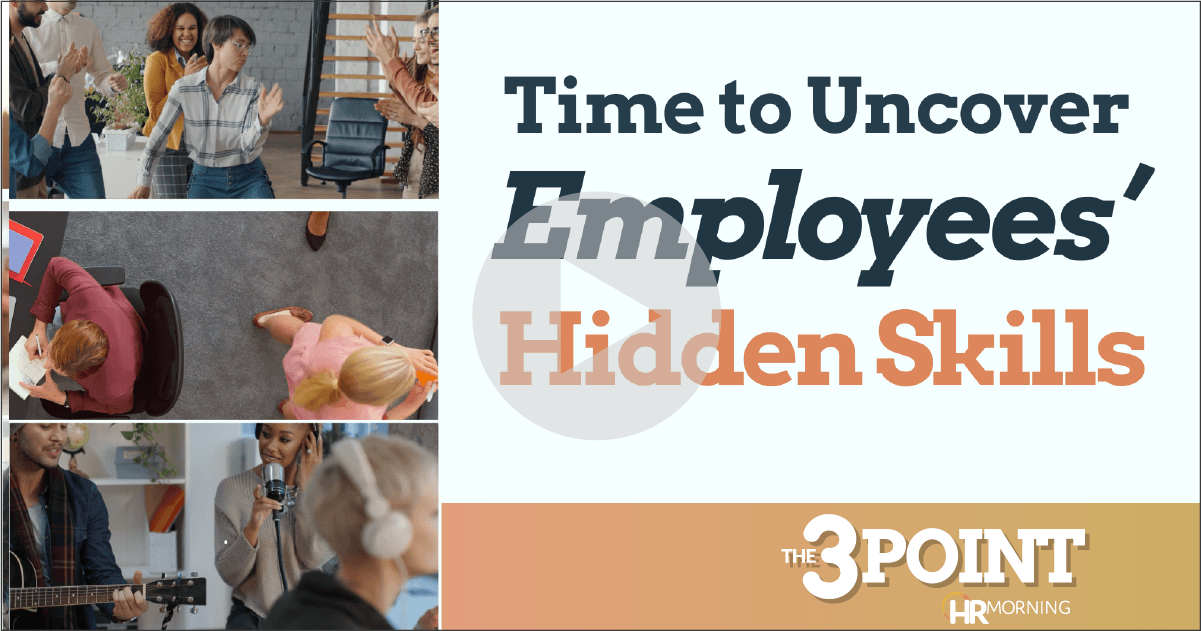
Your employees are probably a lot more talented than you realize. They have unique skills that can improve your workplace.
You can likely capitalize on those, a move that benefits both your organization and employees.
It’s more important — and practical — these days because there’s a talent and skills shortage that’s not shrinking any time soon. On the bright side, PwC’s Global Workforce Hopes and Fears Survey found most younger employees are looking for flexibility, training, development and autonomy. So they’re interested in and willing to use their lesser-known talents at work.
Know Those Unique Skills
This exercise in “Skills Visibility” — that’s what our expert in this episode of the 3-Point calls it — is sort of like cross-training. But it’s even better.
In this case, you learn about their skills, passions or interests outside of work and find ways for them to incorporate those into your workspace. They’re already skilled, so there’s little or no need for training.
Of course, this is mostly a matter of volunteering — employees choose to share their unique skills and talents, and if they’d like to apply them in areas outside of their normal roles.
What’s Up in This Episode
In this episode of HRMorning’s 3-Point, our expert, Phenom’s John Deal, walks us through their insight and best practices in working with employees to uncover unique skills and capitalize on those to improve the workplace. Plus, he gives us tips on how any organization can make this work.
Click, watch and listen for more details on how you can uncover employees’ unique skills and get them more engaged by using those at work.
Transcript (edited for clarity):
You know your employees are a lot more than their job title, right?
So why not capitalize on everything they can bring to the table?
It’s called Skills Visibility and Phenom’s John Deal can explain.
John Deal: A lot of times when you’re in a role in an organization they know the context of you in that role. You’ve done a lot of things before. And you have an entire life outside of work that you do things on. It might not just be hobbies. Maybe you freelance on the side. Or maybe you do some contract work to fill the hours.
Now here’s the example. Let’s say Jude in finance is in a rock band on the weekend. So with his passion for music, he’d probably be great at helping your marketer score promo videos or social media posts. When that happens, you’ve likely done two things … engaged and motivated Jude and improved another project.
But how do you get these other skills out in the open?
Deal: It’s imperative for organizations to understand that you’re not just looking at that person as an employee of the organization. You’re looking at them as a collection of experiences that they’re bringing into your organization. And you need to put a system in place that you highlight those experiences.
So how do you get Jude the rockstar and others to reveal these hidden skills?
Deal: You want to build a culture where people feel comfortable sharing information about themselves and where managers don’t feel their talent is going to be taken by other people because these skills are all becoming visible in the organization.
So when it comes to finding the hidden rockstars, social media experts, coders and beyond within your halls:
- Normalize it. Create a culture where people are comfortable sharing their other talents. That usually starts at the top.
- Formalize it. Create a space where people can share the outside talents and interests they want others to know about.
- Patronize it. Encourage employees and managers to look within the organization for different skills. Then share success stories when those new collaborations work.
Skills Visibility has the potential to improve employee engagement and work quality.
Further Reading
31 Ways to Tell Employees You’re Thankful for Their Efforts
Words can be the most powerful tool you want to thank employees for their efforts. While any day of the year is a good day to praise or thank employees, this time of year reminds us it’s especially important to show employees how thankful we are. Even better, thanking employees isn’t just fluff. It pays […]
3 ‘Learning Culture’ Fails and How HR Can Fix Them Before Gen Z Quits
As a leader, it is easy to become “snowblind” in the current business climate. We are bombarded daily by a slew of buzzwords — job-hopping, job hugging, quiet quitting — and the looming, yet still undefined, shadow of AI’s impact on the workforce. But amid the noise, one statistic from a recent large-scale study demands […]
Kind v. Nice: It Makes a Big Difference for Employee Feedback | 2-Minute Video
When it comes to giving employee feedback, there’s a difference between being kind and being nice. It’s an important distinction HR pros and front-line managers want to make. What’s Up in This Episode: Kind v. Nice In this episode of HRMorning’s 3-Point, Amy Baker, Managing Partner at Happy Humans Consulting LLC, explains the difference between […]
10 Tips to Improve Employee Engagement as Engagement Rates Plummet
HR professionals might consider employee engagement the glue that holds company success together. No matter what you talk about – productivity, leadership, professional growth, retention, recognition, culture, well-being – everything ties back to employee engagement. Not to mention, it is the most important indicator to gauge work satisfaction. But it’s at high risk: Employee engagement […]
A Better Way to Give Employees Feedback Now | 2-Minute Video
Giving and receiving feedback can be difficult. Giving and receiving bad feedback is even worse. We’re not talking about negative evaluations. We’re talking about doing a bad job with any kind of performance or behavior conversation. What’s Up in This Episode: Feedback Redo In this episode of HRMorning’s 3-Point, Kathie Leslie, Owner of Kathryn Leslie, […]
Employees Have FOBO: 5 Factors to Manage the AI Anxiety
Many employees are struggling with AI in ways you didn’t even imagine. They have FOBO – fear of becoming obsolete. And that fear has the potential to paralyze them — making the possibility of becoming obsolete a reality. “AI has accelerated that shift over the past year: tasks are being automated and employees are watching […]