AI recruiting: An HR professional’s guide

Artificial intelligence (AI) is becoming an increasingly large part of the recruitment process, especially for companies looking to optimize their hiring efforts.
AI in HR can make a big difference in how efficiently teams operate and when used correctly can help with everything from eradicating biases to improving candidate relationships.
So, let’s take a deep dive into AI recruiting to find out how to incorporate it into recruitment best practices.
What is AI for recruiting?
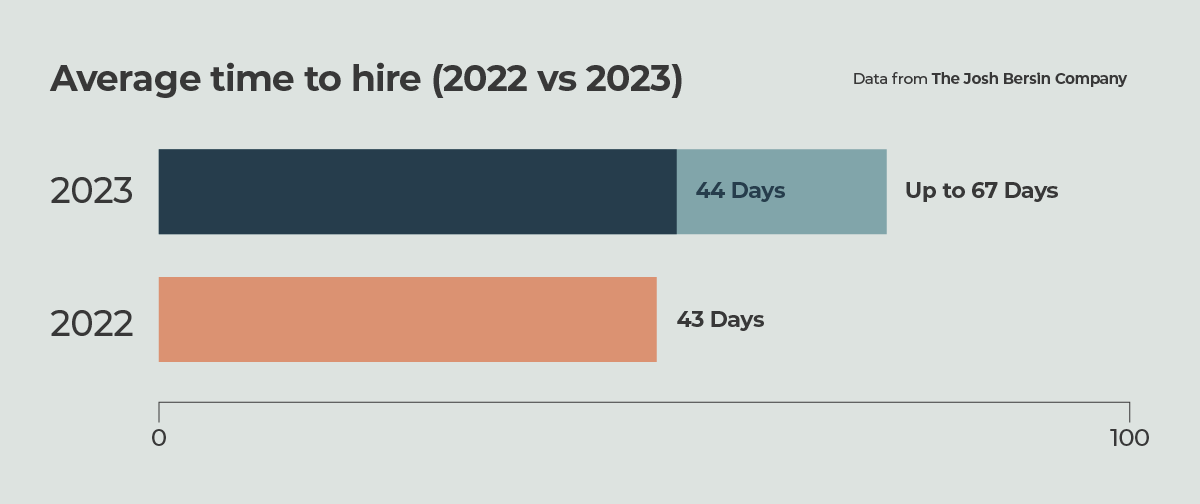
Recent data from The Josh Bersin Company found that the average time to hire is now 44 days, up from 43 days last year.
In some industries, such as Energy and Defense, it takes even longer – 67 days.
These stats are estimated to grow as the year continues, meaning that the more recruiters can do to reduce their time to hire, the greater the chances they’ll have of hiring top talent every time.
This is where recruitment automation can help. The use of AI in any stage of the hiring process can streamline time-consuming, repetitive tasks that are necessary but leave recruiters with little time for the more human side of hiring.
For example, when it comes to talent acquisition, it can source quality candidates in real time. This means recruiters have more time to take actionable steps toward hiring the best talent before they’re off the market.
Why should HR adopt AI into the recruiting process?
AI has already had a huge impact on human resources teams. That impact will increase the more technology improves.
Almost 67% of HR professionals believe AI has a lot of benefits and can positively impact recruiting, according to a study from Tidio.
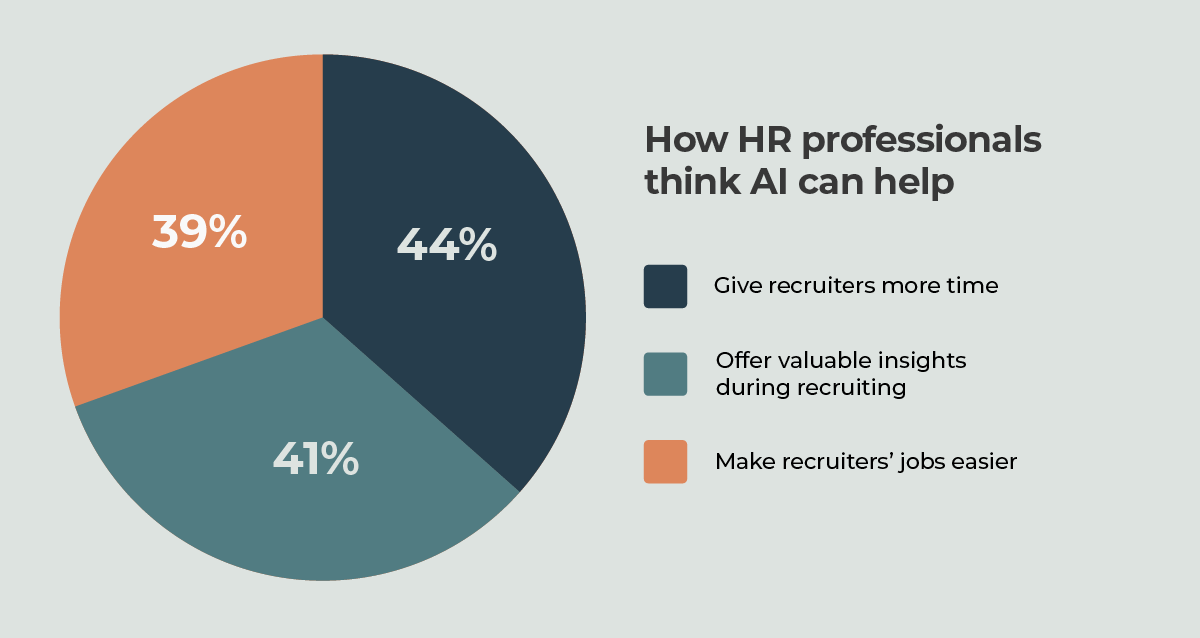
Some of the ways HR professionals think AI can help them include:
- Give recruiters more time (44%)
- Offer valuable insights during recruiting (41%)
- Make recruiters’ jobs easier (39%)
Given AI’s ability to streamline workflows, it’s almost certain that it will give recruiters more time and make their jobs easier.
Its ability to offer valuable insights will help hiring managers analyze the content of resumes and interviews throughout the hiring process, and potentially help them make more effective hiring decisions.
However, 35% of respondents are concerned AI could lead to unique or unconventional talents being overlooked.
This could be a risk when hiring diverse candidates, but this is why it’s important to train AI technology to focus on skills, experience and mindset, rather than just on things like academic qualifications.
It’s also why it’s still important to include humans in any hiring decisions.
Core areas of the recruiting process AI can positively impact
We’ve looked at why HRs should adopt AI into their recruitment processes. Now, let’s explore some of the benefits of AI in recruitment:
Sourcing
Using AI in your candidate sourcing means there’s less manual involvement that recruitment teams need to devote to filling the talent pool.
AI can write job descriptions and can edit existing ones to improve on them. It removes unconscious biases that human recruiters may have let creep into everyday language without realizing it.
Once the job description is sorted, AI recruitment tools can handle candidate sourcing, too.
This can include sharing the role on social media sites like LinkedIn, or more specialized job boards for the position or industry.
It also can search through more expansive talent pools faster than a human recruiter, getting more qualified candidates into the talent pool sooner.
Interviewing
Once AI has sourced and screened a candidate, it can automatically schedule an interview with them. No recruiter is required. Even if that scheduling process involves group interviews, panel interviews or complex sequenced interviews.
In fact, 71% of job applicants expect to wait a week or less for an interview, according to scheduling experts Cronofy.

Reducing how long scheduling interviews takes could save each recruiter up to 284 hours per year.
AI can also be used to conduct video interviews and analyze the results, but this is more effective at the early stages of the hiring process.
While AI can’t replace an in-person interview, it can help with pre- and post-interview communications.
Candidates want more feedback and want to keep informed of the process. No one wants to be part of the 34% who were ghosted after applying for a role, or the 8% who didn’t hear back after getting a job offer.
Not providing any communication risks negative reviews and decreases the likelihood a great candidate will reapply if they’re unsuccessful this time.
Keeping candidates informed makes them feel valued. It can also help their mental health, removing the anxiety of waiting to hear back if it’s too early.
This turns the hiring process into a two-sided process, which improves the candidate experience and positively impacts the employer brand.
The best candidates are off the market fast. So, if you want to keep that top talent for yourself, the more you can do to provide them with a high-quality candidate experience, the better.
Hiring
Screening candidates’ resumes is one of the most time-consuming parts of the hiring process. It’s impossible for a hiring manager to properly read and process every resume they receive, particularly in industries or companies with high-volume recruitment.
AI algorithms can also help with job matching any applications that come into the organization’s job openings. Looking for keywords related to suitable candidates’ skills, mindset and experience helps it identify the potential quality of hire each potential candidate could provide.
A human will never be able to screen a resume as fast as AI can.
On top of this, it can help with candidate assessments. These can assess potential candidates’ skill sets alongside or without the need for a resume, helping attract diverse talent from different backgrounds.
As machine learning helps natural language processing improve, it will only get better at analyzing resumes, assessments and interview responses.
Conversational AI’s ability to converse with candidates and answer their questions will continue to grow, too.
How will AI impact recruiting teams?
The intelligent recruitment marketplace believes that “in today’s competitive landscape, AI has moved from novelty to necessity for forward-thinking recruiting teams,” says Will Kramer, CEO at Laila Technologies Inc. “It automates mundane tasks, freeing recruiters to focus on building genuine relationships with candidates.”
Almost a fifth of candidates want more communication from recruiters, so building those genuine relationships could make a huge difference to candidate experience and employer brand, according to CareerPlug’s 2023 Candidate Experience Survey.
“Even more impactful are the recent advancements in AI that can identify unconscious biases, making for a more diverse talent pool,” adds Kramer. “This efficiency and awareness lead to long-term, value-aligned matches, reducing churn. Far from rendering recruiters obsolete, AI makes them more efficient, delivering better-matched candidates to hiring managers in less time, accelerating the hiring process while enhancing its quality.”
Jason Averbook, senior partner at Mercer, and global leader in digital HR strategy and AI capability took this one step further: “The future of talent acquisition is generative AI. Recruiters all over the world are already using AI to match candidates to jobs, but the next frontier is using AI to automate the entire recruiting process, from sourcing to outreach to onboarding.”
He then explained some of the things AI could help with: “Generative AI can be used to create personalized job descriptions, generate interview questions and even write tailored follow-up emails to candidates. By embracing generative AI, recruiters can free up their time to focus on more strategic tasks, such as building relationships with candidates and developing talent pipelines. Organizations that don’t start experimenting now will be left behind as this is not a fad, but the future.”
Kelly Bunting, Co-Chair of Greenberg Traurig’s Labor & Employment Practice’s Workplace Compliance & Counseling Group, warns of the legal pitfalls to be aware of when using AI for recruitment. “For example, both recent EEOC guidance and New York City’s new AI law require bias audits to be conducted on AI-driven software used in the hiring process to ensure fair consideration is being given to each applicant.
“It’s not just the software vendor that must conduct audits to determine whether the use of AI in HR software will result in certain protected groups being singled out and rejected, perhaps solely on the basis of their membership in that protected category. It is also the employer’s responsibility to make sure such bias audits are conducted every year, and that the software which will make the process easier for HR recruiters doesn’t also make the process discriminatory.
“Therefore although the technology may streamline many recruiting and other HR tasks making them faster and easier, HR managers and their legal counsel will still be required to ensure compliance with the law, even as it changes – which will take some time and thought.”
So, while AI can provide huge time-saving options for HR, it’s important to keep humans involved not just to train the tools, but to ensure any decision making is legally compliant, too.
Getting started with AI recruiting tools
Many HR teams may already use AI recruiting software, either independently or as part of a greater talent acquisition or applicant tracking system.
Have a look at what AI tools your recruitment platform offers already. There’s a high chance that if you check their roadmap, more will be on the way.
How can you leverage these tools in your workflows?
Could you use generative AI in your recruiting?
As Averbook suggested above, you could use generative AI to write a job description or compose a tailored response to candidates’ emails. If you’ve already got a template that you use and are happy with, you could run it through an AI tool to check it for signs of human biases, like gendered language.
You could use AI to submit a job description to the right platforms to reach the right candidates, removing the need for you to manually share new jobs in different places.
And it could work out where the best place to publish that role is so that you’re more likely to attract the best quality candidates.
Using chatbots can also have a big impact on the candidate experience.
Unlike a person, AI can be online 24/7. It doesn’t get sick (not like a human anyway), and it doesn’t need time off.
That means candidates can get in touch and ask common questions any time of day, getting the answers they need sooner. And since they’ll get a response via conversational AI, in most cases, it will still feel like talking to a human.
This messaging can help job seekers who have questions about the role get the responses they need faster.
If they don’t feel they’re a good fit after the conversation, they can remove themselves from the hiring process. Those who are a great fit can continue in the process.
If you hire from different countries or time zones, AI’s ability to answer questions at any time of day or night can be particularly helpful. It can even translate existing job descriptions, FAQs, and responses into different languages.
You’ll still want to run it past a native speaker, as it may read unnaturally, as some AI-generated text can.
AI recruitment software makes life easier
AI already plays a huge role in streamlining the hiring process. As its capabilities increase, it will not only be able to help with the automation of time-consuming tasks, but also be able to analyze and understand more and more data, considering different contexts. It’ll play a larger role in HR teams’ daily activities, giving them more time to spend building relationships with job seekers and employees.
Embracing AI will allow HR teams to do more with less, assisting with every step of the recruiting process. This will give candidates a more positive impression of the company during the hiring process, boosting the candidate experience and possibly helping with talent retention.
- Share on


Free Training & Resources
Webinars
White Papers
Provided by AbsenceSoft