9 Phrases That Kill Collaboration in the Workplace

Before you start your next team meeting, read this — and don’t say that!
There are at least nine things you don’t want to say to the group because they can kill collaboration and put a damper on teamwork.
Researchers and communication experts have found that some phrases sabotage forward movement. Other phrases take the wind out of people’s sails. Some hurt feelings. And others stifle creativity or crush ingenuity.
Skip These, Improve Collaboration
And here’s why it’s important that leaders (and any team member, for that matter) do the least harm when it’s time for the group to collaborate: Teams collaborate less these days in the remote and hybrid environments. In fact, a third of leaders don’t think their people collaborate enough, according to a McLean & Company study.
So when we’re together making decisions, setting course and reviewing, we need to make the most of that time.
We need to make teamwork work. The best way to do that is to make sure we don’t stop good collaboration in its tracks with bad talk.
Here are nine phrases that can hinder good work. You want to avoid saying or writing …
1. ‘Let’s agree to disagree’
This often puts an end to healthy conflict that could create greater ideas if given the time to be hashed out. Instead, when someone says it, the conversation is brought to a screeching halt.
Plus, you might momentarily save face or eliminate friction, but don’t doubt that differing opinions will bubble up again, and it might be at a time when the conflict is too escalated for a healthy recovery.
Better to address differences in the moment and suggest the team explore solutions that everyone can work with.
2. ‘It’s too late to …’
… change course. … fix this. … reboot.
Saying it’s too late to do something shows a lack of flexibility and ingenuity.
If it seems late in the game to change something, ask the team what they feel is in their control to change and how they’d execute that.
3. ‘Nothing personal, but …’
We’ve said it before: Once you introduce the word “but,” it negates everything said before it. So when this phrase is uttered, whatever comes next will sound and be personal.
And statements about a person or their ideas will surely be met with defensiveness.
Instead, everyone needs to focus on the project and progress. Address those, not people.
4. ‘Just kidding’
When someone follows up on what they’ve said or written with this line, it’s often too late. The “joke” was likely interpreted as an insult or a slight as soon as it was said.
Better for everyone to take the task and teammates seriously, and address them that way.
5. ‘I’ve done my part – it’s on you now’
This implies you aren’t in it to win it with the team. Whoever says it has not-so-subtly dumped collective ownership and accountability to the task at hand.
What’s more, it suggests that the person doesn’t care about the whole group’s success.
What’s better is to explain what you’ve done and the next steps others will want to take to move you toward a successful collaborative effort.
6. ‘That won’t work’
This is usually said too early in the brainstorming process. It stops ideas before they’ve had the potential to be hashed out into more concrete plans.
Instead, when ideas that seem impossible arise, say something like, “That’s an interesting approach. Tell me more.”
7. ‘I’m too busy to …’
Everyone’s busy so the person who says this needs to notice all the eyes rolling in the room. No matter how it’s said — “I have too much on my plate” or “I don’t have the time” — it sounds like your time and presence are more important than others.
We realize the statement may be true — you don’t have the capacity to do more — but to be a team player, talk about what’s the highest priority so you can determine where your time is best spent.
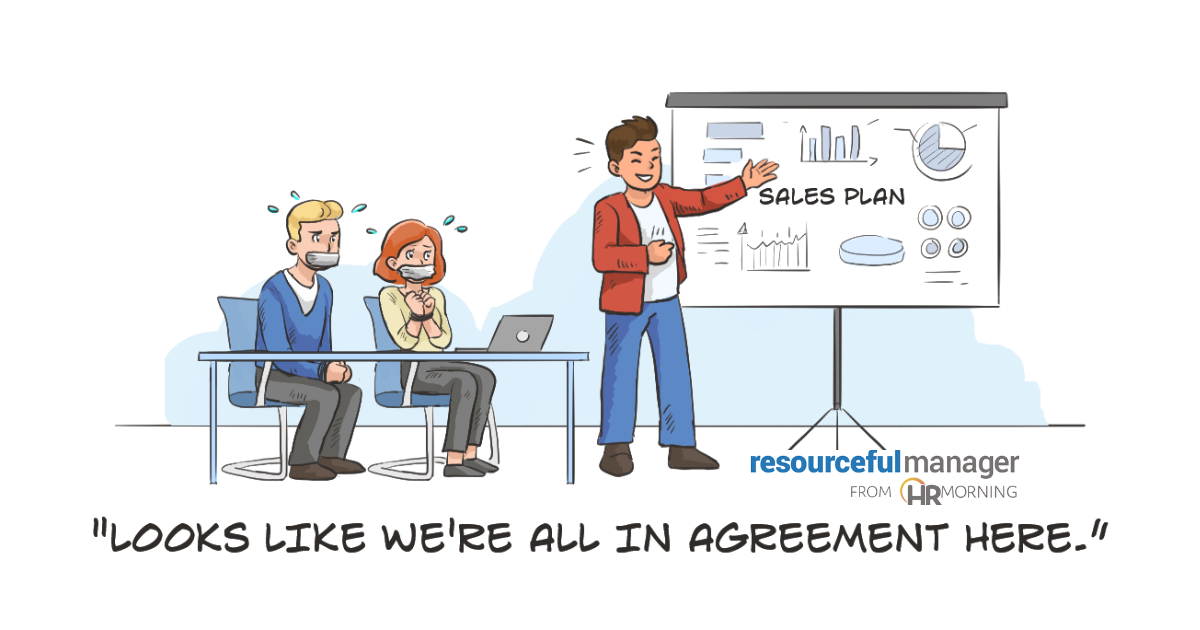
8. ‘Looks like we’re all in agreement’
It might look like it because people are quiet, nodding politely or not pushing back. But it may also be because you or someone else is pressing hard with one idea and other team members fear resistance.
Instead, invite people to make more suggestions before you take the matter to a real vote where people can disagree.
9. ‘We can’t do that’
Some challenges seem overwhelming. Some opportunities seem too out of the norm. And when that happens, someone — or worse, the whole team — immediately goes to why it can’t be done.
Instead, when presented with opportunities and challenges, don’t ask, “Why?” Ask “Why not?” That can change a difficult perspective on its head.

- Share on


Free Training & Resources
White Papers
Provided by Maven Clinic