• Skip to primary navigation
  • Skip to main content

HRMorning

  • FREE RESOURCES
  • PREMIUM CONTENT
  • HR DEEP DIVES
  • PODCASTS
    • VOICES OF HR
    • WOMEN’S LEADERSHIP TODAY
  • LOGIN
  • SIGN UP FREE
  • Employment Law
  • Benefits
  • Recruiting
  • HR Technology
  • Payroll
  • Management
  • Women’s Leadership
  • More
    • Talent Management
    • Performance Management
    • Leadership & Strategy
    • Compensation
    • Policy & Procedures
    • Wellness
    • Staff Departure
    • HR Career & Self-Care
    • Health Care
    • Retirement Plans
RM Logo
  • Talent Management

Why the Water Cooler Still Matters Today (Plus Lessons from 4 Other Bygone Workplace Staples)

Michele McGovern
By: Michele McGovern
  • Share on

About the Author

Michele McGovern writes. A lot. These days, she covers HR, digging deep into company culture, DEI, leadership, management and the everchanging world of work. In the years between getting a BA in journalism from a state school and writing about HR, she wrote about big-city crime for a wire service and small-town life for local newspapers. She’s a mediocre mom, decent wife, wannabe athlete and consummate pursuer of fun - on land, snow and water. Find her on LinkedIn @michele-mcgovern-writer.

Show Less
Last Updated: June 30, 2026
6 minute engagement

Ah, the humble water cooler – the keeper of secrets and inventor of many great ideas in the workplace.

It’s so important to workplaces that many organizations that are remote or hybrid still crowd around virtual water coolers.

But how did it become an office mainstay? And why is it still so important?

“It’s important not to underestimate the importance of social connection at work. I think it is for that reason that the water cooler has had so much longevity as a mainstay in the office,” says Jan Bruce, CEO and co-founder of meQuilibrium. “It’s not the water, or even the break from work, it’s the opportunity to connect with peers and share experiences.”

Take a Closer Look at What and Why

It’s not the first time I’ve wondered about these kinds of things — the history of what we do and how we behave at work. So my curiosity led to some digging in.

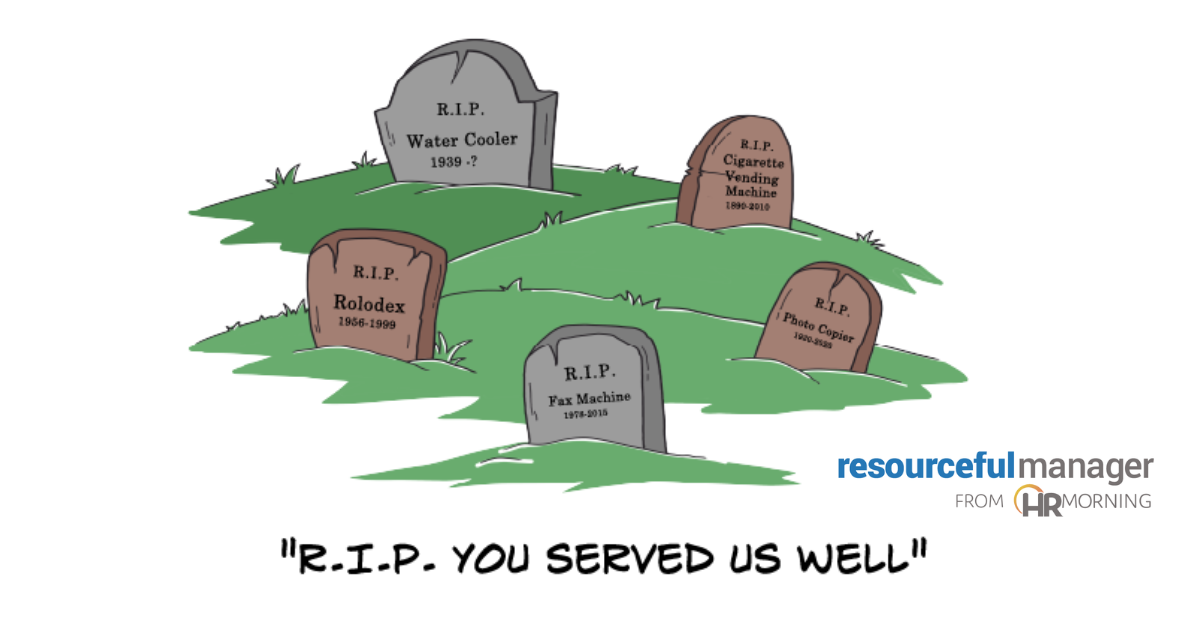
And that’s what we have here: The origins of five office mainstays, why they’re still important and how managers can use them to become better team leaders.

1. The Water Cooler

Origin: Luther Haws, a safe water advocate and inventor, created a portable dispensing machine in 1938. It quickly gained popularity in offices, not just for the cool beverage but for the cool, communal spot to gossip and brainstorm. “Watercooler Talk” was born.

Importance today: Watercooler Talk – or any informal gathering around with workplace friends – is linked to profitability, engagement, efficiency, safety and retention.

Lead your team: Watercooler moments don’t happen as easily these days because people working in hybrid or remote situations aren’t physically together as much. So you might need to nurture it. Try Zoom and apps such as WaterCooler and Slingshot to help teams connect virtually and informally. In the office, simply call for water breaks.

Plus, you never know what can happen at the water cooler. Here’s a watercooler moment Dean Guida, CEO and founder of Infragistics, shared with me:

I used to have a parrot named Rex, and when I traveled, I would board Rex at the local pet shop owned by Eileen. One day, I went to my office kitchen to fill up my water bottle, and I saw Eileen there. I said to her, ‘What are you doing here?’ 

‘I just started as a salesperson,’ Eileen replied.

‘That’s great, I am the Founder & CEO of the company,’ I said. 

It was a fun surprise for both of us. She had sold the pet shop and, unbeknownst to me, was hired as a salesperson at my company!

2. Rolodex

Origin: Office supply company Zephyr American patented the rolling index (thus “Rolodex”) of alphabetized contacts in 1956. Professionals, or their secretaries of the time, could write or type details on the cards and file them until the next meeting. One famous businessman’s Rolodex equaled 200,000 pages of contacts and notes.

Importance today: The Rolodex lost its luster to technology (although this Gen Xer still has an outdated one tucked in a desk drawer!) For the most part, cell phone contact lists replaced the Rolodex – and the Yellow Pages, White Pages and every other address book we owned.

Lead your team: Where you keep professional and personal contact lists isn’t what’s important today. Using it to purposefully connect is. Maintain reminders to connect with team members and colleagues and notes on what happened when you last chatted and what you’d like catch up on.

“Any time you have the opportunity to get to know your business colleagues on a personal level, it helps your working relationships and creates a sense of belonging and trust,” says Guida.

3. Fax Machine

Origin: The office fax machine evolved through many inventions, starting in the 1860s. By the late 1970s, businesses paid about $20,000 for a fax machine that weighed 100 pounds and took six minutes to transmit one page! By the early 1990s, homeowners paid less than $500 for 15-pound machines that transmitted a page in 20 seconds.

Importance today: We share documents in a variety of ways; email, text, apps and beyond.

Lead your team: With so many options on how to communicate within a team, there are risks that people will be overwhelmed or confused – and just start to ignore the messages. So it’s important to decide as a team the most effective ways to share information. For instance, a specific Slack channel may work for one group and email works better for another. Same goes for individual communication: Let employees know your preferences and ask theirs.

“Work is a social and human experience, and we all need to remember this.  Employees and managers who work in person in an office want to share, communicate, and connect with their colleagues,” says Jeanne Meister, a strategic advisor and trustee at Excelsior University.

4. Photocopier

Origin: Chester Carlson used an array of household items to create the first copy in 1930. Xerox made the copy machine an office mainstay in 1959. In addition to creating reams of paper printed with confidential, boring and silly images (anyone remember smooshed faces and butt cheeks?), the copier created another place for employees to gather and shoot the breeze.

Importance today: The actual machine seems like an office villain today, as more and more businesses try to go paperless. But what it represents – shared information – is still critical to team success.

Lead your team: Share as much information as legally possible about the industry, company and team with employees. When people feel there’s more to a story than what they know, they’ll fill it with misinformation. That’s fertile ground for gossip, resentment and disengagement.

5. Vending Machines

Origin: The office vending machine has been the source of love and hate since the early 1900s, a few years after the first coin-operated, postcard-selling machine was invented. From soda to snacks, cigarettes to candy, employees rave or rant about the contents.

Importance today: We don’t vend like we used to. Companies bolster the food and beverage experience with catered meals, in-house taps and at-home deliveries to remote staff. But the idea behind vending – eating, drinking and gathering – remains an important part of work life.

Lead your team: Make time at least quarterly to “break bread” with your team. Buy each person a favorite vending machine item over a one-on-one. Call in a catered lunch. Go out for happy hour. Connect on a human level.

“The data bears this out: Employees who feel that they have strong social connections and feel supported by colleagues at work have significantly higher engagement than those who feel isolated,” says Bruce of meQuilibrium. “In short, it’s time that pays off – it also helps people feel comfortable reaching out to others and relying on them for advice, mentoring and problem-solving.”

To that is another water cooler anecdote that shows the water cooler – no matter where it is – works. This one is compliments of Meister with Excelsior University:

It’s the bumping into people across functions that can really advance your idea further and take it in a new direction. My favorite watercooler moment did not happen in person at a water cooler but in a group dinner with colleagues from my publisher when they gave input to the title of a book I was writing at the time. The book title was then born and published as The 2020 Workplace – the original title was much longer and not nearly as impactful.

Filed under
RM Logo
  • Talent Management
  • Share on

Get the HRMorning Newsletter

With HRMorning arriving in your inbox, you will never miss critical stories on labor laws, benefits, retention and onboarding strategies.

  • This field is for validation purposes and should be left unchanged.
  • This field is hidden when viewing the form
  • This field is hidden when viewing the form
  • This field is hidden when viewing the form
  • This field is hidden when viewing the form
  • This field is hidden when viewing the form
  • This field is hidden when viewing the form
  • This field is hidden when viewing the form
  • This field is hidden when viewing the form
  • This field is hidden when viewing the form
  • This field is hidden when viewing the form
  • This field is hidden when viewing the form
  • This field is hidden when viewing the form
  • This field is hidden when viewing the form
  • This field is hidden when viewing the form
  • This field is hidden when viewing the form
  • This field is hidden when viewing the form
  • This field is hidden when viewing the form
  • This field is hidden when viewing the form
  • This field is hidden when viewing the form
  • This field is hidden when viewing the form
  • This field is hidden when viewing the form
  • This field is hidden when viewing the form
  • This field is hidden when viewing the form
  • This field is hidden when viewing the form
  • This field is hidden when viewing the form
  • This field is hidden when viewing the form
  • This field is hidden when viewing the form
  • This field is hidden when viewing the form
  • This field is hidden when viewing the form
  • This field is hidden when viewing the form
  • This field is hidden when viewing the form
  • This field is hidden when viewing the form
  • This field is hidden when viewing the form
  • This field is hidden when viewing the form
  • This field is hidden when viewing the form
  • This field is hidden when viewing the form
  • This field is hidden when viewing the form
  • This field is hidden when viewing the form
  • This field is hidden when viewing the form
  • This field is hidden when viewing the form
  • This field is hidden when viewing the form
  • This field is hidden when viewing the form
  • This field is hidden when viewing the form
  • This field is hidden when viewing the form
  • This field is hidden when viewing the form
  • This field is hidden when viewing the form
  • This field is hidden when viewing the form
  • This field is hidden when viewing the form
  • This field is hidden when viewing the form
  • This field is hidden when viewing the form
  • This field is hidden when viewing the form
  • This field is hidden when viewing the form
  • This field is hidden when viewing the form
  • This field is hidden when viewing the form
  • This field is hidden when viewing the form
  • This field is hidden when viewing the form

Free Training & Resources

White Papers

Building an Incident Management Program? Start With These Four Fundamentals

Provided by Navex

White Papers

The State of Corporate Travel and Expense 2025

Provided by Navan

Webinars

Top HR Trends and Priorities for 2026

Provided by Paycom

White Papers

Compliance First: Avoid Costly Payroll Risks While Strengthening Operations

Provided by Paypro

SPONSORED CONTENT

HR Technology

sponsored content
The Best AI Software for HR Automation

Courtesy of G-P

Talent Management

sponsored content
Powerful Employee Retention Strategies for 2025: How to Keep Your Best People

Courtesy of PEOPLEGURU

Benefits

Health Care

Wellness

sponsored content
Proven Results: 5 Ways Teladoc Health Chronic Condition Management Transforms HR Outcomes

Courtesy of TELADOC HEALTH

Further Reading

  • Talent Management
Unmotivated Employees? 7 Telltale Signs They’ve Checked Out

When employees are happy, their productivity level jumps 12% – but it drops by 10% if they’re unhappy. So can you tell if yo...

  • Talent Management
9 Phrases That Kill Collaboration in the Workplace

Before you start your next team meeting, read this — and don’t say that! There are at least nine things you don’t want...

  • Talent Management
10 of the Most Loathed Words at Work

Some things are better left unsaid, especially at work. And the most loathed words are definitely better left unsaid. Here’s th...

  • Talent Management
No. 1 Reason Employees Stay: It Might Not Be What You Think

What’s the most critical element to keep good employees? Salary? Sure, that helps. Flexibility? Yep, that’s important, but n...

  • Talent Management
Get Your Jam On! How Music Can Help You Get More Done (Plus 20 Best Songs, Artists)

Do you get your jam on every day — or some days — at work? Well, if you’re going to listen, you might as well listen t...

  • Talent Management
Benefits of Friendship at Work: 5 Important Do’s and Don’ts

Friendship at work is much more than having a buddy to lunch with. Workplace friendships improve morale, culture and business results. L...

Get the latest from HRMorning in your inbox PLUS immediately access 10 FREE HR guides.

I WANT MY FREE GUIDES
HR Morning Logo
  • Facebook
  • Linked In
  • ABOUT HRMORNING
  • ADVERTISE WITH US
  • WRITE FOR US
  • CONTACT
  • Employment Law
  • Benefits
  • Recruiting
  • Talent Management
  • Performance Management
  • HR Technology
  • Leadership & Strategy
  • Compensation
  • Policy & Procedures
  • Wellness
  • Staff Departure
  • HR Career & Self-Care
  • Health Care
  • Retirement Plans
  • DEI

HRMorning, part of the Rover Insights Network, provides the latest HR and employment law news for HR professionals in the trenches of small-to-medium-sized businesses. Rather than simply regurgitating the day's headlines, HRMorning delivers actionable insights, helping HR execs understand what HR trends mean to their business.

Powered By Rover Insights
Privacy Policy | Terms of Service
Copyright© 2026 Rover Insights
HRMorning Logo

WELCOME BACK!

Enter your username and password below to log in

Forget Your Username or Password?

Reset Password

Lost your password? Please enter your username or email address. You will receive a link to create a new password via email.

Log In

Why do we need your credit card for a free trial?

We ask for your credit card to allow your subscription to continue should you decide to keep your membership beyond the free trial period.  This prevents any interruption of content access.

Your card will not be charged at any point during your 21 day free trial
and you may cancel at any time during your free trial.

During your free trial, you can cancel at any time with a single click on your “Account” page.  It’s that easy.