• Skip to primary navigation
  • Skip to main content

HRMorning

  • FREE RESOURCES
  • PREMIUM CONTENT
  • HR DEEP DIVES
  • PODCASTS
    • VOICES OF HR
    • WOMEN’S LEADERSHIP TODAY
  • LOGIN
  • SIGN UP FREE
  • Employment Law
  • Benefits
  • Recruiting
  • HR Technology
  • Payroll
  • Management
  • Women’s Leadership
  • More
    • Talent Management
    • Performance Management
    • Leadership & Strategy
    • Compensation
    • Policy & Procedures
    • Wellness
    • Staff Departure
    • HR Career & Self-Care
    • Health Care
    • Retirement Plans
RM Logo
  • Leadership & Strategy

How Much Harder Must You Work To Be A Top-Notch Leader? The Answer is Surprising

Michele McGovern
By: Michele McGovern
  • Share on

About the Author

Michele McGovern writes. A lot. These days, she covers HR, digging deep into company culture, DEI, leadership, management and the everchanging world of work. In the years between getting a BA in journalism from a state school and writing about HR, she wrote about big-city crime for a wire service and small-town life for local newspapers. She’s a mediocre mom, decent wife, wannabe athlete and consummate pursuer of fun - on land, snow and water. Find her on LinkedIn @michele-mcgovern-writer.

Show Less
Last Updated: May 25, 2026
3 minute engagement

How much harder would you have to work to be a top-notch leader?

50%? 25%? 10%?

Nope.

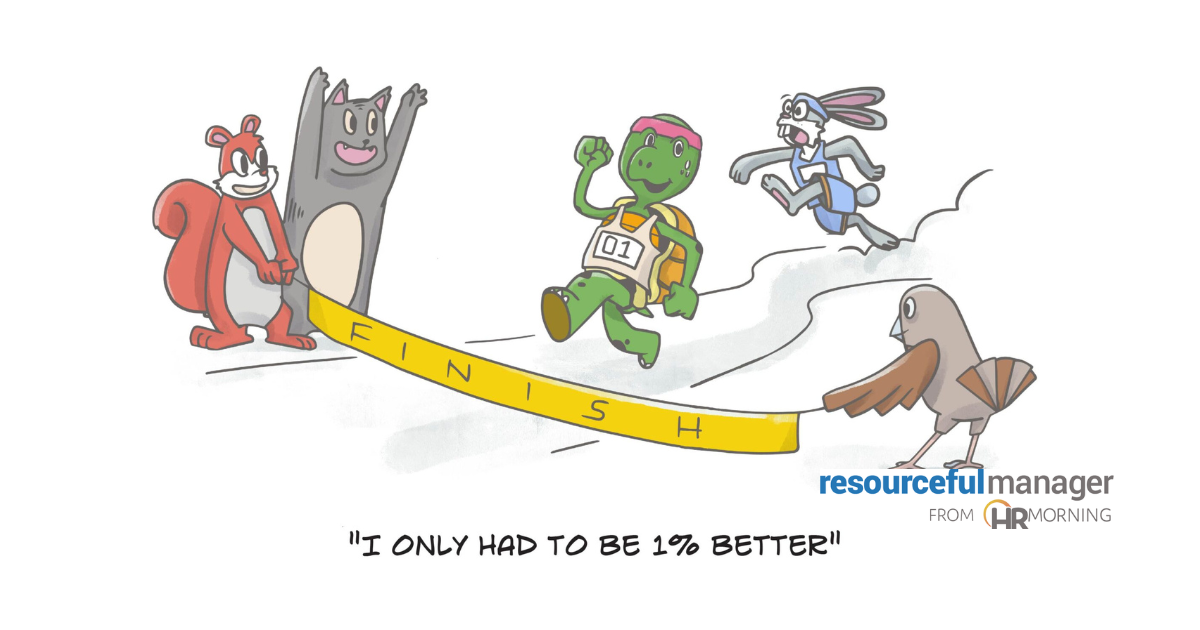
Just 1%, says one researcher. Then you can become a top-notch leader in your org – the manager whose name is synonymous with “engaging,” “awesome,” “epic” and “phenomenal.”

Top-Notch Leader in the Making

“There are no ‘irrefutable laws’ of leadership or power; there is no single secret,” says Andy Ellis, CEO of Duha and author of 1% Leadership: Master the Small, Daily Improvements that Set Great Leaders Apart. “{But} anyone, at any stage of their career, can continuously make tiny ‘1% at a time’ improvements.”

And that’s enough to get ahead and be the boss everyone wants to work for or wants to become.

Here are six areas of development where good leaders want to focus on 1% improvements, according to Ellis:

1. Keep the Future in Check

Great leaders are present with employees, listening, sharing and engaging in the moment. But you want to have an eye on the future.

“Worrying about failure will make success even more unlikely,” says Ellis. “Only by engaging in the present, with that worry set aside, can we find the path to success.”

1% better: If a negative outcome – essentially worry – enters your mind when planning for the future, turn it on its head and counter with another potential positive outcome.

2. Become More Self-Aware

Own your wrongs. Leaders need to be right about many things – such as following policies and procedures or training employees to do the job well. But you can grow and learn when you consider that you might be wrong – and accept that something or someone else is right.

“Accepting the possibility of being wrong also helps build relationships within teams,” says Ellis.

1% better: Add this phrase to your regular vocabulary, and use it when you encounter a difference of opinions: “I might be wrong, but …. What do you think about that?”

3. Stay Committed

One percent better is absolutely doable for a day, a week or a month. But sustained success at being a top-notch leader depends on a commitment that goes well beyond that.

“Strong leaders demonstrate that long-term wellness matters,” says Ellis.

1% better: Schedule 10 minutes each week to spend more time scheduling! Use the time to review tomorrow and next week’s goals and to-dos. Then add anything you’ll need to follow up on, improve or finalize for those items in three or four months.

4. Become More Perceptive

Top-notch leaders are seldom at odds with others. They recognize that their careers and success as a leader isn’t about a competition with winners (them) and losers (colleagues).

“It perpetuates negative energy that carries over into future engagements,” says Ellis. “Instead, flip the hero v. villain trope by looking at the situation from the perspective of the other person.”

1% better: Collaborate more. Ask one colleague or employee each week for insight or help on something you’d normally attack alone. And then offer to do the same for them.

5. Take Calculated Risks

We might think top-notch leaders are crazy risk-takers. In actuality, they’re more like conscientious MacGyvers. They set big goals, but they expect the unexpected. They often rely on a set of resources, processes and protocols that can be adapted to handle almost anything.

“Whether you jump out of an airplane or get pushed out, you still need a parachute,” Ellis jokes.

1% better: Look closer at an informal process that works well now. Document it and try using it in other situations so you have an adaptable process available to take on more calculated risks.

6. Empower Employees

Top-notch leaders develop their employees. They do more than teach employees to do a job. They encourage employees to approach their work as problem-solvers, and invite them to share perspectives on how to get the work done.

“Take valuable team members from irreplaceable to unclonable,” says Ellis. “This ensures that work remains ongoing and stimulates each team member to proactively solve problems.”

1% better: Stop when your immediate reaction to a question is to do the task for an employee or give instructions. Instead, ask employees if they think there’s a different or better way to accomplish something. If there is, give them the resources to make the changes.

Filed under
RM Logo
  • Leadership & Strategy
  • Share on

Get the HRMorning Newsletter

With HRMorning arriving in your inbox, you will never miss critical stories on labor laws, benefits, retention and onboarding strategies.

  • This field is for validation purposes and should be left unchanged.
  • This field is hidden when viewing the form
  • This field is hidden when viewing the form
  • This field is hidden when viewing the form
  • This field is hidden when viewing the form
  • This field is hidden when viewing the form
  • This field is hidden when viewing the form
  • This field is hidden when viewing the form
  • This field is hidden when viewing the form
  • This field is hidden when viewing the form
  • This field is hidden when viewing the form
  • This field is hidden when viewing the form
  • This field is hidden when viewing the form
  • This field is hidden when viewing the form
  • This field is hidden when viewing the form
  • This field is hidden when viewing the form
  • This field is hidden when viewing the form
  • This field is hidden when viewing the form
  • This field is hidden when viewing the form
  • This field is hidden when viewing the form
  • This field is hidden when viewing the form
  • This field is hidden when viewing the form
  • This field is hidden when viewing the form
  • This field is hidden when viewing the form
  • This field is hidden when viewing the form
  • This field is hidden when viewing the form
  • This field is hidden when viewing the form
  • This field is hidden when viewing the form
  • This field is hidden when viewing the form
  • This field is hidden when viewing the form
  • This field is hidden when viewing the form
  • This field is hidden when viewing the form
  • This field is hidden when viewing the form
  • This field is hidden when viewing the form
  • This field is hidden when viewing the form
  • This field is hidden when viewing the form
  • This field is hidden when viewing the form
  • This field is hidden when viewing the form
  • This field is hidden when viewing the form
  • This field is hidden when viewing the form
  • This field is hidden when viewing the form
  • This field is hidden when viewing the form
  • This field is hidden when viewing the form
  • This field is hidden when viewing the form
  • This field is hidden when viewing the form
  • This field is hidden when viewing the form
  • This field is hidden when viewing the form
  • This field is hidden when viewing the form
  • This field is hidden when viewing the form
  • This field is hidden when viewing the form
  • This field is hidden when viewing the form
  • This field is hidden when viewing the form
  • This field is hidden when viewing the form
  • This field is hidden when viewing the form
  • This field is hidden when viewing the form
  • This field is hidden when viewing the form
  • This field is hidden when viewing the form

Free Training & Resources

Webinars

How Digital HR Drives Agility, Resilience, and Long-Term Success

EBOOK, White Papers

The Prevention Mandate: An Employer’s Framework for a Healthier Workforce

Provided by Personify Health

Webinars

Remote Recruiting, Interviewing, Hiring, and Onboarding During COVID-19

White Papers

A Year of Employee Appreciation Ideas

Provided by Inspirus

SPONSORED CONTENT

HR Technology

sponsored content
The Best AI Software for HR Automation

Courtesy of G-P

Talent Management

sponsored content
Powerful Employee Retention Strategies for 2025: How to Keep Your Best People

Courtesy of PEOPLEGURU

Benefits

Health Care

Wellness

sponsored content
Proven Results: 5 Ways Teladoc Health Chronic Condition Management Transforms HR Outcomes

Courtesy of TELADOC HEALTH

Further Reading

  • Leadership & Strategy
3 Ways to Spread Culture to Front-Line Employees

It’s difficult enough to build and spread culture where employees feel valued, engaged and satisfied — but it can be even more ...

  • Leadership & Strategy
  • Staff Administration
Workplace mental health: What to do when HR’s discouraged from talking about it

More than half of employers (55%) are having some kind of conversation about workplace mental health, according to a survey of workers and ...

  • Employment Law
  • Leadership & Strategy
The Silent Warning Inside Today’s Workplaces: Harassment Prevention Strategies Aren’t Landing

Nearly a decade after #MeToo ignited a global reckoning around workplace harassment, there was hope that workplaces would look fundamentall...

  • Leadership & Strategy
6 keys to better training from the ultimate trainers – schoolteachers

One of the most important things you can do each day is help employees become better. So most managers want to provide better training. ...

  • Leadership & Strategy
  • Policy & Procedures
New Generative AI Court Ruling Puts HR on Notice: What to Know Now

A federal judge in New York ruled from the bench that documents an individual created using generative AI and sent to his lawyer were not p...

  • Leadership & Strategy
Quiet Quitting vs. Loud Quitting: A Guide to Identify, Understand and Mitigate

By now, you’ve surely heard about quiet quitting – and its obvious counterpart, loud quitting. They were trendy buzzwords, but they des...

Get the latest from HRMorning in your inbox PLUS immediately access 10 FREE HR guides.

I WANT MY FREE GUIDES
HR Morning Logo
  • Facebook
  • Linked In
  • ABOUT HRMORNING
  • ADVERTISE WITH US
  • WRITE FOR US
  • CONTACT
  • Employment Law
  • Benefits
  • Recruiting
  • Talent Management
  • Performance Management
  • HR Technology
  • Leadership & Strategy
  • Compensation
  • Policy & Procedures
  • Wellness
  • Staff Departure
  • HR Career & Self-Care
  • Health Care
  • Retirement Plans
  • DEI

HRMorning, part of the Rover Insights Network, provides the latest HR and employment law news for HR professionals in the trenches of small-to-medium-sized businesses. Rather than simply regurgitating the day's headlines, HRMorning delivers actionable insights, helping HR execs understand what HR trends mean to their business.

Powered By Rover Insights
Privacy Policy | Terms of Service
Copyright© 2026 Rover Insights
HRMorning Logo

WELCOME BACK!

Enter your username and password below to log in

Forget Your Username or Password?

Reset Password

Lost your password? Please enter your username or email address. You will receive a link to create a new password via email.

Log In

Why do we need your credit card for a free trial?

We ask for your credit card to allow your subscription to continue should you decide to keep your membership beyond the free trial period.  This prevents any interruption of content access.

Your card will not be charged at any point during your 21 day free trial
and you may cancel at any time during your free trial.

During your free trial, you can cancel at any time with a single click on your “Account” page.  It’s that easy.
