
3 Ways to Build a Bridge Over the Generation Gap | 2-Minute Video
By
From grandmas to grandkids, you probably have several generations in your workplace. And they don’t always see eye to eye. There’s likely a generation gap.
Even worse, 35% of employees say age or generational differences contributed to acts of incivility — witnessed or experienced — at work, according to SHRM’s Civility Index. People aren’t being nice to each other because just because they aren’t the same age. That’s unreal!
What’s Up in This Episode: Fill the Generation Gap
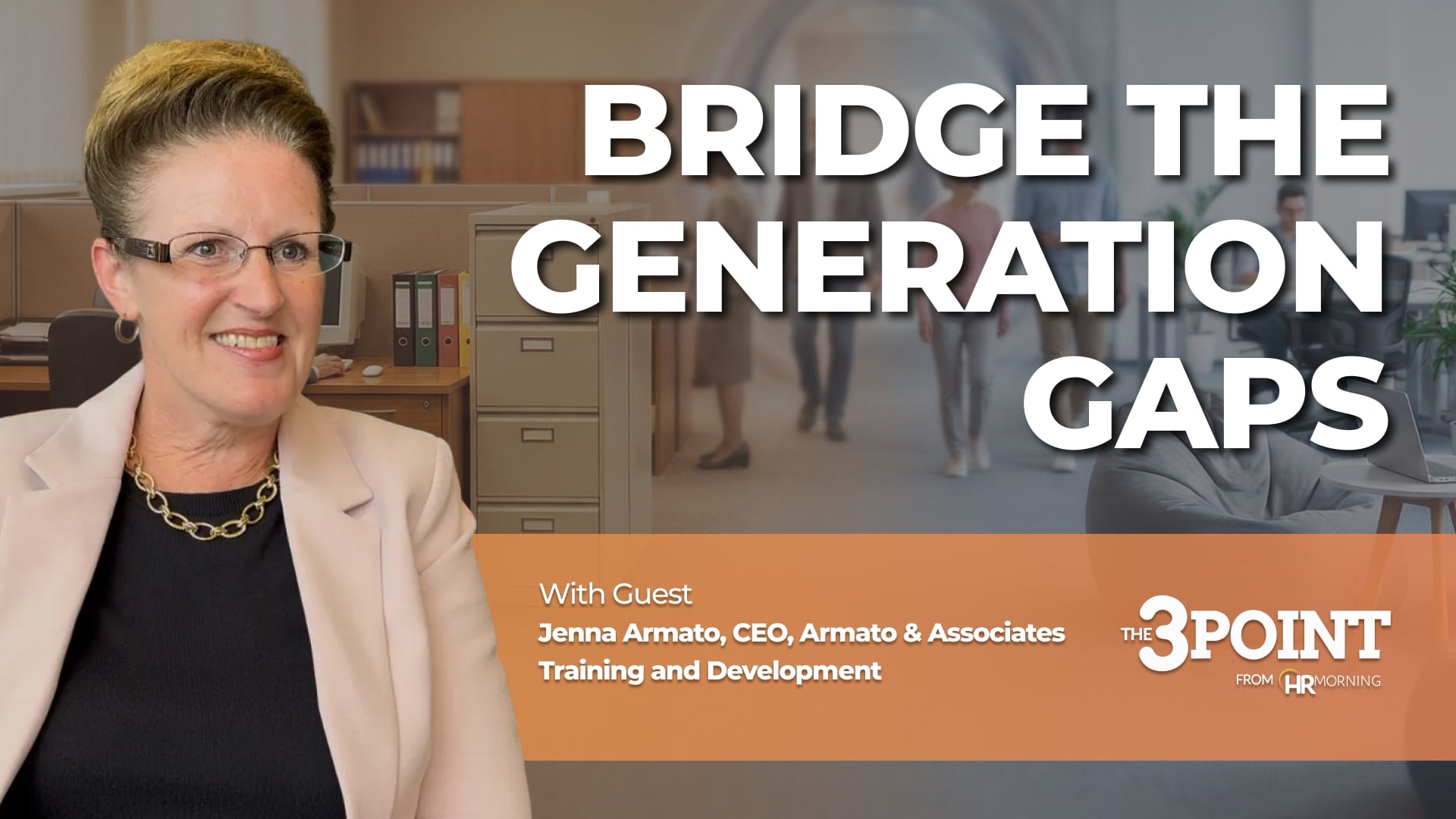
That’s why in this episode of HRMorning’s 3-Point, we talk with Jenna Armato, CEO, Armato & Associates Training and Development, about generational gaps. She helps us see why different generations sometimes don’t get along — or at least struggle to see eye to eye. And she identifies some ways HR pros and front-line leaders can help their employees bridge the generation gaps and even enjoy working together more.
White Papers
Building an Adoption-Friendly Workplace: Benefits That Help Families Grow and Employees Stay
Click, watch and listen for more on how you can help the five different generations can work together better.
Transcript (edited for clarity):
Can’t we all just get along? That’s the question we’ll explore in this episode of HRMorning’s 3-Point. We’ll look at why there’s often a generation gap in the workplace, and more importantly, how leaders can fix it. But let’s get some perspective on that first question right away.
Jenna Armato, CEO, Armato & Associates Training and Development: “That’s where the tension comes in, right – if you’re not understanding where I’m coming from. And I think at the end of the day, a lot of times, people are looking for being understood. They want you to hear them. You don’t have to agree with it. That’s OK. I just want you to understand where I’m coming from.”
Now, that makes sense, right. Employees from different generations literally don’t know where the other is coming from – say, 1980 or 2010. And while the years are just numbers, it’s all the things that happened in those years that influenced how they think, work and interact. So we can’t change who they are, but we can …
Armato: “If you really want to work together successfully, it’s important that you understand that someone has a completely different communication style than you do, right. It’s the same exact concept, but it’s about understanding what drives and shapes their thinking and coming from that place of empathy and understanding where they’ve been.“
But it’s not just about communication. There are many bridges to build.
Armato: “In understanding a little about what it might be like for someone else, what it might be like to be in someone else’s shoes. I think there’s great value in being in someone else’s shoes, but in also recognizing that we’re all different and we might need something a little different in order to succeed or thrive, and how to support other people in an organization.“
Advertisement

See the theme here? You aren’t trying to change any generation’s view. The goal is to help them understand one another’s perspectives so they can work together better. How? Armato gave these suggestions.
- Make connections. Set up fun events in or out of work for employees to mingle. Give the option to join in.
- Get their insight. Throw an organizational issue out to a cross-generation team and get them to work on a solution.
- Get out of their way. Remember, adults know how to be adults, too!
You can find many more articles on our website HRMorning.com on how to motivate, engage and work with the four generations in the workplace. Thanks again for watching this episode.
Further Reading
Kind v. Nice: It Makes a Big Difference for Employee Feedback | 2-Minute Video
When it comes to giving employee feedback, there’s a difference between being kind and being nice. It’s an important distinction HR pros and front-line managers want to make. What’s Up in This Episode: Kind v. Nice In this episode of HRMorning’s 3-Point, Amy Baker, Managing Partner at Happy Humans Consulting LLC, explains the difference between […]
A Better Way to Give Employees Feedback Now | 2-Minute Video
Giving and receiving feedback can be difficult. Giving and receiving bad feedback is even worse. We’re not talking about negative evaluations. We’re talking about doing a bad job with any kind of performance or behavior conversation. What’s Up in This Episode: Feedback Redo In this episode of HRMorning’s 3-Point, Kathie Leslie, Owner of Kathryn Leslie, […]
Employees Have FOBO: 5 Factors to Manage the AI Anxiety
Many employees are struggling with AI in ways you didn’t even imagine. They have FOBO – fear of becoming obsolete. And that fear has the potential to paralyze them — making the possibility of becoming obsolete a reality. “AI has accelerated that shift over the past year: tasks are being automated and employees are watching […]
4 Ways Workplace Community Drives Collaboration, Innovation and Growth
Across industries, workforce conversations often begin with the candidate experience. Long-term success depends just as much on what happens after someone joins an organization. To build resilient teams, leaders need to create workplaces where people feel connected, supported, authentic and able to envision a future. A strong sense of workplace community can help turn a […]
7 Keys to Give Feedback That’ll Help Employees Grow
Most bosses want to give feedback that helps employees do better. Unfortunately, many give feedback that makes employees feel worse about themselves and their work. It can be so bad that employees feel the impact of feedback delivered badly for years. That’s not the kind of impression leaders want to make. Feedback Gone Bad More […]
Build the Relationships That Matter Most at Work | 2-Minute Video
When it comes to recognition, the person who gives it is just as important as the message. Sure, it’s important for the boss to recognize employees. But peer-to-peer recognition packs the most punch: Employee relationships matter most. What’s Up in This Episode: Building Better Relationships That’s based on research and observation from Awardco. In this […]